
Grey-necked Rockfowl
Picathartes oreas
The grey-necked rockfowl (Picathartes oreas) is a medium-sized bird in the family Picathartidae with a long neck and tail.
- Kingdom
- Animalia
- Phylum
- Chordata
- Class
- Aves
- Order
- Passeriformes
- Family
- Picathartidae
- Genus
- Picathartes
- Species
- Picathartes oreas
Description
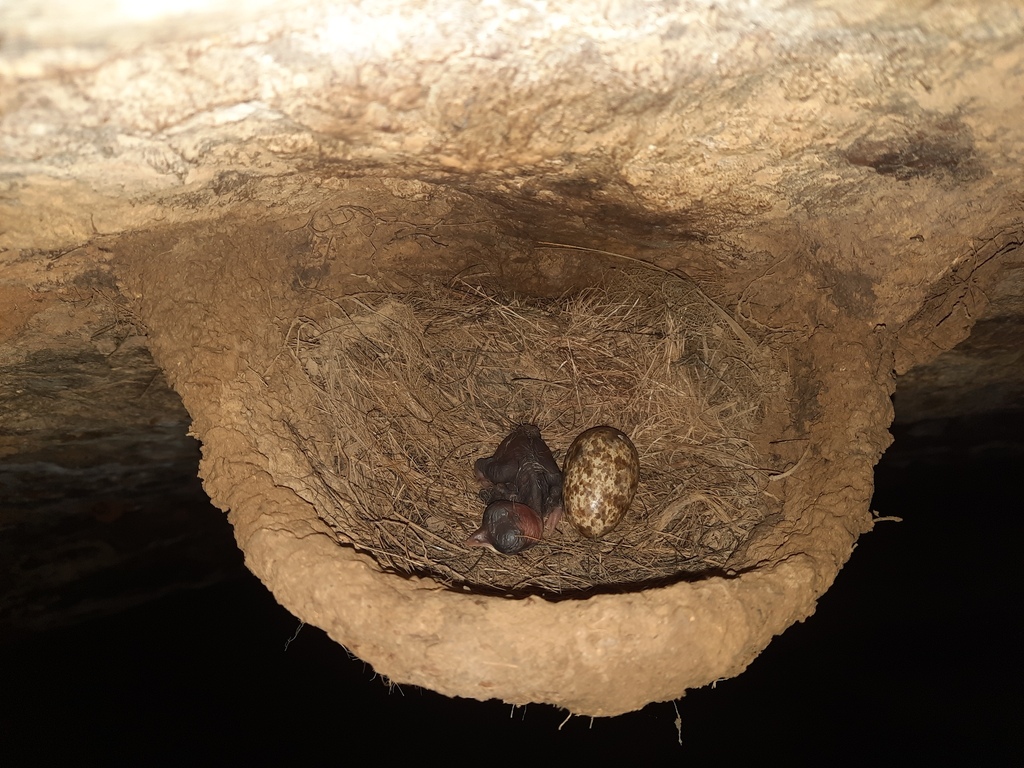
The grey-necked rockfowl (Picathartes oreas) is a medium-sized bird in the family Picathartidae with a long neck and tail. Also known as the grey-necked picathartes, this passerine is mainly found in rocky areas of close-canopied rainforest from south-west Nigeria through Cameroon, Equatorial Guinea, and south-west Gabon. It additionally lives on the island of Bioko. Its distribution is patchy, with populations often isolated from each other. The rockfowl typically chooses to live near streams and inselbergs in its forested habitat. It has no recognized subspecies, though some believe that it forms a superspecies with the white-necked rockfowl. The grey-necked rockfowl has grey upperparts, a light grey breast, and lemon-coloured underparts. Its unusually long tail is used for balance, and its thighs are muscular. The head is nearly featherless, with the exposed skin being powder blue on the forehead and upper mandible and carmine on the hindcrown. The bird's cheeks and eyes are covered in a large, circular black patch that, though narrow, connects and divides the carmine and powder blue skin at the peak of the crown. Though the bird is usually silent, some calls are known. This rockfowl feeds primarily on insects, though some plant matter, such as fruit and flower buds, is eaten. One feeding strategy involves following Dorylus army ant swarms, feeding on insects flushed by the ants. Rockfowl move through the forest mainly through a series of hops and bounds, or short flights in low vegetation. It travels either alone or in small groups. This species rarely flies for long distances. The grey-necked rockfowl is monogamous and pairs nest either alone or in the vicinity of other pairs, sometimes in colonies of two to five nests, though one colony of forty nests has been recorded. These nests are constructed out of mud and are formed into a deep cup that is built on rock surfaces, typically in caves or on cliffs. Two eggs are laid twice a year. Though the birds breed in colonies, infanticide exists in this species, with rockfowl attempting to kill the young of other pairs. Nestlings mature in about a month. This species is classified as vulnerable as its dwindling and fragmented populations are threatened by habitat destruction. A conservation plan has been drawn up for this species, and research into its current distribution is ongoing. Some of the indigenous peoples of Cameroon either respect this species or, in some cases, fear it. Today, this rockfowl is considered one of Africa's most desirable birds by birders and is a symbol of ecotourism across its range.
Gallery
Ajouter des photos
Partagez vos photos de cette espèce (jusqu'à 20 à la fois) : elles sont vérifiées automatiquement, puis publiées.
Répartition
Occurrences observées (données GBIF). Les zones hors aire d'origine peuvent indiquer une présence introduite ou invasive.
Sources et crédits
Informations provenant de plusieurs sources vérifiées. Dernière mise à jour : .
Crédits photos (8)
- Photo : @zbrd · CC BY-NC 4.0 · via iNaturalist
- Photo : César María Aguilar Gómez (@tiracantos) · CC BY-NC 4.0 · via iNaturalist
- Photo : @markusgmeiner · CC BY-NC 4.0 · via iNaturalist
- Photo : @koenbetjes · CC BY-NC 4.0 · via iNaturalist
- Photo : Martin Kennewell (@kenny_well) · CC BY-NC 4.0 · via iNaturalist
- Photo : Parc de la Lékédi (@parc-de-la-lekedi) · CC BY-NC 4.0 · via iNaturalist
- Photo : Niall Perrins (@niallp) · CC BY-NC 4.0 · via iNaturalist
- Photo : Jens Thalund (@langli) · CC BY-NC 4.0 · via iNaturalist
Mentions de licence
Texte disponible sous licence CC BY-SA 4.0. Il adapte notamment Wikipedia (CC BY-SA) : Grey-necked rockfowl (Wikipédia, auteurs dans l’historique de l’article).
- Taxonomie : GBIF Backbone Taxonomy (CC BY 4.0)
- Carte : occurrences GBIF, fond © contributeurs OpenStreetMap (ODbL)
- Statut de conservation : Liste rouge de l'UICN, via Wikidata (CC0)
Détail : Sources et licences.
Discussion (0)
Aucun message pour l’instant. Lancez la discussion sur cette fiche (sources, précisions, débats éditoriaux).
Connectez-vous pour participer à la discussion.