
Ashy woodpecker
Mulleripicus fulvus
The ashy woodpecker (Mulleripicus fulvus) is a species of bird in the woodpecker family Picidae.
- Kingdom
- Animalia
- Phylum
- Chordata
- Class
- Aves
- Order
- Piciformes
- Family
- Picidae
- Genus
- Mulleripicus
- Species
- Mulleripicus fulvus
Description
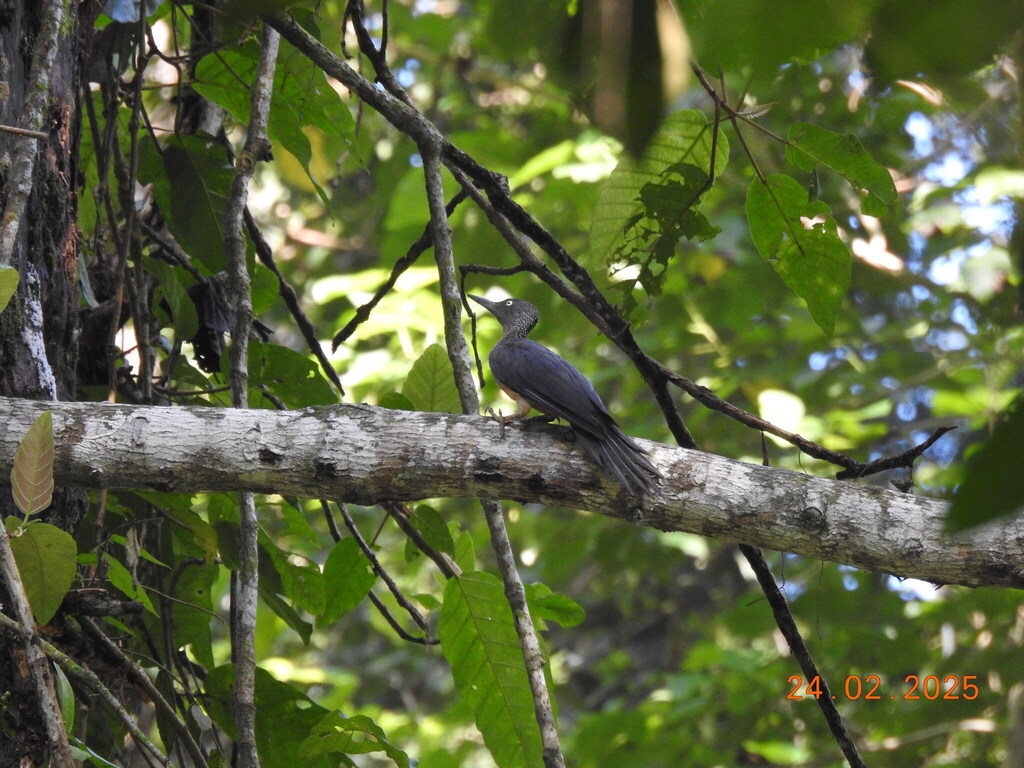
The ashy woodpecker (Mulleripicus fulvus) is a species of bird in the woodpecker family Picidae. It is endemic to Sulawesi and surrounding islands in Indonesia. There are two subspecies, the nominate race M. f. fulvus, which is found in northern Sulawesi, the islands of Lembeh and Manterawu, and the archipelagos of Togian and Banggai; and M. f. wallacei, from southern Sulawesi and the islands of Muna and Buton. The second subspecies is named after the collector and scientist Alfred Russel Wallace. Its natural habitats are tropical moist lowland forests and tropical moist montane forests. They prefer closed forest, but can be found in secondary forest and patches of forest in savannah. They are assumed to be non-migratory, and can be found from sea level to 2,000 m (6,600 ft).The species is not uncommon and is considered secure for now. The ashy woodpecker is a large woodpecker, 40 cm (16 in) in length, though not as large as the related great slaty woodpecker which replaces it from Borneo westwards. The male has a red face to the mid-crown, and the back of the head and neck are grey. The throat, front of the neck and belly are buff-coloured, and the rest of the back and wings are grey-brown to dark slate grey. The long bill is black, and the iris of the eye yellow; the eye is surrounded by a grey eye-ring. The female is like the male but the head is entirely grey, faintly spotted except for the forehead. M. f. wallacei resembles the nominate subspecies, but the red on the face encompasses most of the head. It also has a slightly longer tail and wings, but a slightly shorter bill. The calls include laughing calls of hew-hew-hew-hew-hew and tuk tuk tuk, but these are muffled, not loud. They also drum during the breeding season. Ashy woodpeckers predominantly feed on trees, but may also break into termite nests on the ground. In trees, they are often seen on trunks. They feed on termites, caterpillars and other insects and arthropods. Little is known about their nesting; one pair was observed digging a nest hole, with the male doing most of the work. Nesting holes are found in dead trees or in the dead sections of living trees. Two to three eggs are laid.
Gallery
Ajouter des photos
Partagez vos photos de cette espèce (jusqu'à 20 à la fois) : elles sont vérifiées automatiquement, puis publiées.
Répartition
Occurrences observées (données GBIF). Les zones hors aire d'origine peuvent indiquer une présence introduite ou invasive.
Sources et crédits
Informations provenant de plusieurs sources vérifiées. Dernière mise à jour : .
Crédits photos (8)
- Photo : @achmadjaelani · CC BY-NC 4.0 · via iNaturalist
- Photo : Jason Alexander (@jasonalexander) · CC BY 4.0 · via iNaturalist
- Photo : Marcel Bingley (@dibaeis) · CC BY-NC 4.0 · via iNaturalist
- Photo : Michael Barth (@burguenomuc) · CC BY-NC 4.0 · via iNaturalist
- Photo : ꦥꦤ꧀ꦗꦶꦒꦸꦱ꧀ꦠꦶꦄꦏ꧀ꦧꦂ (@panjigusti) · CC BY 4.0 · via iNaturalist
- Photo : Andy Pittway (@andypitt) · CC BY-NC 4.0 · via iNaturalist
- Photo : Mitch Rose (@mroseup) · CC BY-NC 4.0 · via iNaturalist
- Photo : @koenbetjes · CC BY-NC 4.0 · via iNaturalist
Mentions de licence
Texte disponible sous licence CC BY-SA 4.0. Il adapte notamment Wikipedia (CC BY-SA) : Ashy woodpecker, Pic fauve (Wikipédia, auteurs dans l’historique de l’article).
- Taxonomie : GBIF Backbone Taxonomy (CC BY 4.0)
- Carte : occurrences GBIF, fond © contributeurs OpenStreetMap (ODbL)
- Statut de conservation : Liste rouge de l'UICN, via Wikidata (CC0)
Détail : Sources et licences.
Discussion (0)
Aucun message pour l’instant. Lancez la discussion sur cette fiche (sources, précisions, débats éditoriaux).
Connectez-vous pour participer à la discussion.