
Great Cuckoo-dove
Reinwardtoena reinwardti
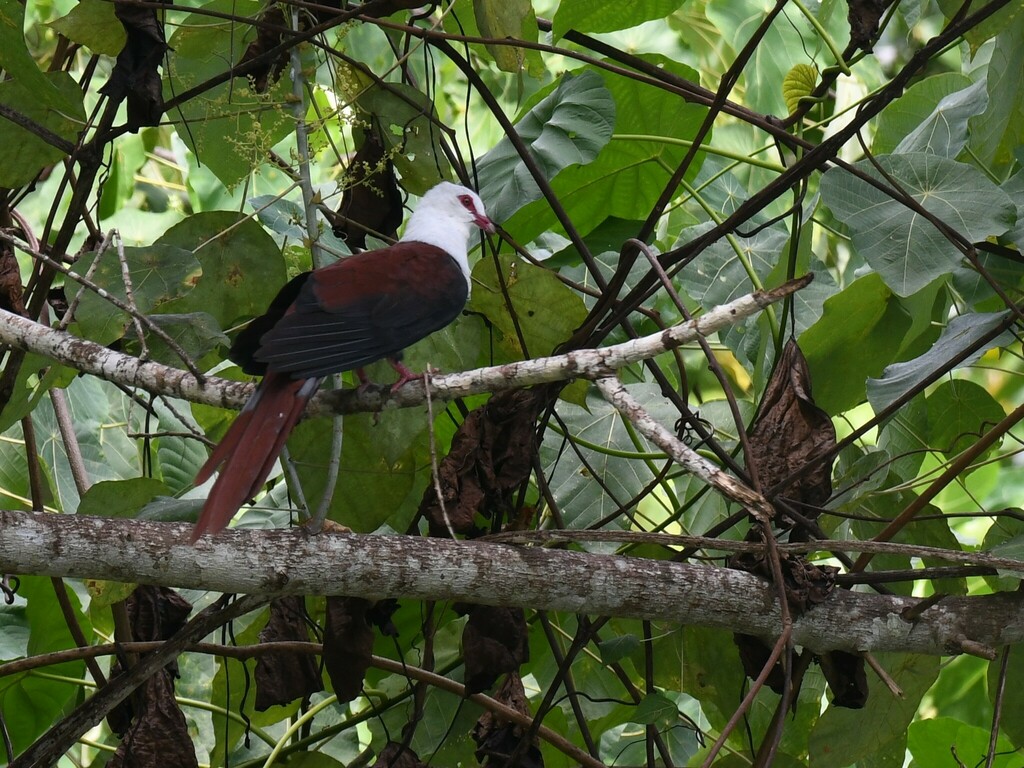
The great cuckoo-dove (Reinwardtoena reinwardti) is a species of bird in the pigeon family, Columbidae.
- Kingdom
- Animalia
- Phylum
- Chordata
- Class
- Aves
- Order
- Columbiformes
- Family
- Columbidae
- Genus
- Reinwardtoena
- Species
- Reinwardtoena reinwardti
Description
The great cuckoo-dove (Reinwardtoena reinwardti) is a species of bird in the pigeon family, Columbidae. First described by the Dutch zoologist Coenraad Jacob Temminck in 1824, it is found on New Guinea, several surrounding islands, and Wallacea, where it mainly inhabits primary forest and the forest edge. It is a large, distinctive pigeon, with a length of 47.5–52.5 cm (18.7–20.7 in) and a weight of 208–305 g (7.3–10.8 oz). In adults, the head, neck, and breast are whitish or blue-grey, the underparts are pale bluish-grey, the upperparts are chestnut-brown, and the outer wings are black. Females differ from males in having more yellowish irises and duller orbital skin. Juveniles are mainly dull grey-brown, with dirty-white throats and bellies. The species feeds on fruit and seeds. It is usually seen alone or in pairs, but forms flocks with other frugivorous birds at fruit trees. It is known to defend fruiting shrubs it is feeding on, an uncommon foraging behaviour among birds. Breeding occurs throughout the year and varies in different parts of its range, seemingly peaking from October to December on New Guinea. Nests are flat or slightly concave platforms made of sticks, moss, roots, and ferns, and contain a single white egg. The species is classified as being of least concern by the International Union for Conservation of Nature due to its sufficiently large range and stable population.
Gallery
Ajouter des photos
Partagez vos photos de cette espèce (jusqu'à 20 à la fois) : elles sont vérifiées automatiquement, puis publiées.
Répartition
Occurrences observées (données GBIF). Les zones hors aire d'origine peuvent indiquer une présence introduite ou invasive.
Sources et crédits
Informations provenant de plusieurs sources vérifiées. Dernière mise à jour : .
Crédits photos (8)
- Photo : Jean-Marie Frenoux (@janmar) · CC BY-NC 4.0 · via iNaturalist
- Photo : Ganjar Cahyo Aprianto (@ganjaraprianto) · CC BY-NC 4.0 · via iNaturalist
- Photo : Ahmad Yasin Chumaedi (@kareopadi) · CC BY-NC 4.0 · via iNaturalist
- Photo : Jason Alexander (@jasonalexander) · CC BY 4.0 · via iNaturalist
- Photo : @andrew2285 · CC0 (domaine public) · via iNaturalist
- Photo : @leekelai · CC BY-NC 4.0 · via iNaturalist
- Photo : Stephen John Davies (@stephen220) · CC BY-NC 4.0 · via iNaturalist
- Photo : Nigel Voaden (@terathopius) · CC BY 4.0 · via iNaturalist
Mentions de licence
Texte disponible sous licence CC BY-SA 4.0. Il adapte notamment Wikipedia (CC BY-SA) : Great cuckoo-dove (Wikipédia, auteurs dans l’historique de l’article).
- Taxonomie : GBIF Backbone Taxonomy (CC BY 4.0)
- Carte : occurrences GBIF, fond © contributeurs OpenStreetMap (ODbL)
- Statut de conservation : Liste rouge de l'UICN, via Wikidata (CC0)
Détail : Sources et licences.
Discussion (0)
Aucun message pour l’instant. Lancez la discussion sur cette fiche (sources, précisions, débats éditoriaux).
Connectez-vous pour participer à la discussion.