
Black-faced Spoonbill
Platalea minor
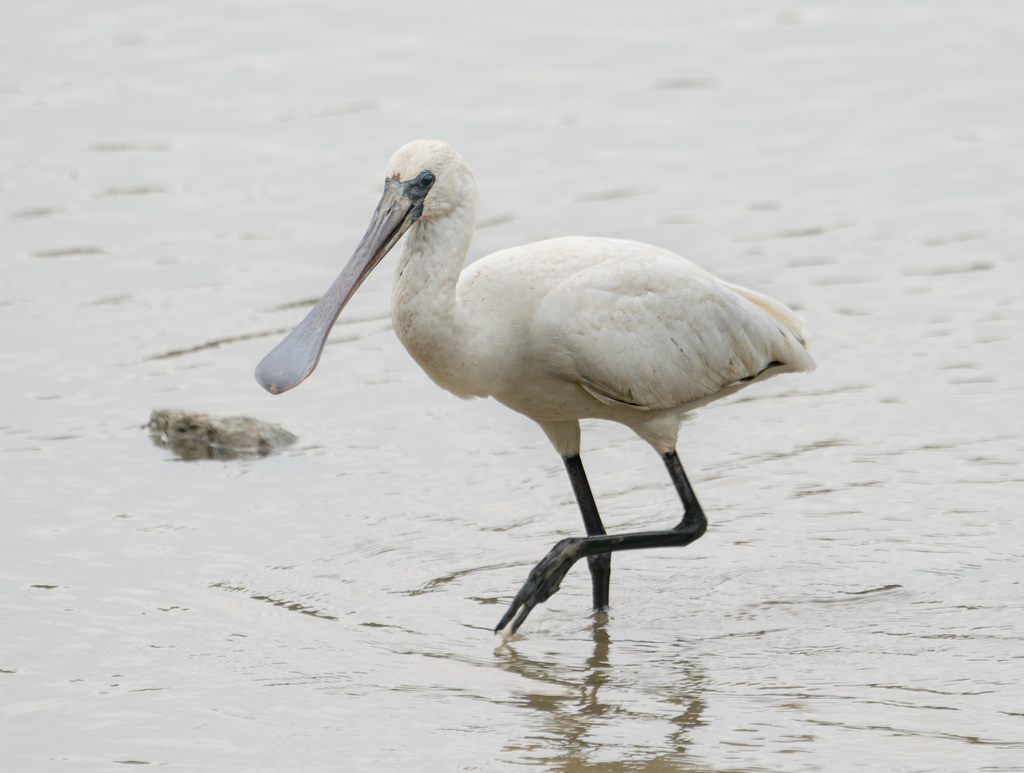
The black-faced spoonbill (Platalea minor) is a species of wading bird in the ibis and spoonbill family Threskiornithidae, found in eastern Asia.
- Kingdom
- Animalia
- Phylum
- Chordata
- Class
- Aves
- Order
- Pelecaniformes
- Family
- Threskiornithidae
- Genus
- Platalea
- Species
- Platalea minor
Description
The black-faced spoonbill (Platalea minor) is a species of wading bird in the ibis and spoonbill family Threskiornithidae, found in eastern Asia. This species has the most restricted distribution of the six spoonbill species, and is the only one regarded as endangered. Spoonbills are large water birds with dorso-ventrally flattened, spatulate bills; they use a tactile method of feeding, wading in the water and sweeping their beaks from side-to-side to detect prey. Confined to the coastal areas of eastern Asia, it seems that it was once common throughout its area of distribution. It currently breeds mostly on a few small rocky islands off the west coast of North Korea and South Korea, with four wintering sites at Macau, Hong Kong, Taiwan and Vietnam, as well as other places where they have been observed in migration. Wintering also occurs in Jeju, South Korea, Kyushu and Okinawa, Japan, and the Red River delta in Vietnam. More recently, sightings were noted in Thailand, the Philippines, and at additional sites in China. Black-faced spoonbill was internationally classified as an endangered species by the IUCN in 2000. Nearly driven to global extinction in the 1980s, conservation efforts amongst various Asian countries in recent years has helped in bringing its population back onto a steadily increasing trend. The population in the 2012 census was recorded at 2,693 birds, with an estimation of 1,600 mature birds. Breeding colonies occur between March and August, on small islands. In the 2022 global census, the population was recorded at 6,162 individuals. Black-faced spoonbill is a crepuscular feeder, dependent on intertidal mudflats. Conservation efforts on protecting breeding sites and wintering sites have been made since, and surveys were taken in order to determine the opinions and awareness of the local residents, residing close to their natural habitats. One survey taken by Jin et al. 2008, inquired upon the 'Willingness-To-Pay" factor in the locals, as well as understanding effects on mandatory surcharges compared to voluntary payments.
Gallery
Ajouter des photos
Partagez vos photos de cette espèce (jusqu'à 20 à la fois) : elles sont vérifiées automatiquement, puis publiées.
Répartition
Occurrences observées (données GBIF). Les zones hors aire d'origine peuvent indiquer une présence introduite ou invasive.
Sources et crédits
Informations provenant de plusieurs sources vérifiées. Dernière mise à jour : .
Crédits photos (8)
- Photo : Kelvin Joshua Che (@kelvinche) · CC BY-NC 4.0 · via iNaturalist
- Photo : Max Hsieh(雁子) (@maxhsieh) · CC BY-NC 4.0 · via iNaturalist
- Photo : 葉子 (@leaf0605) · CC0 (domaine public) · via iNaturalist
- Photo : Stephen Matthews (@stephenmatthews) · CC0 (domaine public) · via iNaturalist
- Photo : 洪廷維 (@modrawnu1984) · CC BY-NC 4.0 · via iNaturalist
- Photo : Hong (@doggy0406) · CC BY-NC 4.0 · via iNaturalist
- Photo : Meng-Chi Hung (@mengchi) · CC BY 4.0 · via iNaturalist
- Photo : 梁士明 (@ssnp099) · CC BY-NC 4.0 · via iNaturalist
Mentions de licence
Texte disponible sous licence CC BY-SA 4.0. Il adapte notamment Wikipedia (CC BY-SA) : Black-faced spoonbill (Wikipédia, auteurs dans l’historique de l’article).
- Taxonomie : GBIF Backbone Taxonomy (CC BY 4.0)
- Carte : occurrences GBIF, fond © contributeurs OpenStreetMap (ODbL)
- Statut de conservation : Liste rouge de l'UICN, via Wikidata (CC0)
Détail : Sources et licences.
Discussion (0)
Aucun message pour l’instant. Lancez la discussion sur cette fiche (sources, précisions, débats éditoriaux).
Connectez-vous pour participer à la discussion.