
Little Woodswallow
Artamus minor
The little woodswallow (Artamus minor), is a bird patchily distributed over much of mainland Australia, avoiding only the driest deserts and the area within about 300 kilometres of the southern coastline, and showing a preference for…
- Kingdom
- Animalia
- Phylum
- Chordata
- Class
- Aves
- Order
- Passeriformes
- Family
- Artamidae
- Genus
- Artamus
- Species
- Artamus minor
Description
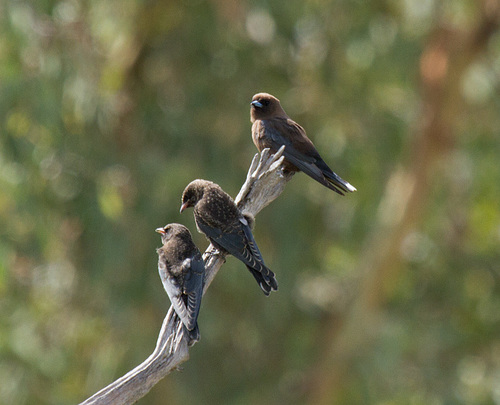
The little woodswallow (Artamus minor), is a bird patchily distributed over much of mainland Australia, avoiding only the driest deserts and the area within about 300 kilometres of the southern coastline, and showing a preference for rugged terrain around inland ranges. As its name suggests, at 12 to 14 cm in length it is the smallest of the woodswallows. It is dark, smoky brown overall, with deep gunmetal grey wings and a black-tipped, blue-tinged bill. Like other woodswallows, groups cluster huddled close together on high, dead branches to rest or sleep. Typical group sizes are modest but it is not uncommon to have hundreds gather together at a roost site. Little woodswallows soar effortlessly above the treetops or along cliff faces when hunting flying insects-being small, they are easily confused with martins. The nest is a rudimentary affair, placed in a tree hollow or similar space, and made of twigs and other vegetable matter. Breeding takes place from August to January, or after rain. Three eggs are laid and the young leave the nest when barely able to fly, taking up a perch on a nearby tree and calling incessantly for the food the parents bring them.
Gallery
Ajouter des photos
Partagez vos photos de cette espèce (jusqu'à 20 à la fois) : elles sont vérifiées automatiquement, puis publiées.
Répartition
Occurrences observées (données GBIF). Les zones hors aire d'origine peuvent indiquer une présence introduite ou invasive.
Sources et crédits
Informations provenant de plusieurs sources vérifiées. Dernière mise à jour : .
Crédits photos (6)
- Photo : (c) Gavin Goodyear, some rights reserved (CC BY-NC) · CC BY-NC 4.0 · via iNaturalist
- Photo : @mikew65 · CC BY-NC 4.0 · via iNaturalist
- Photo : @iclare · CC BY-NC 4.0 · via iNaturalist
- Photo : @rivendel · CC BY-NC 4.0 · via iNaturalist
- Photo : Keith Morris (@boobook99) · CC BY-NC 4.0 · via iNaturalist
- Photo : Keith Morris (@boobook99) · CC BY-NC 4.0 · via iNaturalist
Mentions de licence
Texte disponible sous licence CC BY-SA 4.0. Il adapte notamment Wikipedia (CC BY-SA) : Little woodswallow, Petit Langrayen (Wikipédia, auteurs dans l’historique de l’article).
- Taxonomie : GBIF Backbone Taxonomy (CC BY 4.0)
- Carte : occurrences GBIF, fond © contributeurs OpenStreetMap (ODbL)
- Statut de conservation : Liste rouge de l'UICN, via Wikidata (CC0)
Détail : Sources et licences.
Discussion (0)
Aucun message pour l’instant. Lancez la discussion sur cette fiche (sources, précisions, débats éditoriaux).
Connectez-vous pour participer à la discussion.