
Serendib Scops Owl
Otus thilohoffmanni
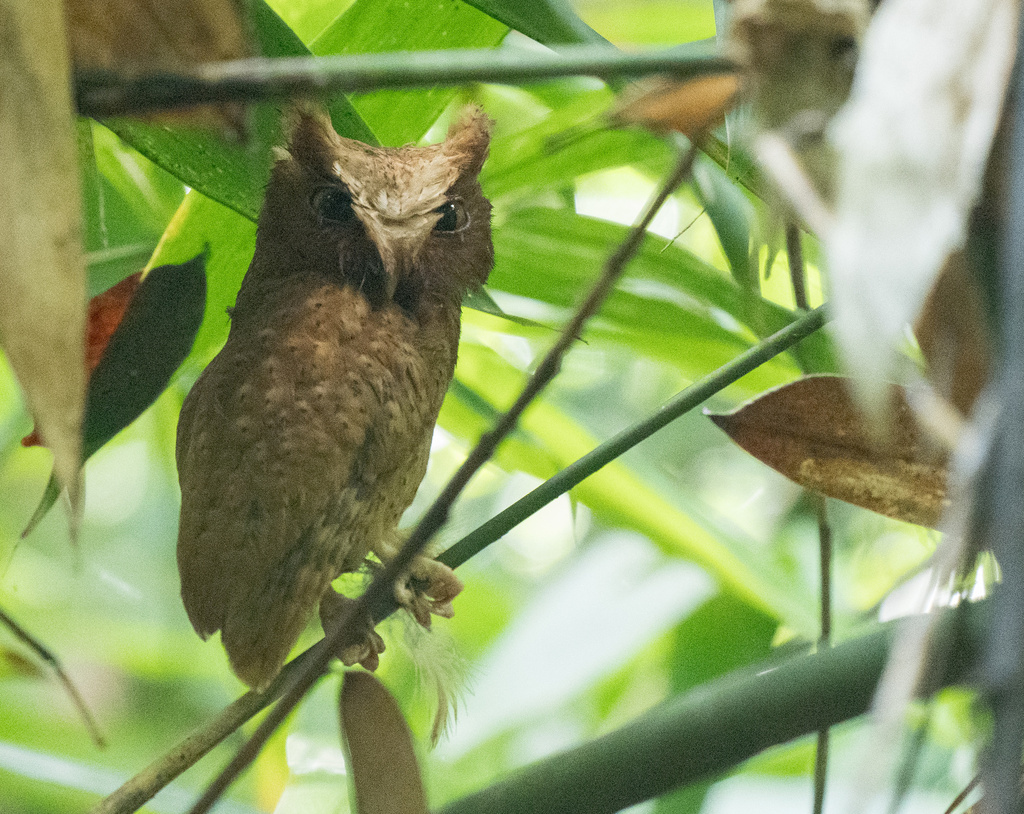
The Serendib scops owl (Otus thilohoffmanni) is the most recently discovered bird of Sri Lanka.
- Kingdom
- Animalia
- Phylum
- Chordata
- Class
- Aves
- Order
- Strigiformes
- Family
- Strigidae
- Genus
- Otus
- Species
- Otus thilohoffmanni
Description
The Serendib scops owl (Otus thilohoffmanni) is the most recently discovered bird of Sri Lanka. It was originally located by its unfamiliar poo-ooo call in the Kitulgala rainforest by prominent Sri Lankan ornithologist Deepal Warakagoda. Six years later, it was finally seen by him on 23 January 2001 in Sinharaja, and formally described as a species new to science in 2004. Apart from Sinharaja and Kitulgala, it has also been found at Runakanda Reserve in Morapitiya and Eratna Gilimale. It is known as පඬුවන් බස්සා in Sinhala. It is the first new bird to be discovered in Sri Lanka since 1868, when the Sri Lanka whistling thrush-then Ceylon whistling thrush-(Myophonus blighi) was discovered. It is also the 24th (according to some authorities the 27th) endemic bird species for Sri Lanka. The habitat of the Serendib scops owl is in the southern rainforests of Sri Lanka. There is an altitudinal range from 30 to 50 metres. This owl has no competition from other nocturnal birds, as the territories are completely different. This species has a very small population: at the end of January 2006 only 80 of them were known to exist. The places that it is expected to be found are in five protected areas, like the Forest Reserve or the Proposed Reserve of Sri Lanka. They seem to be declining because of the loss of habitat and the degradation. The first two hours of darkness are when the owl hunts for its food. This rare species inhabits the rainforests in the southwestern part of Sri Lanka. Like most owls, it is strictly nocturnal and hunts insects (e.g. beetles and moths) close to the ground. It begins calling at dusk, then its frequency rises again some two hours before dawn. Unlike the other two species of scops owl in Sri Lanka, Indian scops owl (Otus bakkamoena) and oriental scops owl (Otus sunia), it does not have ear-tufts and its facial disc is only weakly defined. The general colour of this 16.5 cm (6.5 in) long, short-tailed owl is reddish-brown with paler underparts, spotted all over with fine black markings. The irides are tawny yellow (more orangish in male) and the feet are a pale fleshy colour. Tarsi are feathered for less than half their length. The claws and bill are a pale ivory colour.
Gallery
Ajouter des photos
Partagez vos photos de cette espèce (jusqu'à 20 à la fois) : elles sont vérifiées automatiquement, puis publiées.
Répartition
Occurrences observées (données GBIF). Les zones hors aire d'origine peuvent indiquer une présence introduite ou invasive.
Sources et crédits
Informations provenant de plusieurs sources vérifiées. Dernière mise à jour : .
Crédits photos (8)
- Photo : Marco Chan (@that_bee_guy) · CC BY 4.0 · via iNaturalist
- Photo : Tero Linjama (@terolinjama) · CC0 (domaine public) · via iNaturalist
- Photo : James McCulloch (@jamesmcculloch) · CC BY-NC 4.0 · via iNaturalist
- Photo : Andrew Kruger (@andrewkruger) · CC BY-NC 4.0 · via iNaturalist
- Photo : @lappuggla · CC BY-NC 4.0 · via iNaturalist
- Photo : Maryse (@rollier) · CC BY-NC 4.0 · via iNaturalist
- Photo : @jackgedge · CC BY-NC 4.0 · via iNaturalist
- Photo : Edward (@ededwarddd) · CC BY-NC 4.0 · via iNaturalist
Mentions de licence
Texte disponible sous licence CC BY-SA 4.0. Il adapte notamment Petit-duc de Sérendip, Wikipedia (CC BY-SA) : Serendib scops owl (Wikipédia, auteurs dans l’historique de l’article).
- Taxonomie : GBIF Backbone Taxonomy (CC BY 4.0)
- Carte : occurrences GBIF, fond © contributeurs OpenStreetMap (ODbL)
Détail : Sources et licences.
Discussion (0)
Aucun message pour l’instant. Lancez la discussion sur cette fiche (sources, précisions, débats éditoriaux).
Connectez-vous pour participer à la discussion.