
Black-headed Tailorbird
Orthotomus nigriceps
The black-headed tailorbird (Orthotomus nigriceps), also known as the white-browed tailorbird, is a species of songbird in the cisticola family, Cisticolidae.
- Kingdom
- Animalia
- Phylum
- Chordata
- Class
- Aves
- Order
- Passeriformes
- Family
- Cisticolidae
- Genus
- Orthotomus
- Species
- Orthotomus nigriceps
Description
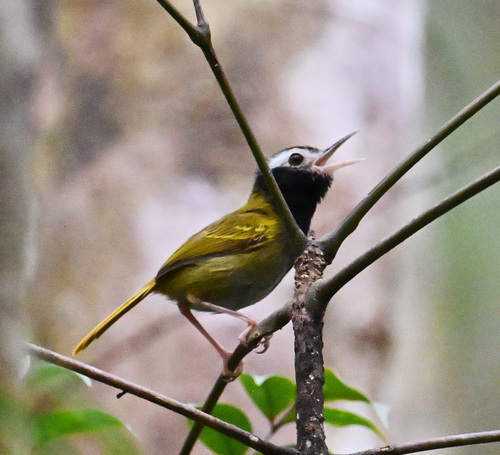
The black-headed tailorbird (Orthotomus nigriceps), also known as the white-browed tailorbird, is a species of songbird in the cisticola family, Cisticolidae. First formally described by the Scottish ornithologist Arthur Hay in 1877, it is endemic to the southeastern Philippines, where it is found on the islands of Mindanao, Dinagat, and Siargao. It inhabits dense undergrowth in lowland forests at elevations of up to 1,000 m (3,300 ft). Black-headed tailorbirds show three distinct phenotypes, which correspond to different stages of maturity: adults have a 'black' phenotype, immature birds have a 'mottled' phenotype, and juveniles have a 'grey' phenotype. These phenotypes were previously incorrectly thought to be related to differences between the sexes or to represent different species. The body mass ranges from 8–14 g (0.28–0.49 oz), with an average of 10.3 g (0.36 oz), and is roughly equal in both males and females. The average adult length is 12 cm (4.7 in). Adults have dull black heads, necks, throats, and chests with a prominent white supercilium, line beneath the eye, and chin patch. The lower breast and belly are dull grey, while the upperparts, flanks, and undertail coverts are olive-green, and the tail is darker olive-green. Immature birds have the chin, throat, and upper breast whitish with light grey and black mottling, as well as shorter tails. Juveniles have plain grey chins, throats, and upper breasts. The species is elusive and most commonly seen in pairs in the undergrowth. It feeds on small invertebrates. Little is known of the species' breeding, but males with enlarged testicles have been seen in March, April, and May. The black-headed tailorbird is listed as being of least concern on the IUCN Red List despite its restricted range due to its presumed stable population. It is usually thought to be uncommon or rare, but this perception may be affected by its retiring nature. No threats to the species are known.
Gallery
Ajouter des photos
Partagez vos photos de cette espèce (jusqu'à 20 à la fois) : elles sont vérifiées automatiquement, puis publiées.
Répartition
Occurrences observées (données GBIF). Les zones hors aire d'origine peuvent indiquer une présence introduite ou invasive.
Sources et crédits
Informations provenant de plusieurs sources vérifiées. Dernière mise à jour : .
Crédits photos (6)
- Photo : jet · CC BY-NC 4.0 · via Wikimedia Commons
- Photo : Amado Bajarias Jr. · CC BY 4.0
- Photo : Pierre de Chabannes (@pierredechabannes) · CC BY-NC 4.0 · via iNaturalist
- Photo : Benoît Segerer (@benoit_segerer) · CC BY-NC 4.0 · via iNaturalist
- Photo : jet (@jeremyang01) · CC BY-NC 4.0 · via iNaturalist
- Photo : jet (@jeremyang01) · CC BY-NC 4.0 · via iNaturalist
Mentions de licence
Texte disponible sous licence CC BY-SA 4.0. Il adapte notamment Wikipedia (CC BY-SA) : Black-headed tailorbird (Wikipédia, auteurs dans l’historique de l’article).
- Taxonomie : GBIF Backbone Taxonomy (CC BY 4.0)
- Carte : occurrences GBIF, fond © contributeurs OpenStreetMap (ODbL)
- Statut de conservation : Liste rouge de l'UICN, via Wikidata (CC0)
Détail : Sources et licences.
Discussion (0)
Aucun message pour l’instant. Lancez la discussion sur cette fiche (sources, précisions, débats éditoriaux).
Connectez-vous pour participer à la discussion.