
Plain Chachalaca
Ortalis vetula
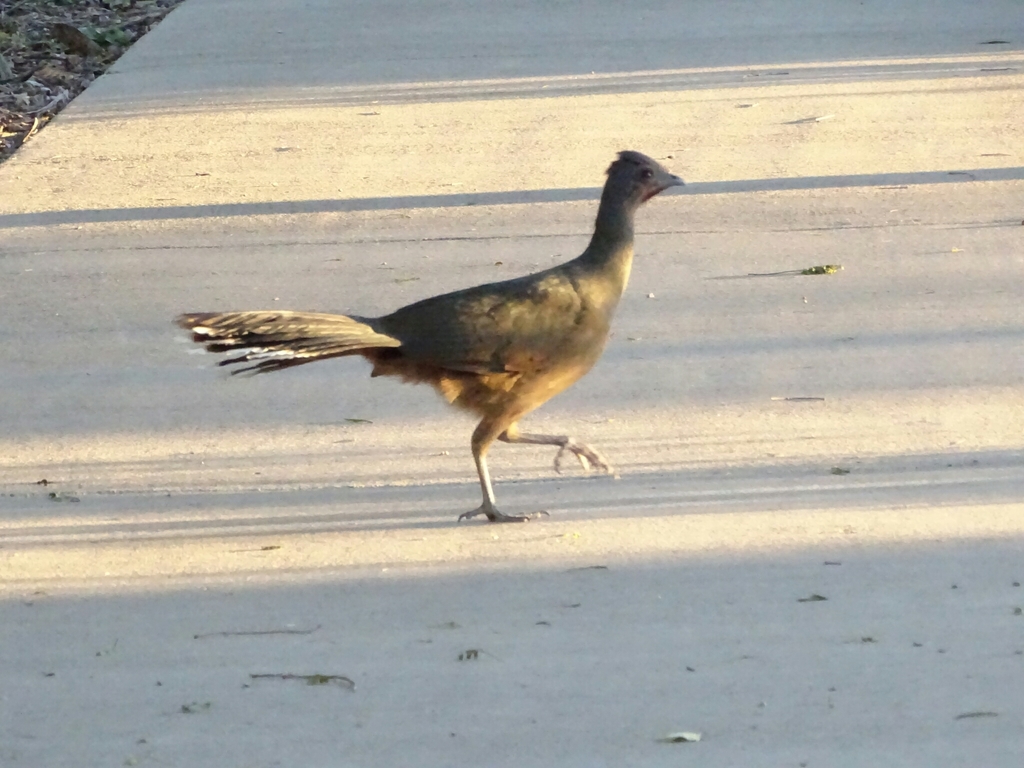
The plain chachalaca (Ortalis vetula) is a large bird in the chachalaca, guan and curassow family Cracidae.
- Kingdom
- Animalia
- Phylum
- Chordata
- Class
- Aves
- Order
- Galliformes
- Family
- Cracidae
- Genus
- Ortalis
- Species
- Ortalis vetula
Description
The plain chachalaca (Ortalis vetula) is a large bird in the chachalaca, guan and curassow family Cracidae. It breeds in tropical and subtropical environments from mezquital thickets in the Rio Grande Valley in southernmost Texas, United States to northernmost Costa Rica. In Central America, this species occurs in the Pacific lowlands from Chiapas, Mexico to northern Nicaragua and as a separate population in Costa Rica, where its range is separated by a short distance, as a disjunct population. This species frequents dry and moist forests, especially where interspersed with scrub and savanna. Usually found in groups of up to 15 birds, the plain chachalaca is furtive and wary and prefers to escape from danger by running swiftly on the ground or leaping and gliding through brushy tangles. The plain chachalaca feeds in trees or on the ground on fruit (figs, palms, Sapotaceae), seeds, leaves, and flowers. It is sometimes a pest of crops such as tomatoes and cucumbers. The call is a loud, raucous RAW-pa-haw or cha-cha-LAW-ka, often by several birds in a rhythmical chorus, especially in early morning and evening, usually from well up in trees. It also produces peeping whistles and cackles. Others describe chachalaca calls as irritating noises mimicking a bunch of men arguing. The plain chachalaca typically breeds in the early wet season. The nest is a shallow saucer of twigs and plant fibers, lined with leaves, in thick vegetation. The clutch is 2–4 rough-shelled white to cream eggs.
Gallery
Ajouter des photos
Partagez vos photos de cette espèce (jusqu'à 20 à la fois) : elles sont vérifiées automatiquement, puis publiées.
Répartition
Occurrences observées (données GBIF). Les zones hors aire d'origine peuvent indiquer une présence introduite ou invasive.
Sources et crédits
Informations provenant de plusieurs sources vérifiées. Dernière mise à jour : .
Crédits photos (8)
- Photo : Isaac Lord (@isaacthelord) · CC BY-NC 4.0 · via iNaturalist
- Photo : Sebastián de Jesús Herrera Buenfil (@sebastian_hb) · CC BY 4.0 · via iNaturalist
- Photo : David Marroquin Perez (@marroquidavi) · CC BY-NC 4.0 · via iNaturalist
- Photo : @ottodkc1 · CC BY-NC 4.0 · via iNaturalist
- Photo : Salvador Sánchez (@yolcaquixtiani) · CC BY-NC 4.0 · via iNaturalist
- Photo : Adriana Nelly Correa Sandoval (@adriananelly) · CC BY 4.0 · via iNaturalist
- Photo : Craig Hensley (@craighensley) · CC BY 4.0 · via iNaturalist
- Photo : Jennifer Linde (@jblinde) · CC BY-NC 4.0 · via iNaturalist
Mentions de licence
Texte disponible sous licence CC BY-SA 4.0. Il adapte notamment Wikipedia (CC BY-SA) : Plain chachalaca (Wikipédia, auteurs dans l’historique de l’article).
- Taxonomie : GBIF Backbone Taxonomy (CC BY 4.0)
- Carte : occurrences GBIF, fond © contributeurs OpenStreetMap (ODbL)
- Statut de conservation : Liste rouge de l'UICN, via Wikidata (CC0)
Détail : Sources et licences.
Discussion (0)
Aucun message pour l’instant. Lancez la discussion sur cette fiche (sources, précisions, débats éditoriaux).
Connectez-vous pour participer à la discussion.