
Trinidad Euphonia
Euphonia trinitatis
The Trinidad euphonia (Euphonia trinitatis) is a species of bird in the family Fringillidae.
- Kingdom
- Animalia
- Phylum
- Chordata
- Class
- Aves
- Order
- Passeriformes
- Family
- Fringillidae
- Genus
- Euphonia
- Species
- Euphonia trinitatis
Description
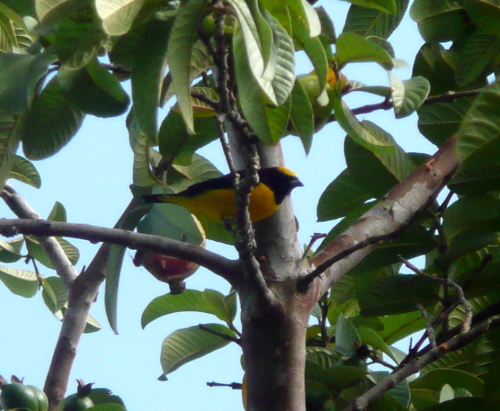
The Trinidad euphonia (Euphonia trinitatis) is a species of bird in the family Fringillidae. It is common in northern Colombia and northern Venezuela and uncommon to rare on the Caribbean island of Trinidad. Like all euphonias, it is small, stocky, and short-tailed; unlike some, it is sexually dimorphic. The male is glossy blue-black on the head, back, throat, and upper breast, with a bright yellow forehead and crown, and bright yellow underparts. The female is olive-green above and yellow-olive below, with a grayer patch running down the center of her breast and abdomen, and bright yellow undertail coverts. Its calls are high-pitched, plaintive whistles: the two most common are a single-pitched, double-noted "pee pee" or "tee dee", or a rising, double-noted "puwee", "cooleee" or "duu dee". Its song is a short, jumbled mix of musical and nonmusical notes. It is primarily a fruit-eater, specializing on mistletoe berries, but also eating other fruits, as well as occasional seeds and invertebrates. Pairs are monogamous, and stay together year round. Both parents build a globular nest of dried grass and stems, lined with finer material and with a side entrance. The female lays three to four cream-colored, brown-splotched eggs, which she alone incubates. Both parents feed the hatched chicks. English ornithologist Hugh Edwin Strickland first described the Trinidad euphonia in 1851. It has no subspecies. Across its range, it is considered a species of least concern, though it is rare on Trinidad due to overtrapping for the caged bird trade.
Gallery
Ajouter des photos
Partagez vos photos de cette espèce (jusqu'à 20 à la fois) : elles sont vérifiées automatiquement, puis publiées.
Répartition
Occurrences observées (données GBIF). Les zones hors aire d'origine peuvent indiquer une présence introduite ou invasive.
Sources et crédits
Informations provenant de plusieurs sources vérifiées. Dernière mise à jour : .
Crédits photos (6)
- Photo : Cristóbal Alvarado Minic from Cagua, Venezuela · CC BY 2.0
- Photo : Paula Peña-Amaya (@paulapenamaya) · CC BY-NC 4.0 · via iNaturalist
- Photo : Oswaldo Hernández (@ozzhernandez) · CC BY-NC 4.0 · via iNaturalist
- Photo : @vince929 · CC BY-NC 4.0 · via iNaturalist
- Photo : Liam Pentangelo (@liam_pentangelo) · CC BY-NC 4.0 · via iNaturalist
- Photo : Jim Moore (Maryland) (@jimmoore) · CC BY 4.0 · via iNaturalist
Mentions de licence
Texte disponible sous licence CC BY-SA 4.0. Il adapte notamment Wikipedia (CC BY-SA) : Trinidad euphonia (Wikipédia, auteurs dans l’historique de l’article).
- Taxonomie : GBIF Backbone Taxonomy (CC BY 4.0)
- Carte : occurrences GBIF, fond © contributeurs OpenStreetMap (ODbL)
- Statut de conservation : Liste rouge de l'UICN, via Wikidata (CC0)
Détail : Sources et licences.
Discussion (0)
Aucun message pour l’instant. Lancez la discussion sur cette fiche (sources, précisions, débats éditoriaux).
Connectez-vous pour participer à la discussion.