
Ross's Goose
Anser rossii
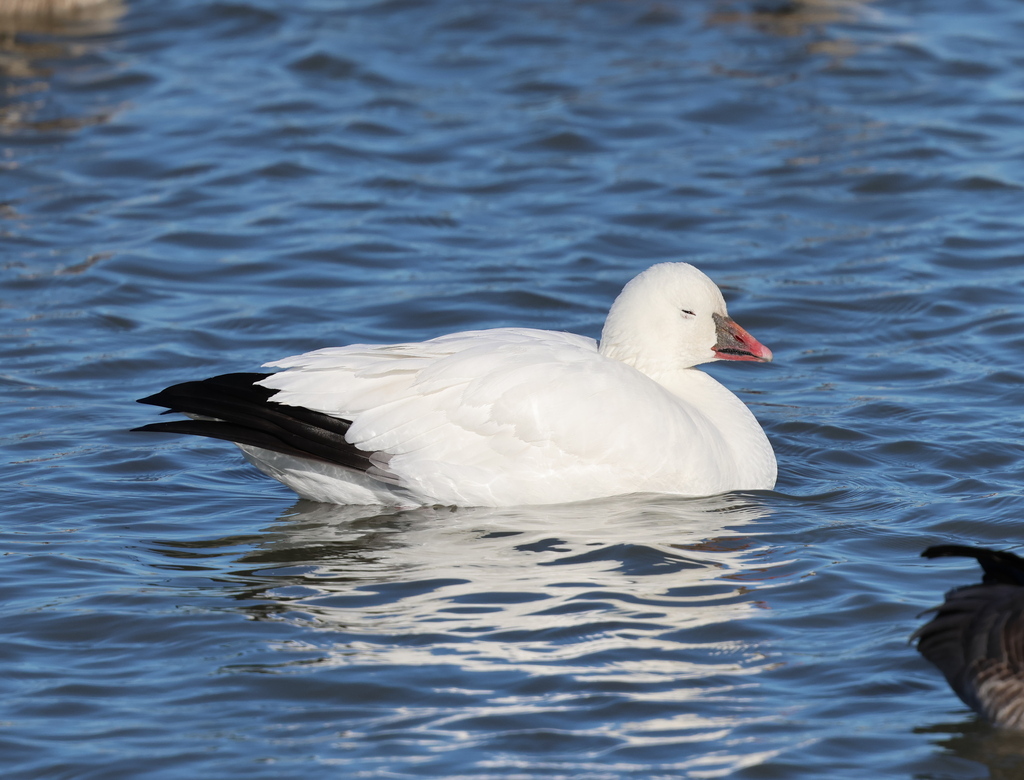
Ross's goose (Anser rossii) is a white goose with black wingtips and a relatively short neck.
- Kingdom
- Animalia
- Phylum
- Chordata
- Class
- Aves
- Order
- Anseriformes
- Family
- Anatidae
- Genus
- Anser
- Species
- Anser rossii
Description
Ross's goose (Anser rossii) is a white goose with black wingtips and a relatively short neck. It is the smallest of the three white geese that breed in North America. It is similar in appearance to a white-phase snow goose, but about 40% smaller. Other differences from the snow goose are that the bill is smaller in proportion to its body and lacks "black lips". Like snow geese, Ross's geese may exhibit a darker "blue" phase or morph, though this is extremely rare (<0.01% of adult birds). Before the early 1900s, this goose was considered a rare species, possibly as a consequence of open hunting, but numbers have increased dramatically as a result of conservation measures. It is now listed as a species of Least Concern by the IUCN, and is protected by the Migratory Bird Treaty Act. Ross's goose is named in honor of Bernard R. Ross (1827–1874), who was associated with the Hudson's Bay Company in Canada's Northwest Territories. Members of the Hudson's Bay Company were the first Europeans to discover the arctic nesting grounds of Ross's geese in 1940. The first recognizable description of Ross's geese, under the name "horned wavey", was given by explorer Samuel Hearne 80 years before John Cassin named it after Ross.
Gallery
Ajouter des photos
Partagez vos photos de cette espèce (jusqu'à 20 à la fois) : elles sont vérifiées automatiquement, puis publiées.
Répartition
Occurrences observées (données GBIF). Les zones hors aire d'origine peuvent indiquer une présence introduite ou invasive.
Sources et crédits
Informations provenant de plusieurs sources vérifiées. Dernière mise à jour : .
Crédits photos (8)
- Photo : @jugbayjs · CC BY-NC 4.0 · via iNaturalist
- Photo : A (@the_little_elephant) · CC BY-NC 4.0 · via iNaturalist
- Photo : Randall M (@m-randall) · CC BY-NC 4.0 · via iNaturalist
- Photo : David Tan (@g33k5p34k) · CC BY-NC 4.0 · via iNaturalist
- Photo : Howard Friedman (@howardfriedman1) · CC BY-NC 4.0 · via iNaturalist
- Photo : Aubrey Dreaming (@actuallyaubrey) · CC BY-NC 4.0 · via iNaturalist
- Photo : Lori Arent (@loriarent) · CC BY-NC 4.0 · via iNaturalist
- Photo : @lonnyholmes · CC BY-NC 4.0 · via iNaturalist
Mentions de licence
Texte disponible sous licence CC BY-SA 4.0. Il adapte notamment Wikipedia (CC BY-SA) : Ross's goose (Wikipédia, auteurs dans l’historique de l’article).
- Taxonomie : GBIF Backbone Taxonomy (CC BY 4.0)
- Carte : occurrences GBIF, fond © contributeurs OpenStreetMap (ODbL)
- Statut de conservation : Liste rouge de l'UICN, via Wikidata (CC0)
Détail : Sources et licences.
Discussion (0)
Aucun message pour l’instant. Lancez la discussion sur cette fiche (sources, précisions, débats éditoriaux).
Connectez-vous pour participer à la discussion.