
Greylag Goose
Anser anser
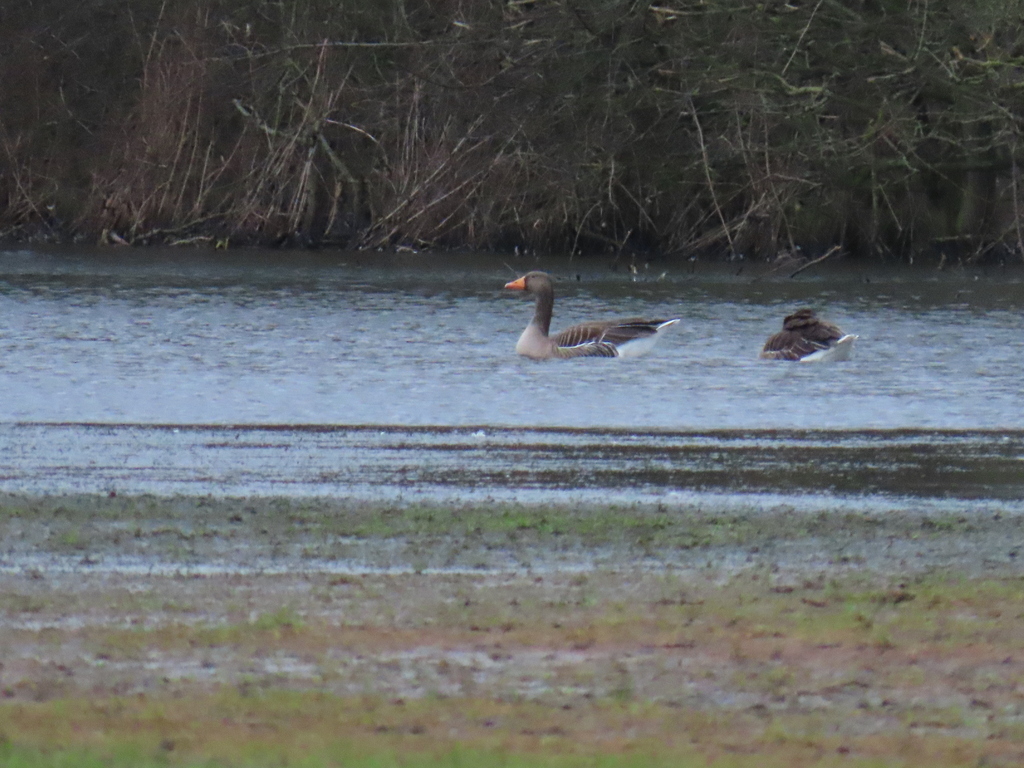
The greylag goose (Anser anser) is a species of large goose in the waterfowl family Anatidae and the type species of the genus Anser.
- Kingdom
- Animalia
- Phylum
- Chordata
- Class
- Aves
- Order
- Anseriformes
- Family
- Anatidae
- Genus
- Anser
- Species
- Anser anser
Description
The greylag goose (Anser anser) is a species of large goose in the waterfowl family Anatidae and the type species of the genus Anser. It has mottled and barred grey and white plumage and an orange beak and pink legs. A large bird, it measures between 74 and 91 centimetres (29 and 36 in) in length, with an average weight of 3.3 kilograms (7 lb 4 oz). Its distribution is widespread, with birds from the north of its range in Europe and Asia often migrating southwards to spend the winter in warmer places, although many populations are resident, even in the north. It is the ancestor of most breeds of domestic goose, having been domesticated at least as early as 1360 BCE. The genus name and specific epithet are from anser, the Latin for "goose". In the USA, its name has been spelled "graylag". Greylag geese travel to their northerly breeding grounds in spring, nesting on moorlands, in marshes, around lakes and on coastal islands. They normally mate for life and nest on the ground among vegetation. A clutch of three to five eggs is laid; the female incubates the eggs and both parents defend and rear the young. The birds stay together as a family group, migrating southwards in autumn as part of a flock, and separating the following year. During the winter they occupy semi-aquatic habitats, estuaries, marshes and flooded fields, feeding on grass and often consuming agricultural crops. Some populations, such as those in southern England and in urban areas across the species' range, are primarily resident and occupy the same area year-round.
Gallery
Ajouter des photos
Partagez vos photos de cette espèce (jusqu'à 20 à la fois) : elles sont vérifiées automatiquement, puis publiées.
Répartition
Occurrences observées (données GBIF). Les zones hors aire d'origine peuvent indiquer une présence introduite ou invasive.
Sources et crédits
Informations provenant de plusieurs sources vérifiées. Dernière mise à jour : .
Crédits photos (5)
- Photo : Africa Gomez (@hootinghoopoe) · CC BY-NC 4.0 · via iNaturalist
- Photo : Stefan Palm (@yumxac) · CC BY-NC 4.0 · via iNaturalist
- Photo : Christina s.l. (@christinasensulatu) · CC BY 4.0 · via iNaturalist
- Photo : Elaine Richmond (@elaine82222) · CC BY-NC 4.0 · via iNaturalist
- Photo : A Emmerson (@a_emmerson) · CC BY-NC 4.0 · via iNaturalist
Mentions de licence
Texte disponible sous licence CC BY-SA 4.0. Il adapte notamment Wikipedia (CC BY-SA) : Greylag goose (Wikipédia, auteurs dans l’historique de l’article).
- Taxonomie : GBIF Backbone Taxonomy (CC BY 4.0)
- Carte : occurrences GBIF, fond © contributeurs OpenStreetMap (ODbL)
- Statut de conservation : Liste rouge de l'UICN, via Wikidata (CC0)
Détail : Sources et licences.
Discussion (0)
Aucun message pour l’instant. Lancez la discussion sur cette fiche (sources, précisions, débats éditoriaux).
Connectez-vous pour participer à la discussion.