
Morepork
Ninox novaeseelandiae
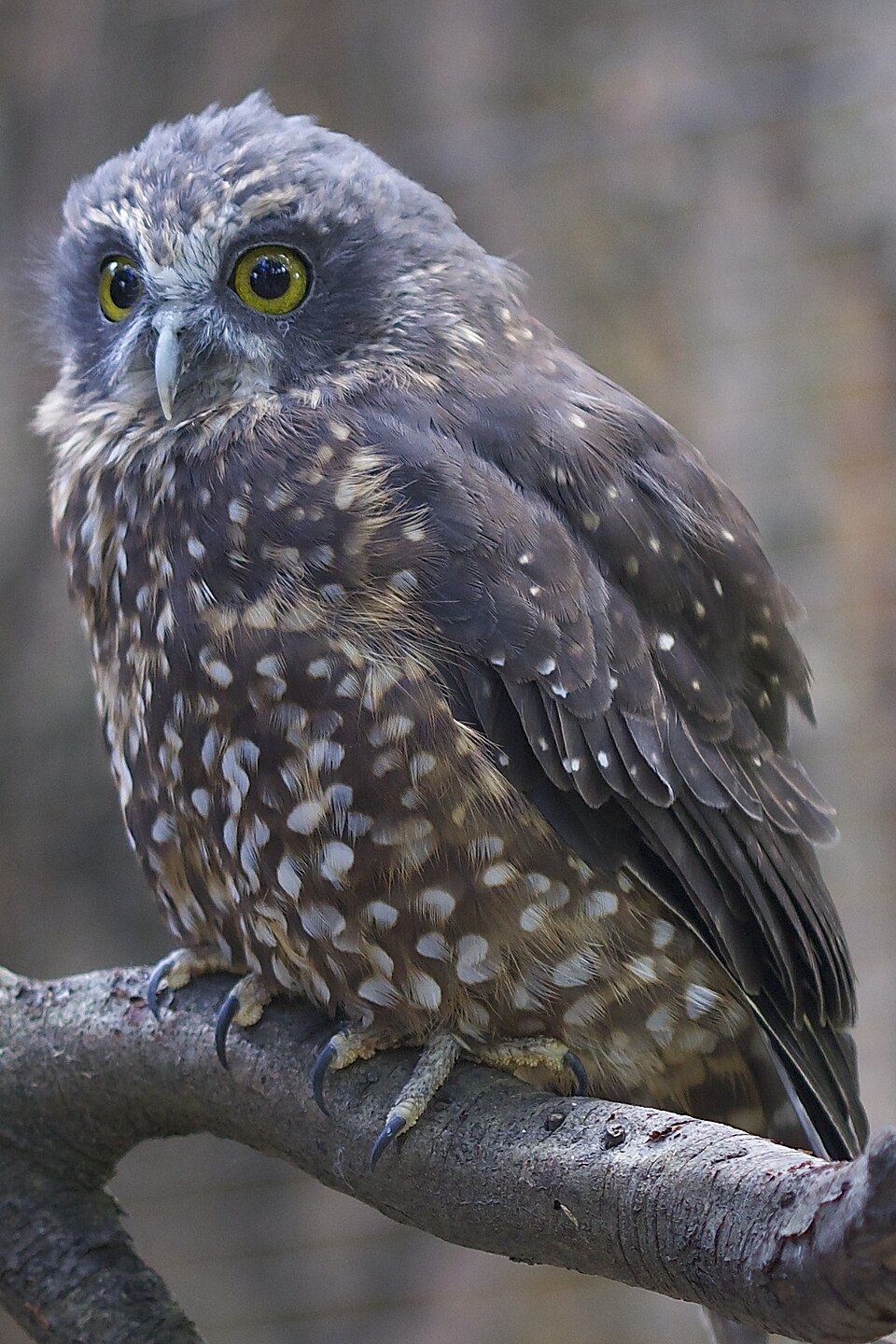
The morepork (Ninox novaeseelandiae), also known by its Māori name ruru, is a small brown owl found in New Zealand, the Australian islands of Norfolk Island, and formerly on Lord Howe Island.
- Kingdom
- Animalia
- Phylum
- Chordata
- Class
- Aves
- Order
- Strigiformes
- Family
- Strigidae
- Genus
- Ninox
- Species
- Ninox novaeseelandiae
Description
The morepork (Ninox novaeseelandiae), also known by its Māori name ruru, is a small brown owl found in New Zealand, the Australian islands of Norfolk Island, and formerly on Lord Howe Island. Its names (also including boobook and mopoke) are onomatopoeic, owing to the species’ distinctive calls. Three subspecies of the morepork are recognised, one of which is extinct and another that exists only as a hybrid population. First described by Johann Friedrich Gmelin in 1788, the morepork was thought to be the same species as the Australian boobook (N. boobook), native to Australia, Timor-Leste and New Guinea, something that endured for more than two hundred years, until 1999. Similarly, it was also considered the same as the Tasmanian boobook (N. leucopsis) until 2022 . The morepork has dark-brown plumage with prominent pale spots and golden-yellow eyes. Like most owls, the species is generally nocturnal, though may be crepuscular at times (or active at dawn and dusk), retiring to roost in secluded spots within the branches of trees. The morepork feeds on larger insects and small vertebrates, hunting by pouncing on them from tree perches. As with all owls, the morepork has supreme night vision and excellent hearing, able to locate a tiny lizard or rodent from many metres above and away. They then stealthily approach their targeted prey with near-silent flight, without flapping their wings, the prey often not even aware they are being pursued. The International Union for Conservation of Nature (IUCN) has assessed the morepork's population and its potential for decline, and ranked the species as being of least concern (not currently at-risk), owing to its presently large range and apparently stable population.
Gallery
Ajouter des photos
Partagez vos photos de cette espèce (jusqu'à 20 à la fois) : elles sont vérifiées automatiquement, puis publiées.
Répartition
Occurrences observées (données GBIF). Les zones hors aire d'origine peuvent indiquer une présence introduite ou invasive.
Sources et crédits
Informations provenant de plusieurs sources vérifiées. Dernière mise à jour : .
Crédits photos (6)
- Photo : Hase · CC BY-SA 3.0
- Photo : @lwnrngr · CC BY-NC 4.0 · via iNaturalist
- Photo : Jonathan Anderson (@jonathan-ngaio) · CC BY-NC 4.0 · via iNaturalist
- Photo : Chris Paulin (@erinaceus) · CC BY-NC 4.0 · via iNaturalist
- Photo : Edi Ramirez (@ediardo) · CC BY-NC 4.0 · via iNaturalist
- Photo : @herman_watercain · CC BY-NC 4.0 · via iNaturalist
Mentions de licence
Texte disponible sous licence CC BY-SA 4.0. Il adapte notamment Wikipedia (CC BY-SA) : Morepork (Wikipédia, auteurs dans l’historique de l’article).
- Taxonomie : GBIF Backbone Taxonomy (CC BY 4.0)
- Carte : occurrences GBIF, fond © contributeurs OpenStreetMap (ODbL)
- Statut de conservation : Liste rouge de l'UICN, via Wikidata (CC0)
Détail : Sources et licences.
Discussion (0)
Aucun message pour l’instant. Lancez la discussion sur cette fiche (sources, précisions, débats éditoriaux).
Connectez-vous pour participer à la discussion.