
Micronesian Myzomela
Myzomela rubratra
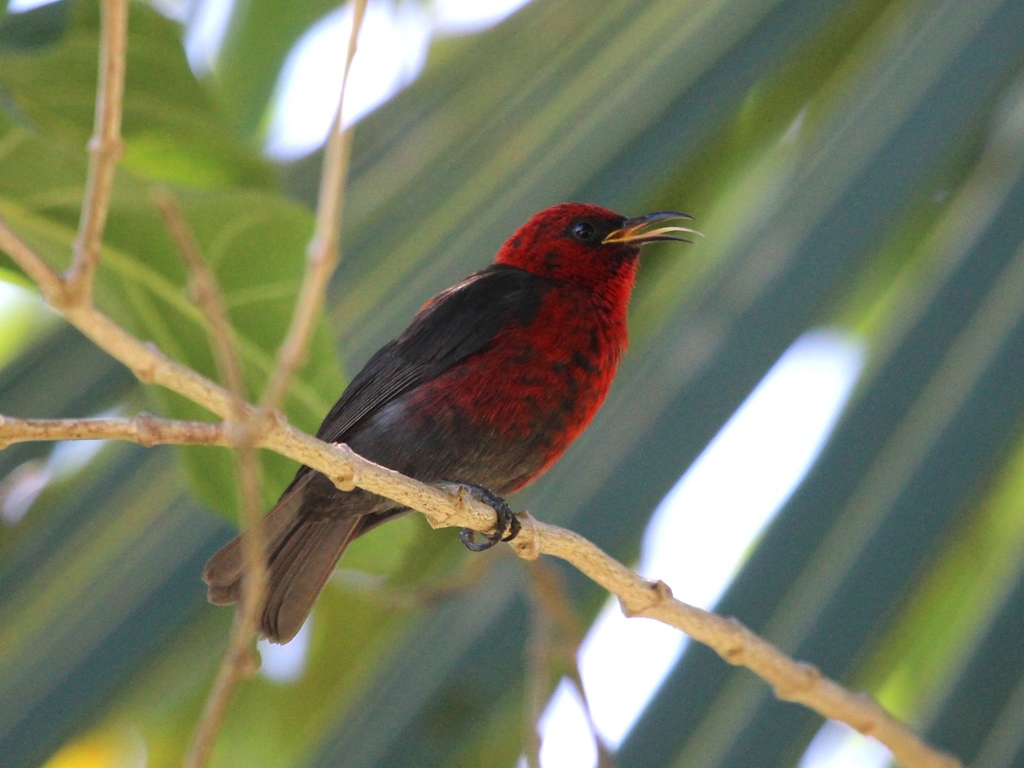
The Micronesian myzomela (Myzomela rubratra), also known as the Micronesian honeyeater, is a small honeyeater.
- Kingdom
- Animalia
- Phylum
- Chordata
- Class
- Aves
- Order
- Passeriformes
- Family
- Meliphagidae
- Genus
- Myzomela
- Species
- Myzomela rubratra
Description
The Micronesian myzomela (Myzomela rubratra), also known as the Micronesian honeyeater, is a small honeyeater. It is found on the Caroline and Mariana islands, except on Guam, where it has been extinct since 1986. It occurs in and around the edges of forests, as well as coconut plantations, coastal strand, savanna brush, villages, towns, and gardens. Both genders have a predominantly black or brown body with scarlet-red patches-the location and coloration, however, varies widely by subspecies. When mature, the female, unlike the male, usually has olive fringing on her tail and wing feathers; additionally, the male does not have any brown on his body. Juveniles are much browner compared to adults and have little or no red coloring. The Micronesian myzomela has a unique song in the dawn-a continuous stream of trilled whistles and phrases, lasting for about 25 minutes on Kosrae, Yap, or Pohnpei, or a wheezy whistle on the Mariana Islands. Later in the day, the Kosrae bird produces a short, variable song and a wide array of "rather uninteresting" scolding or buzzy calls. On the Mariana Islands, the daytime song is a simple and tuneful "per-mit-you". The Palau bird's call is unique, resembling that of the great crested flycatcher or Micronesian starling. The Micronesian myzomela breeds year-round. Courtship behaviors are varied-grounded displays where pairs walk together along branches on Aguiguan; erratic aerial chases where the male chases the female, often touching wingtips on Guam. The nest is built low to the ground, in shrubs or small trees with thick foliage, often along woodland edges, open areas, or near residential buildings. It is cup-shaped, and may be composed of grasses and other plant fibers, often with a distinct inner lining. The nest measures between 50 to 85 mm in width and 20 to 70 mm in depth. It usually lays 1 to 2 eggs per clutch, which are glossy white to off-white with brown speckles, with dimensions of about 18.5 by 13.6 mm. Incubation is probably done solely by the female and takes 15 to 16 days; hatchlings are altricial, fledging after two weeks.
Gallery
Ajouter des photos
Partagez vos photos de cette espèce (jusqu'à 20 à la fois) : elles sont vérifiées automatiquement, puis publiées.
Répartition
Occurrences observées (données GBIF). Les zones hors aire d'origine peuvent indiquer une présence introduite ou invasive.
Sources et crédits
Informations provenant de plusieurs sources vérifiées. Dernière mise à jour : .
Crédits photos (8)
- Photo : Floyd E. Hayes (@floydehayes) · CC BY-NC 4.0 · via iNaturalist
- Photo : @mnaturalistss · CC BY-NC 4.0 · via iNaturalist
- Photo : Floyd E. Hayes (@floydehayes) · CC BY-NC 4.0 · via iNaturalist
- Photo : @alazon · CC BY-NC 4.0 · via iNaturalist
- Photo : @mangoat1 · CC BY-NC 4.0 · via iNaturalist
- Photo : @leekelai · CC BY-NC 4.0 · via iNaturalist
- Photo : @keishajohnson048 · CC BY-NC 4.0 · via iNaturalist
- Photo : Andria Kroner (@andria4) · CC BY-NC 4.0 · via iNaturalist
Mentions de licence
Texte disponible sous licence CC BY-SA 4.0. Il adapte notamment Wikipedia (CC BY-SA) : Micronesian myzomela (Wikipédia, auteurs dans l’historique de l’article).
- Taxonomie : GBIF Backbone Taxonomy (CC BY 4.0)
- Carte : occurrences GBIF, fond © contributeurs OpenStreetMap (ODbL)
- Statut de conservation : Liste rouge de l'UICN, via Wikidata (CC0)
Détail : Sources et licences.
Discussion (0)
Aucun message pour l’instant. Lancez la discussion sur cette fiche (sources, précisions, débats éditoriaux).
Connectez-vous pour participer à la discussion.