
Trinidad Motmot
Momotus bahamensis
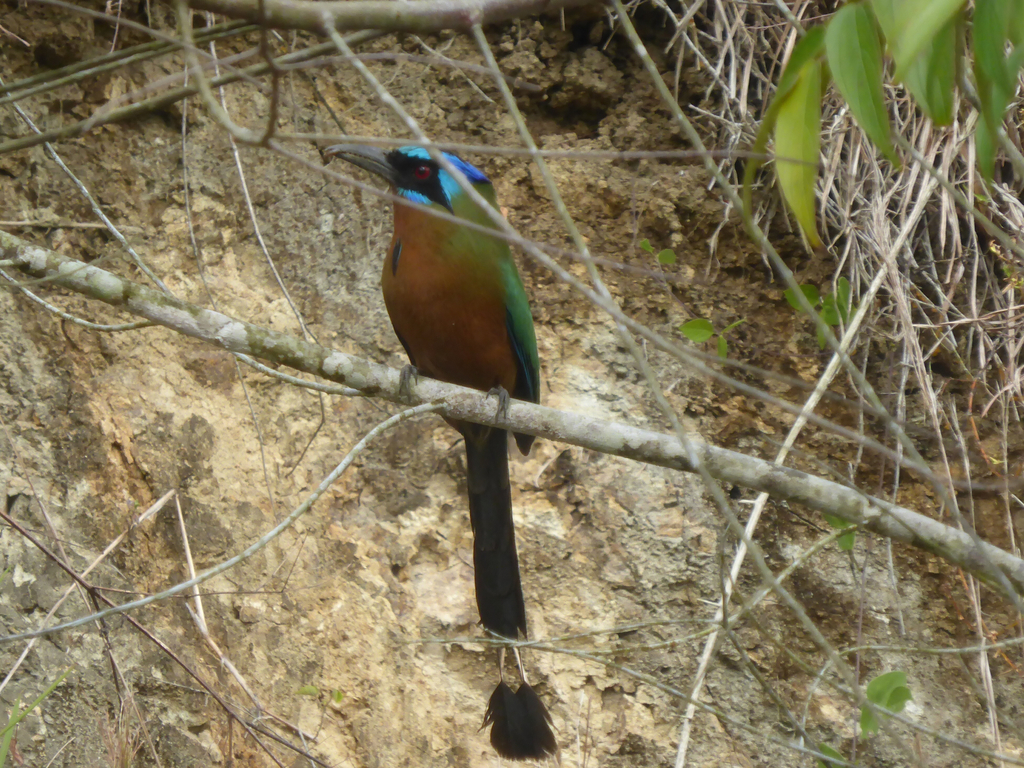
The Trinidad and Tobago motmot (Momotus bahamensis) is a colourful Coraciiform afroavian endemic to the forests and woodlands of Trinidad and Tobago.
- Kingdom
- Animalia
- Phylum
- Chordata
- Class
- Aves
- Order
- Coraciiformes
- Family
- Momotidae
- Genus
- Momotus
- Species
- Momotus bahamensis
Description
The Trinidad and Tobago motmot (Momotus bahamensis) is a colourful Coraciiform afroavian endemic to the forests and woodlands of Trinidad and Tobago. It is a nonmigratory member of the Momotidae family and the Momotus genus. This species and the blue-capped motmot, Lesson's motmot, whooping motmot, Amazonian motmot, and Andean motmot were all considered conspecific. Though found on both islands, this bird is more abundant in Tobago than it is in Trinidad. These birds are characterised by their colourful plumage, heavy bills, and low owl-like "hoot" call. Their underparts are a deep, rufous colour, with a slightly paler breast and an olive-green wash. The black eye-mask and blue-black racquet tails are also distinguishable features for this species. These birds often sit still, and in their dense forest habitat can be difficult to see, despite their size. They eat small prey such as amphibians, small mammals, insects, spiders, earthworms, lizards, small snakes and fledgling birds, and will also regularly take fruit. They are known to eat small tree snails, and to use forest floor rocks as 'anvils' to crack open their hard shells, as well as the exoskeletons of crabs, beetles, and large millipedes, to access the soft edible bodies within. Although little information is known about this species, the population is thought to be stable, and is considered least concern by the International Union for Conservation of Nature (IUCN). Despite its small range and unquantified population size, the Trinidad motmot is not believed to approach the thresholds for a vulnerable species under the range and population size criteria. There are no current conservation actions undertaken to protect this species. The bird is shown on the front of the $5 bank note of Trinidad and Tobago.
Gallery
Ajouter des photos
Partagez vos photos de cette espèce (jusqu'à 20 à la fois) : elles sont vérifiées automatiquement, puis publiées.
Répartition
Occurrences observées (données GBIF). Les zones hors aire d'origine peuvent indiquer une présence introduite ou invasive.
Sources et crédits
Informations provenant de plusieurs sources vérifiées. Dernière mise à jour : .
Crédits photos (8)
- Photo : @lenoreatwood · CC BY-NC 4.0 · via iNaturalist
- Photo : @magintob · CC BY-NC 4.0 · via iNaturalist
- Photo : ColinDJones (@colindjones) · CC BY-NC 4.0 · via iNaturalist
- Photo : Dan Riley (@driley) · CC BY 4.0 · via iNaturalist
- Photo : Martyn Obbard (@ursusont) · CC BY-NC 4.0 · via iNaturalist
- Photo : Mark Hulme (@markhulme) · CC BY-NC 4.0 · via iNaturalist
- Photo : Evan Williams (@evman5) · CC0 (domaine public) · via iNaturalist
- Photo : Cristina Hutchison (@cristina_h28) · CC0 (domaine public) · via iNaturalist
Mentions de licence
Texte disponible sous licence CC BY-SA 4.0. Il adapte notamment Wikipedia (CC BY-SA) : Trinidad motmot (Wikipédia, auteurs dans l’historique de l’article).
- Taxonomie : GBIF Backbone Taxonomy (CC BY 4.0)
- Carte : occurrences GBIF, fond © contributeurs OpenStreetMap (ODbL)
- Statut de conservation : Liste rouge de l'UICN, via Wikidata (CC0)
Détail : Sources et licences.
Discussion (0)
Aucun message pour l’instant. Lancez la discussion sur cette fiche (sources, précisions, débats éditoriaux).
Connectez-vous pour participer à la discussion.