
Turquoise-browed Motmot
Eumomota superciliosa
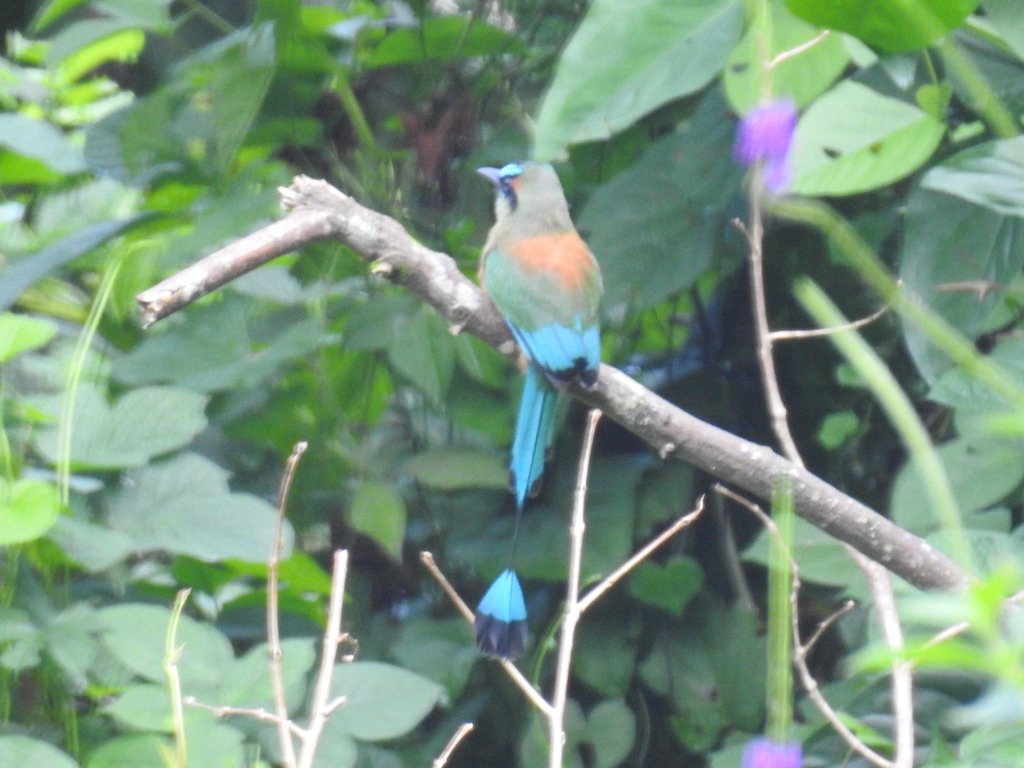
The turquoise-browed motmot (Eumomota superciliosa) is a colourful, medium-sized bird of the motmot family, Momotidae.
- Kingdom
- Animalia
- Phylum
- Chordata
- Class
- Aves
- Order
- Coraciiformes
- Family
- Momotidae
- Genus
- Eumomota
- Species
- Eumomota superciliosa
Description
The turquoise-browed motmot (Eumomota superciliosa) is a colourful, medium-sized bird of the motmot family, Momotidae. It is the only species in its genus Eumomota. It inhabits Central America from south-east Mexico (mostly the Yucatán Peninsula), to Costa Rica, where it is common and not considered threatened. It lives in fairly open habitats such as forest edge, gallery forest and scrubland. It has a preference for higher tree diversity and richness, alongside a low open canopy and dense understory. It also appears to prefer dry forest. This is in contrast to the other motmot known to inhabit the Yucatán, Lesson’s motmot, which prefers moist forest. As a result, their respective distributions allow ecologists to map the process of aridification induced by anthropogenic climate change. Some literature thus considers the turquoise-browed motmot to be a bioindicator. The bird is 34 cm (13 in) long and weighs 65 g (2.3 oz). It has a mostly grey-blue body with a rufous back and belly. There is a bright blue strip above the eye and a blue-bordered black patch on the throat. The flight feathers and upperside of the tail are blue. The tips of the tail feathers are shaped like rackets and the bare feather shafts, also classified as wires, are longer than in other motmots. Although it is often said that motmots pluck the barbs off their tail to create the racketed shape, this is not true; the barbs are weakly attached and fall off due to abrasion with substrates and with routine preening. To reproduce, they lay white eggs (3–6) in a long tunnel nest in an earth bank, or sometimes in a quarry or fresh-water well. However, if this is not available, they will transition to nesting in inaccessible limestone crevices in cenotes or caves. It excavates nesting sites in March to avoid the hotter temperatures. Females lay in 48 hour intervals with a lay time of 24-56 days and hatch time from 16-20 days depending on the bird's location. A shorter lay and hatch time is observed in more populated areas.
Gallery
Ajouter des photos
Partagez vos photos de cette espèce (jusqu'à 20 à la fois) : elles sont vérifiées automatiquement, puis publiées.
Répartition
Occurrences observées (données GBIF). Les zones hors aire d'origine peuvent indiquer une présence introduite ou invasive.
Sources et crédits
Informations provenant de plusieurs sources vérifiées. Dernière mise à jour : .
Crédits photos (8)
- Photo : Heidi Pasch de Viteri (@losttinamou) · CC BY-NC 4.0 · via iNaturalist
- Photo : Rene Villanueva (@villanuevagr) · CC BY-NC 4.0 · via iNaturalist
- Photo : Juan F Fernandez (@juanfernandez) · CC BY-NC 4.0 · via iNaturalist
- Photo : Francisco Dubón (@fcodubon) · CC BY-NC 4.0 · via iNaturalist
- Photo : Daniel Dorantes (@danieldorantes7) · CC BY-NC 4.0 · via iNaturalist
- Photo : Giovanni V (@gonline) · CC BY-NC 4.0 · via iNaturalist
- Photo : Berenice De León (@berenicedll) · CC BY-NC 4.0 · via iNaturalist
- Photo : Nestor Herrera (@nestorh) · CC BY-NC 4.0 · via iNaturalist
Mentions de licence
Texte disponible sous licence CC BY-SA 4.0. Il adapte notamment Wikipedia (CC BY-SA) : Turquoise-browed motmot (Wikipédia, auteurs dans l’historique de l’article).
- Taxonomie : GBIF Backbone Taxonomy (CC BY 4.0)
- Carte : occurrences GBIF, fond © contributeurs OpenStreetMap (ODbL)
- Statut de conservation : Liste rouge de l'UICN, via Wikidata (CC0)
Détail : Sources et licences.
Discussion (0)
Aucun message pour l’instant. Lancez la discussion sur cette fiche (sources, précisions, débats éditoriaux).
Connectez-vous pour participer à la discussion.