
Black Catbird
Melanoptila glabrirostris
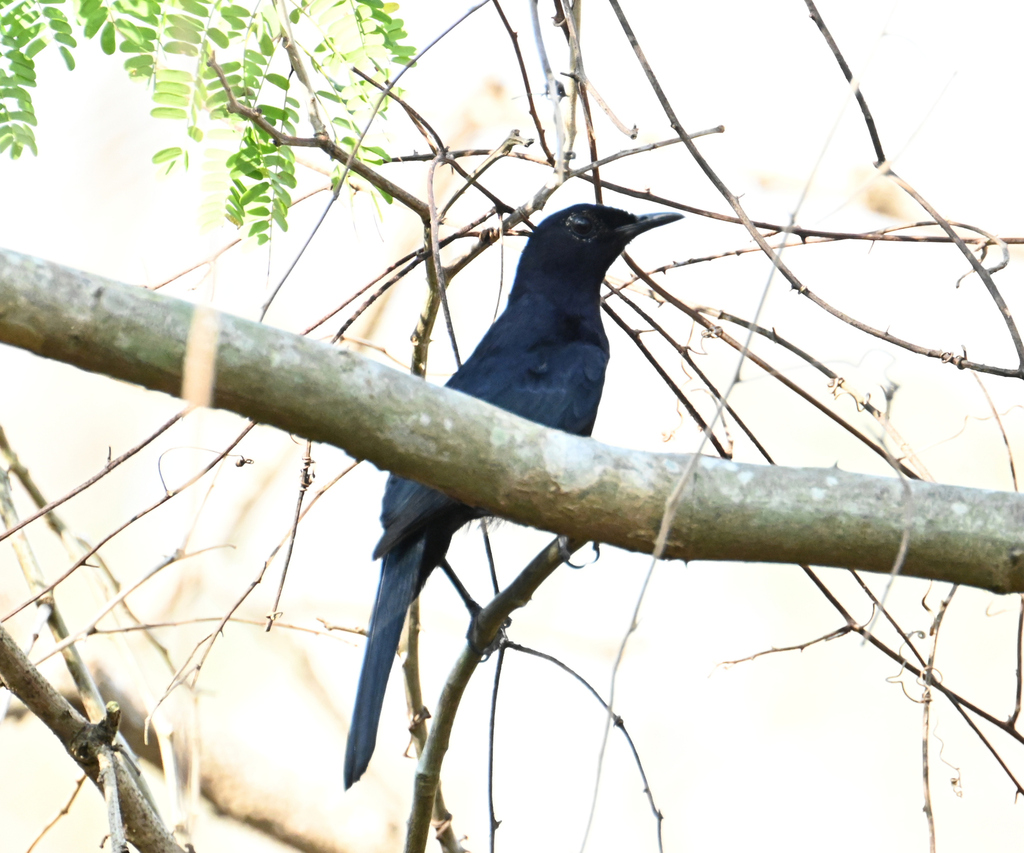
The black catbird (Melanoptila glabrirostris) is a songbird species in the monotypic genus Melanoptila, part of the family Mimidae.
- Kingdom
- Animalia
- Phylum
- Chordata
- Class
- Aves
- Order
- Passeriformes
- Family
- Mimidae
- Genus
- Melanoptila
- Species
- Melanoptila glabrirostris
Description
The black catbird (Melanoptila glabrirostris) is a songbird species in the monotypic genus Melanoptila, part of the family Mimidae. At 19–20.5 cm (7.5–8.1 in) in length and 31.6–42 g (1.11–1.48 oz) in mass, it is the smallest of the mimids. Sexes appear similar, with glossy black plumage, black legs and bill, and dark brownish eyes. The species is endemic to the Yucatán Peninsula, and is found as far south as Campeche, northern Guatemala and northern Belize. Although there are historical records from Honduras and the US state of Texas, the species is not now known to occur in either location. It is found at low elevations in semi-arid to humid habitats ranging from shrubland and abandoned farmland to woodland with thick understory, and is primarily sedentary. Although it is a mimid, the black catbird is not known to imitate any other species. Its song is a mix of harsh notes and clear flute-like whistles, with the phrases repeated. It builds a cup nest in low bushes or trees, and lays two bluish eggs. It is threatened by habitat loss, and has been assessed as near threatened by the International Union for Conservation of Nature.
Gallery
Ajouter des photos
Partagez vos photos de cette espèce (jusqu'à 20 à la fois) : elles sont vérifiées automatiquement, puis publiées.
Répartition
Occurrences observées (données GBIF). Les zones hors aire d'origine peuvent indiquer une présence introduite ou invasive.
Sources et crédits
Informations provenant de plusieurs sources vérifiées. Dernière mise à jour : .
Crédits photos (8)
- Photo : Russ Hoverman (@russh) · CC BY-NC 4.0 · via iNaturalist
- Photo : @axelvasquez20 · CC BY-NC 4.0 · via iNaturalist
- Photo : Carlos Arturo Marín Medina (@camamed) · CC BY-NC 4.0 · via iNaturalist
- Photo : ColinDJones (@colindjones) · CC BY-NC 4.0 · via iNaturalist
- Photo : J. Ismael Arellano Ciau (@ichi_wildlife_mx) · CC BY-NC 4.0 · via iNaturalist
- Photo : @blkvulture · CC BY-NC 4.0 · via iNaturalist
- Photo : Janet Guardiola (@janet_guardiola) · CC BY-NC 4.0 · via iNaturalist
- Photo : @rolandwirth · CC BY-NC 4.0 · via iNaturalist
Mentions de licence
Texte disponible sous licence CC BY-SA 4.0. Il adapte notamment Wikipedia (CC BY-SA) : Black catbird (Wikipédia, auteurs dans l’historique de l’article).
- Taxonomie : GBIF Backbone Taxonomy (CC BY 4.0)
- Carte : occurrences GBIF, fond © contributeurs OpenStreetMap (ODbL)
- Statut de conservation : Liste rouge de l'UICN, via Wikidata (CC0)
Détail : Sources et licences.
Discussion (0)
Aucun message pour l’instant. Lancez la discussion sur cette fiche (sources, précisions, débats éditoriaux).
Connectez-vous pour participer à la discussion.