
Cape Sparrow
Passer melanurus
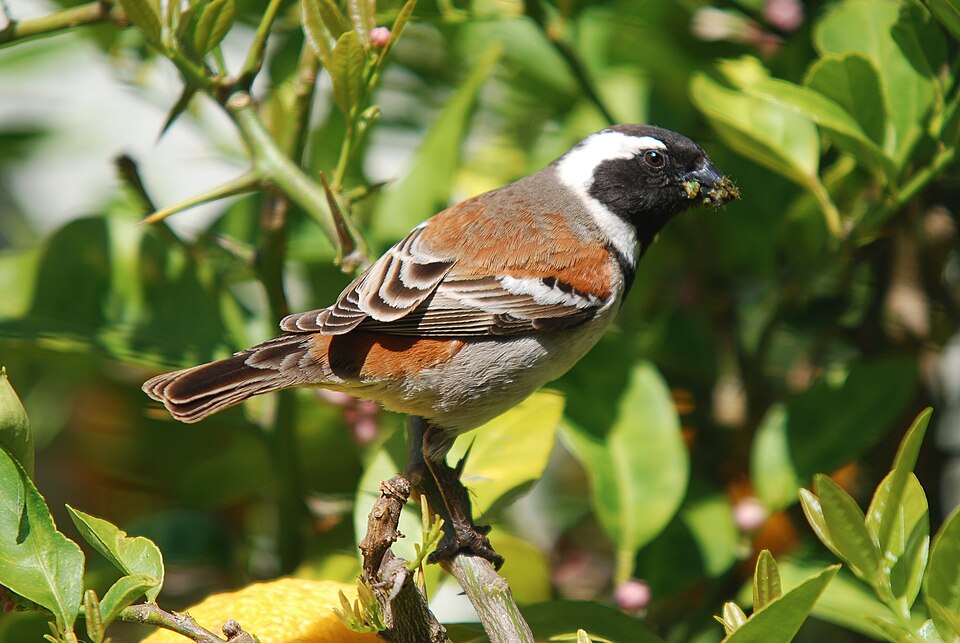
The Cape sparrow (Passer melanurus), or mossie, is a bird of the sparrow family Passeridae found in southern Africa.
- Kingdom
- Animalia
- Phylum
- Chordata
- Class
- Aves
- Order
- Passeriformes
- Family
- Passeridae
- Genus
- Passer
- Species
- Passer melanurus
Description
The Cape sparrow (Passer melanurus), or mossie, is a bird of the sparrow family Passeridae found in southern Africa. A medium-sized sparrow at 14–16 centimetres (5.5–6.3 in), it has distinctive plumage, including large pale head stripes in both sexes. Its plumage is mostly grey, brown, and chestnut, and the male has some bold black and white markings on its head and neck. The species inhabits semi-arid savannah, cultivated areas, and towns, and ranges from the central coast of Angola to eastern South Africa and Eswatini. Three subspecies are distinguished in different parts of its range. Cape sparrows primarily eat seeds, and also eat soft plant parts and insects. They typically breed in colonies, and when not breeding they gather in large nomadic flocks to move around in search of food. The nest can be constructed in a tree, a bush, a cavity, or a disused nest of another species. A typical clutch contains three or four eggs, and both parents are involved in breeding, from nest building to feeding young. The Cape sparrow is common in most of its range and coexists successfully in urban habitats with two of its relatives, the native southern grey-headed sparrow and the house sparrow, an introduced species. The Cape sparrow's population has not been recorded decreasing significantly, and it is not seriously threatened by human activities, so it is assessed as a species of least concern by the International Union for Conservation of Nature (IUCN).
Gallery
Ajouter des photos
Partagez vos photos de cette espèce (jusqu'à 20 à la fois) : elles sont vérifiées automatiquement, puis publiées.
Répartition
Occurrences observées (données GBIF). Les zones hors aire d'origine peuvent indiquer une présence introduite ou invasive.
Sources et crédits
Informations provenant de plusieurs sources vérifiées. Dernière mise à jour : .
Crédits photos (6)
- Photo : Mikejunor · CC BY-SA 4.0
- Photo : @owlice · CC BY-NC 4.0 · via iNaturalist
- Photo : Jared Zachary Herman (@jared103) · CC BY 4.0 · via iNaturalist
- Photo : @ielhaam_bassier · CC BY-NC 4.0 · via iNaturalist
- Photo : @filippoceccolini · CC BY-NC 4.0 · via iNaturalist
- Photo : David R (@davidr) · CC BY-NC 4.0 · via iNaturalist
Mentions de licence
Texte disponible sous licence CC BY-SA 4.0. Il adapte notamment Wikipedia (CC BY-SA) : Cape sparrow (Wikipédia, auteurs dans l’historique de l’article).
- Taxonomie : GBIF Backbone Taxonomy (CC BY 4.0)
- Carte : occurrences GBIF, fond © contributeurs OpenStreetMap (ODbL)
- Statut de conservation : Liste rouge de l'UICN, via Wikidata (CC0)
Détail : Sources et licences.
Discussion (0)
Aucun message pour l’instant. Lancez la discussion sur cette fiche (sources, précisions, débats éditoriaux).
Connectez-vous pour participer à la discussion.