
Sind Sparrow
Passer pyrrhonotus
The Sind sparrow (Passer pyrrhonotus) is a passerine bird of the sparrow family, Passeridae, found around the Indus valley region in South Asia.
- Kingdom
- Animalia
- Phylum
- Chordata
- Class
- Aves
- Order
- Passeriformes
- Family
- Passeridae
- Genus
- Passer
- Species
- Passer pyrrhonotus
Description
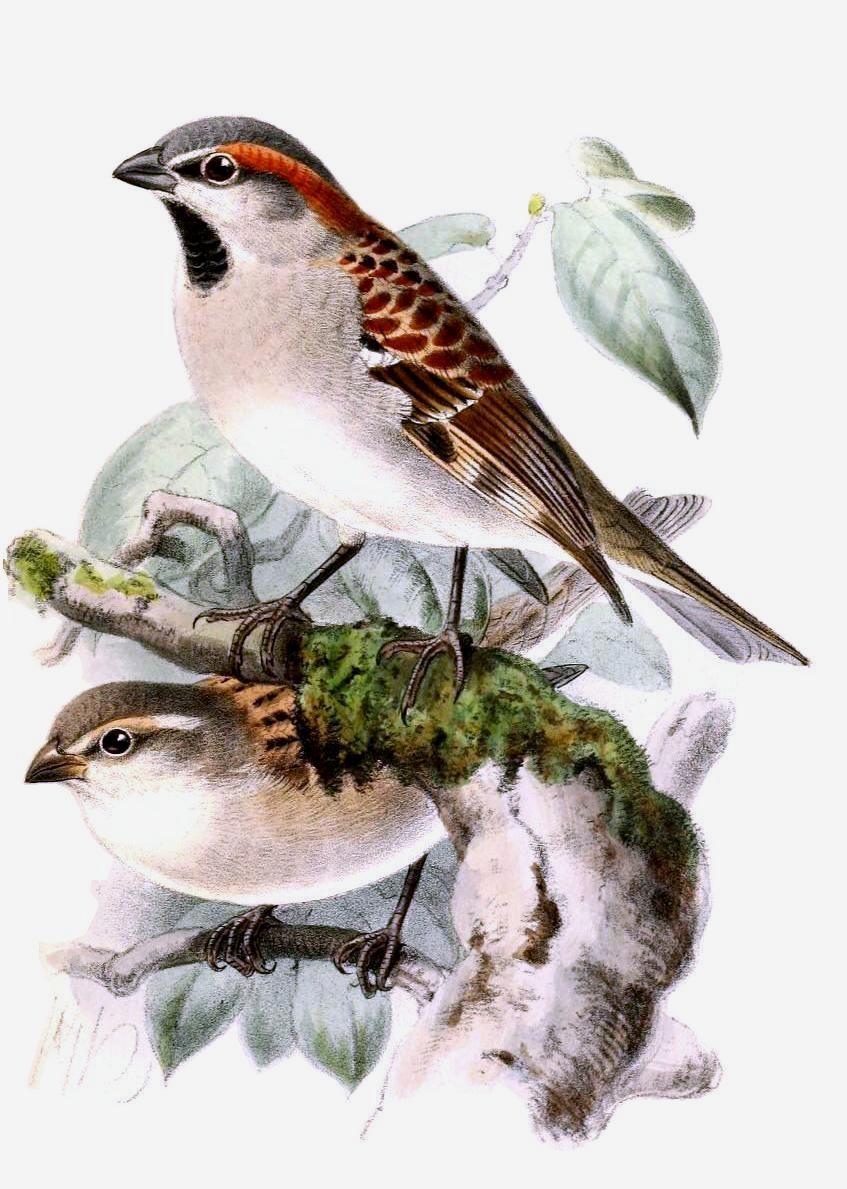
The Sind sparrow (Passer pyrrhonotus) is a passerine bird of the sparrow family, Passeridae, found around the Indus valley region in South Asia. Its name refers to the province of Sindh, and it is also known as the jungle, Sind jungle, or rufous-backed sparrow. Very similar to the related house sparrow, it is smaller and has distinguishing plumage features. As in the house sparrow, the male has brighter plumage than female and young birds, including black markings and a grey crown. Distinctively, the male has a chestnut stripe running down its head behind the eye, and the female has a darker head than other sparrow species. Its main vocalisations are soft chirping calls that are extended into longer songs with other sounds interspersed by breeding males. Historically, this species was thought to be very closely related to the house sparrow, but its closest evolutionary affinities may lie elsewhere. The species was discovered around 1840, but went undetected for several decades afterwards. Within its Indus valley breeding range in Pakistan and western India, the Sind sparrow is patchily distributed in riverine and wetland habitats with thorny scrub and tall grass. During the non-breeding season, some birds enter drier habitats as they disperse short distances from their breeding habitat, or migrate into western Pakistan and the extreme east of Iran. Since this species is fairly common and expanding its range, it is assessed as least concern on the IUCN Red List. The Sind sparrow is social while feeding and gathers in small groups both while breeding and during winter dispersal. It feeds mostly on seeds and less often on insects, foraging close to the ground. Nests are made in the branches of thorny trees, and are untidy globular masses constructed from grass or other plant matter and lined with softer material. Both sexes are involved in building the nest and caring for the young, and usually raise two clutches of three to five young each breeding season.
Gallery
Ajouter des photos
Partagez vos photos de cette espèce (jusqu'à 20 à la fois) : elles sont vérifiées automatiquement, puis publiées.
Répartition
Occurrences observées (données GBIF). Les zones hors aire d'origine peuvent indiquer une présence introduite ou invasive.
Sources et crédits
Informations provenant de plusieurs sources vérifiées. Dernière mise à jour : .
Crédits photos (6)
- Photo : John Gerrard Keulemans · Domaine public
- Photo : Altaf Hussain Talpur (@altafhussain) · CC BY-NC 4.0 · via iNaturalist
- Photo : Remco Hofland (@remco) · CC BY-NC 4.0 · via iNaturalist
- Photo : @johnharshman · CC BY-NC 4.0 · via iNaturalist
- Photo : @dbeadle · CC BY-NC 4.0 · via iNaturalist
- Photo : Mikael Bauer (@neomorphus) · CC BY-NC 4.0 · via iNaturalist
Mentions de licence
Texte disponible sous licence CC BY-SA 4.0. Il adapte notamment Wikipedia (CC BY-SA) : Sind sparrow (Wikipédia, auteurs dans l’historique de l’article).
- Taxonomie : GBIF Backbone Taxonomy (CC BY 4.0)
- Carte : occurrences GBIF, fond © contributeurs OpenStreetMap (ODbL)
- Statut de conservation : Liste rouge de l'UICN, via Wikidata (CC0)
Détail : Sources et licences.
Discussion (0)
Aucun message pour l’instant. Lancez la discussion sur cette fiche (sources, précisions, débats éditoriaux).
Connectez-vous pour participer à la discussion.