
Iago sparrow
Passer iagoensis
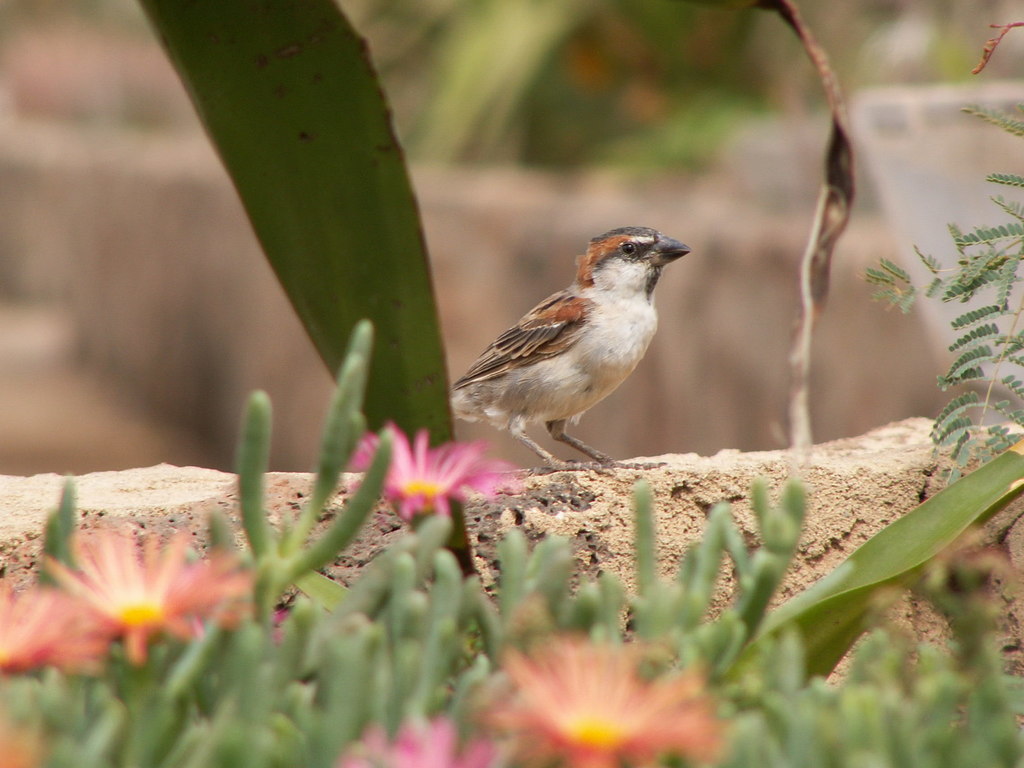
The Iago sparrow (Passer iagoensis), also known as the Cape Verde or rufous-backed sparrow, is a passerine bird of the sparrow family Passeridae.
- Kingdom
- Animalia
- Phylum
- Chordata
- Class
- Aves
- Order
- Passeriformes
- Family
- Passeridae
- Genus
- Passer
- Species
- Passer iagoensis
Description
The Iago sparrow (Passer iagoensis), also known as the Cape Verde or rufous-backed sparrow, is a passerine bird of the sparrow family Passeridae. It is endemic to the Cape Verde archipelago, in the eastern Atlantic Ocean near western Africa. Females and young birds have brown plumage with black marks above, and a dull grey underside, and are distinguished from other species of sparrow by their large, distinct supercilium. Males have a brighter underside and bold black and chestnut stripes on their head. At 12.5–13 centimetres (4.9–5.1 in) long, it is a smaller sparrow. This bird's vocalisations are mostly variations on its chirp, which differ somewhat between males and females. The Iago sparrow was once thought to be most closely related to the rufous sparrows, a group of species within the genus Passer which live in similar habitats on continental Africa. Though the Iago sparrow is closest to the rufous sparrows in appearance, it has a number of crucial differences in morphology and behavior, and is separated by thousands of kilometres. It may in fact be more closely related to the house sparrow and Spanish sparrow. In Cape Verde it occurs on all but one island, and on most of them it is quite common. The Iago sparrow occurs in most of the habitats that are available in its range, such as lava plains, rocky hills, and gorges; however, the house sparrow and Spanish sparrow are typically present instead in denser settlements and richer cultivated areas respectively. Because the Iago sparrow is not under any serious threats, it is assessed as Least Concern on the IUCN Red List.
Gallery
Ajouter des photos
Partagez vos photos de cette espèce (jusqu'à 20 à la fois) : elles sont vérifiées automatiquement, puis publiées.
Répartition
Occurrences observées (données GBIF). Les zones hors aire d'origine peuvent indiquer une présence introduite ou invasive.
Sources et crédits
Informations provenant de plusieurs sources vérifiées. Dernière mise à jour : .
Crédits photos (8)
- Photo : Yves Bas (@yvesbas) · CC BY 4.0 · via iNaturalist
- Photo : @heliastes21 · CC BY-NC 4.0 · via iNaturalist
- Photo : Daniel Eugenio Pérez Garrido (@daniel_eug_perez_garrido) · CC BY-NC 4.0 · via iNaturalist
- Photo : Andreas Duckwe (@anduck) · CC BY-NC 4.0 · via iNaturalist
- Photo : Delphine Froment (@del4444) · CC BY-NC 4.0 · via iNaturalist
- Photo : Georges Olioso (@georges95091) · CC BY-NC 4.0 · via iNaturalist
- Photo : Mike King (@glosterbirder) · CC BY-NC 4.0 · via iNaturalist
- Photo : @davidbeo · CC BY-NC 4.0 · via iNaturalist
Mentions de licence
Texte disponible sous licence CC BY-SA 4.0. Il adapte notamment Wikipedia (CC BY-SA) : Iago sparrow (Wikipédia, auteurs dans l’historique de l’article).
- Taxonomie : GBIF Backbone Taxonomy (CC BY 4.0)
- Carte : occurrences GBIF, fond © contributeurs OpenStreetMap (ODbL)
- Statut de conservation : Liste rouge de l'UICN, via Wikidata (CC0)
Détail : Sources et licences.
Discussion (0)
Aucun message pour l’instant. Lancez la discussion sur cette fiche (sources, précisions, débats éditoriaux).
Connectez-vous pour participer à la discussion.