
Flame Robin
Petroica phoenicea
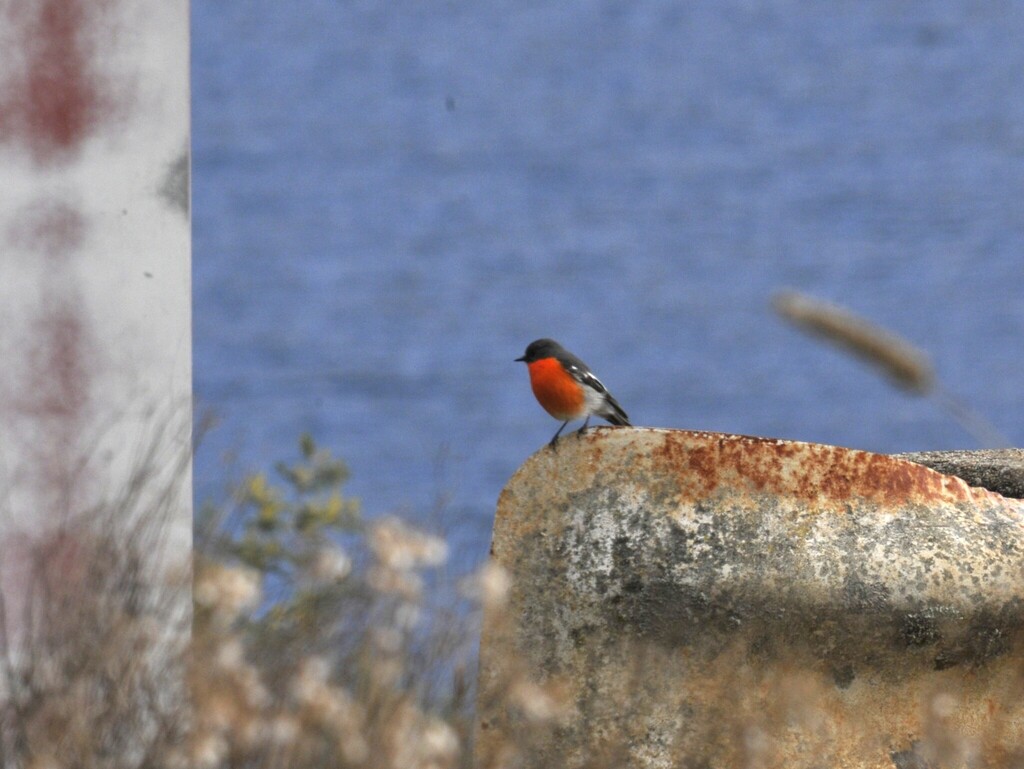
The flame robin (Petroica phoenicea) is a small passerine bird native to Australia.
- Kingdom
- Animalia
- Phylum
- Chordata
- Class
- Aves
- Order
- Passeriformes
- Family
- Petroicidae
- Genus
- Petroica
- Species
- Petroica phoenicea
Description
The flame robin (Petroica phoenicea) is a small passerine bird native to Australia. It is a moderately common resident of the coolest parts of south-eastern Australia, including Tasmania. Like the other two red-breasted Petroica robins-the scarlet robin and the red-capped robin-it is often simply called the robin redbreast. Like many brightly coloured robins of the Petroicidae, it is sexually dimorphic. Measuring 12–14 cm (4.7–5.5 in) long, the flame robin has dark brown eyes and a small thin black bill. The male has a brilliant orange-red chest and throat, and a white patch on the forehead above the bill. Its upper parts are iron-grey with white bars, and its tail black with white tips. Female coloration is a muted grey-brown. Its song has been described as the most musical of its genus. The position of the flame robin and its Australian relatives on the passerine family tree is unclear; the Petroicidae are not closely related to either the European or American robins, but appear to be an early offshoot of the Passerida group of songbirds. The flame robin is predominantly insectivorous, pouncing on prey from a perch in a tree, or foraging on the ground. A territorial bird, the flame robin employs song and plumage displays to mark out and defend its territory. It is classified by BirdLife International as least concern.
Gallery
Ajouter des photos
Partagez vos photos de cette espèce (jusqu'à 20 à la fois) : elles sont vérifiées automatiquement, puis publiées.
Répartition
Occurrences observées (données GBIF). Les zones hors aire d'origine peuvent indiquer une présence introduite ou invasive.
Sources et crédits
Informations provenant de plusieurs sources vérifiées. Dernière mise à jour : .
Crédits photos (8)
- Photo : @sharrisi · CC BY-NC 4.0 · via iNaturalist
- Photo : @kenja · CC BY-NC 4.0 · via iNaturalist
- Photo : @thewildgtrv · CC BY-NC 4.0 · via iNaturalist
- Photo : Mark Clarke (@hatwise) · CC BY-NC 4.0 · via iNaturalist
- Photo : Gemma (@gemclark) · CC BY-NC 4.0 · via iNaturalist
- Photo : Line Perrins (@lineperrins) · CC BY-NC 4.0 · via iNaturalist
- Photo : Allan Lugg (@allanlugg) · CC BY-NC 4.0 · via iNaturalist
- Photo : @mtbin · CC BY-NC 4.0 · via iNaturalist
Mentions de licence
Texte disponible sous licence CC BY-SA 4.0. Il adapte notamment Wikipedia (CC BY-SA) : Flame robin (Wikipédia, auteurs dans l’historique de l’article).
- Taxonomie : GBIF Backbone Taxonomy (CC BY 4.0)
- Carte : occurrences GBIF, fond © contributeurs OpenStreetMap (ODbL)
- Statut de conservation : Liste rouge de l'UICN, via Wikidata (CC0)
Détail : Sources et licences.
Discussion (0)
Aucun message pour l’instant. Lancez la discussion sur cette fiche (sources, précisions, débats éditoriaux).
Connectez-vous pour participer à la discussion.