
Black-sided Robin
Poecilodryas hypoleuca
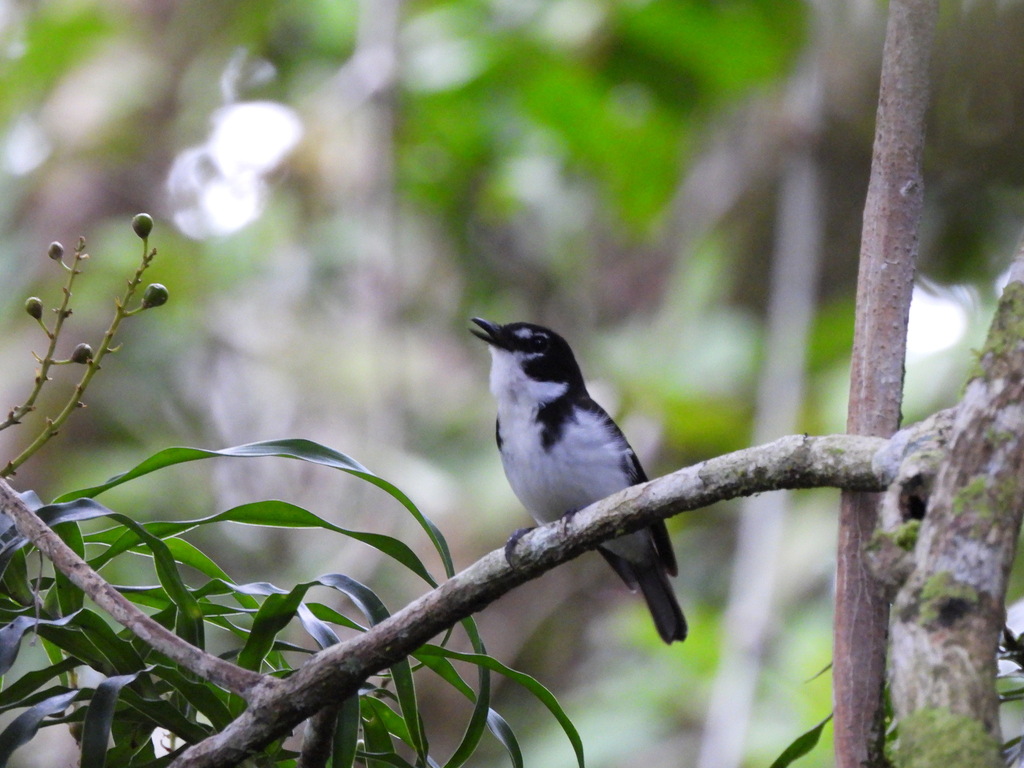
The black-sided robin (Poecilodryas hypoleuca), also known as the pied robin, is a species of bird in the family Petroicidae.
- Kingdom
- Animalia
- Phylum
- Chordata
- Class
- Aves
- Order
- Passeriformes
- Family
- Petroicidae
- Genus
- Poecilodryas
- Species
- Poecilodryas hypoleuca
Description
The black-sided robin (Poecilodryas hypoleuca), also known as the pied robin, is a species of bird in the family Petroicidae. It is widespread throughout New Guinea. Its natural habitat is subtropical or tropical moist lowland forests. The genus name is derived from the Ancient Greek words poikilos 'pied' and dryas 'dryad', and the species name hypoleuca is derived from the Ancient Greek hypoleukos, meaning 'whitish'. Sibley and Ahlquist's DNA-DNA hybridisation studies placed this group in a Corvida parvorder comprising many tropical and Australian passerines including pardalotes, fairy-wrens, honeyeaters and crows. However, subsequent molecular research (and current consensus) places the robins as a very early offshoot of the Passerida (or "advanced" songbirds) within the songbird lineage. Measuring 13 to 15 cm (5 to 6 in), the black-sided robin has black and white plumage. The upperparts including the crown, nape, back, wings and tail are black or brownish-black, as is its eye-stripe. It has white eyebrows, throat and underparts and a white patch on the wings. The bill is black, and the eyes are dark brown, and the legs grey or pink. The black-sided robin is found across New Guinea from the Huon Peninsula west to the western limits of West Papua and West Papuan Islands, although is absent from the transfly region in the south. It inhabits predominantly lowland rainforests and swamp forests from sea level to 1,200 m (3,900 ft). Within the rainforest it is found singly or in pairs in the understory or on the ground. Shy, it is more often heard than seen. It is insectivorous, and hunts by gleaning and snatching insects from tree trunks and branches, and on the ground.
Gallery
Ajouter des photos
Partagez vos photos de cette espèce (jusqu'à 20 à la fois) : elles sont vérifiées automatiquement, puis publiées.
Répartition
Occurrences observées (données GBIF). Les zones hors aire d'origine peuvent indiquer une présence introduite ou invasive.
Sources et crédits
Informations provenant de plusieurs sources vérifiées. Dernière mise à jour : .
Crédits photos (8)
- Photo : Ahmad Yasin Chumaedi (@kareopadi) · CC BY-NC 4.0 · via iNaturalist
- Photo : Donna Belder (@donna90673) · CC BY 4.0 · via iNaturalist
- Photo : Shofar Atthoyibi (@shofar_atthoyibi) · CC BY-NC 4.0 · via iNaturalist
- Photo : @cahyo_lewar · CC BY-NC 4.0 · via iNaturalist
- Photo : Muh Imam Ramdani (@ramdanimam) · CC BY-NC 4.0 · via iNaturalist
- Photo : @rajaampatherping · CC BY-NC 4.0 · via iNaturalist
- Photo : Aponk Al'z Rusdy (@aponkalzrusdy) · CC BY-NC 4.0 · via iNaturalist
- Photo : Nik Borrow (@nikborrow) · CC BY-NC 4.0 · via iNaturalist
Mentions de licence
Texte disponible sous licence CC BY-SA 4.0. Il adapte notamment Miro à flancs noirs, Wikipedia (CC BY-SA) : Black-sided robin (Wikipédia, auteurs dans l’historique de l’article).
- Taxonomie : GBIF Backbone Taxonomy (CC BY 4.0)
- Carte : occurrences GBIF, fond © contributeurs OpenStreetMap (ODbL)
- Statut de conservation : Liste rouge de l'UICN, via Wikidata (CC0)
Détail : Sources et licences.
Discussion (0)
Aucun message pour l’instant. Lancez la discussion sur cette fiche (sources, précisions, débats éditoriaux).
Connectez-vous pour participer à la discussion.