
Buff-sided Robin
Poecilodryas cerviniventris
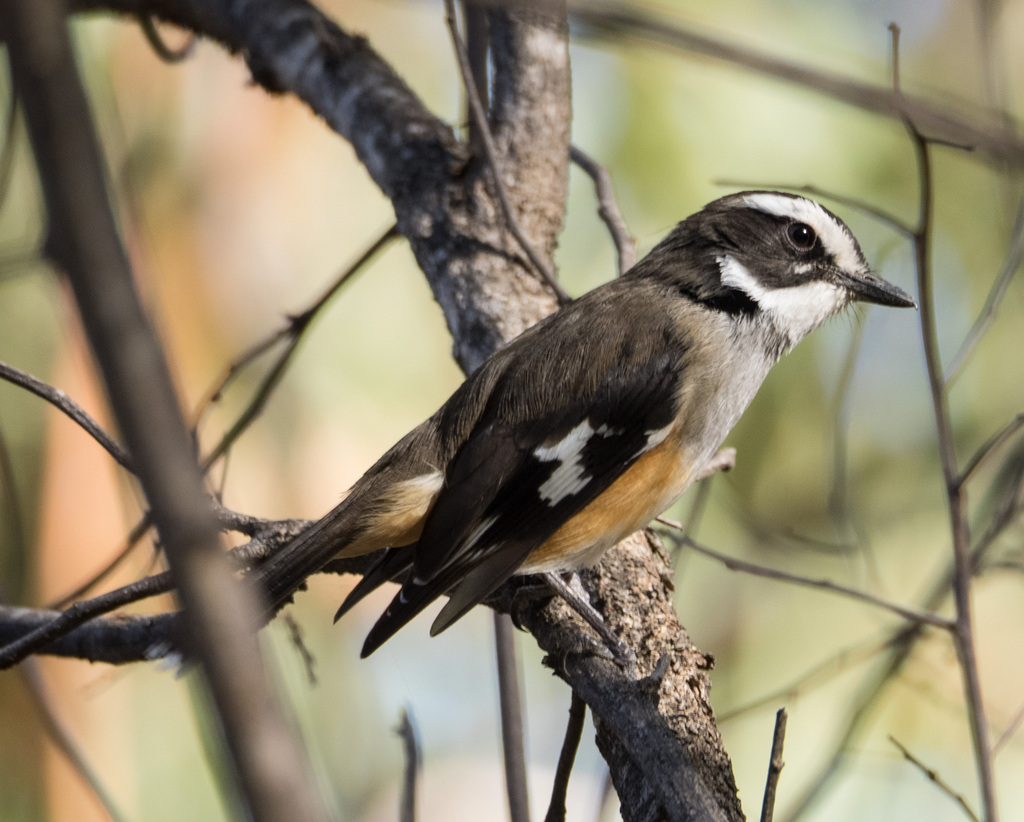
The buff-sided robin (Poecilodryas cerviniventris) is a small, diurnal, insectivorous, perching (passerine) bird in the family Petroicidae, a group commonly known as the Australo-Papuan or Australasian robins.
- Kingdom
- Animalia
- Phylum
- Chordata
- Class
- Aves
- Order
- Passeriformes
- Family
- Petroicidae
- Genus
- Poecilodryas
- Species
- Poecilodryas cerviniventris
Description
The buff-sided robin (Poecilodryas cerviniventris) is a small, diurnal, insectivorous, perching (passerine) bird in the family Petroicidae, a group commonly known as the Australo-Papuan or Australasian robins. It is also known as the buff-sided fly-robin, buff-sided shrike-robin, and Isabellflankenschnäpper (German). The buff-sided robin is endemic to northern Australia, where it primarily occurs in riparian forests and monsoon vine thickets from the Kimberly region of Western Australia to the north-west Queensland Gulf of Carpentaria. The plumage of the adult birds is characterized by a dark hood and back with a prominent white stripe on the supercilium; a white throat, white wing and tail bars, and a striking buff to orange patch on the flank below the wings. Adult birds are not sexually dimorphic; however, males are generally larger and can be separated from females based on morphological measurements. Buff-sided robins predominantly take insects from the ground by sallying from an observational perch. Insects are also occasionally taken by hawking on the wing or by gleaning from the trunk or foliage of riparian vegetation.
Gallery
Ajouter des photos
Partagez vos photos de cette espèce (jusqu'à 20 à la fois) : elles sont vérifiées automatiquement, puis publiées.
Répartition
Occurrences observées (données GBIF). Les zones hors aire d'origine peuvent indiquer une présence introduite ou invasive.
Sources et crédits
Informations provenant de plusieurs sources vérifiées. Dernière mise à jour : .
Crédits photos (8)
- Photo : Paul Whitington (@pmwhitington) · CC BY 4.0 · via iNaturalist
- Photo : @alcedo77 · CC BY-NC 4.0 · via iNaturalist
- Photo : Ron Dowling (@ron4133) · CC BY-NC 4.0 · via iNaturalist
- Photo : Lorraine Phelan (@lorrainecphelan) · CC BY-NC 4.0 · via iNaturalist
- Photo : Andrejs Medenis (@andrejs1) · CC BY-NC 4.0 · via iNaturalist
- Photo : Jemaine Mulcahy (@butt3rflie5r0ck) · CC BY-NC 4.0 · via iNaturalist
- Photo : @coanne · CC BY-NC 4.0 · via iNaturalist
- Photo : @steveparadox · CC BY-NC 4.0 · via iNaturalist
Mentions de licence
Texte disponible sous licence CC BY-SA 4.0. Il adapte notamment Wikipedia (CC BY-SA) : Buff-sided robin (Wikipédia, auteurs dans l’historique de l’article).
- Taxonomie : GBIF Backbone Taxonomy (CC BY 4.0)
- Carte : occurrences GBIF, fond © contributeurs OpenStreetMap (ODbL)
- Statut de conservation : Liste rouge de l'UICN, via Wikidata (CC0)
Détail : Sources et licences.
Discussion (0)
Aucun message pour l’instant. Lancez la discussion sur cette fiche (sources, précisions, débats éditoriaux).
Connectez-vous pour participer à la discussion.