
Secretarybird
Sagittarius serpentarius
The secretarybird or secretary bird (Sagittarius serpentarius) is a large bird of prey that is endemic to Africa.
- Kingdom
- Animalia
- Phylum
- Chordata
- Class
- Aves
- Order
- Accipitriformes
- Family
- Sagittariidae
- Genus
- Sagittarius
- Species
- Sagittarius serpentarius
Description
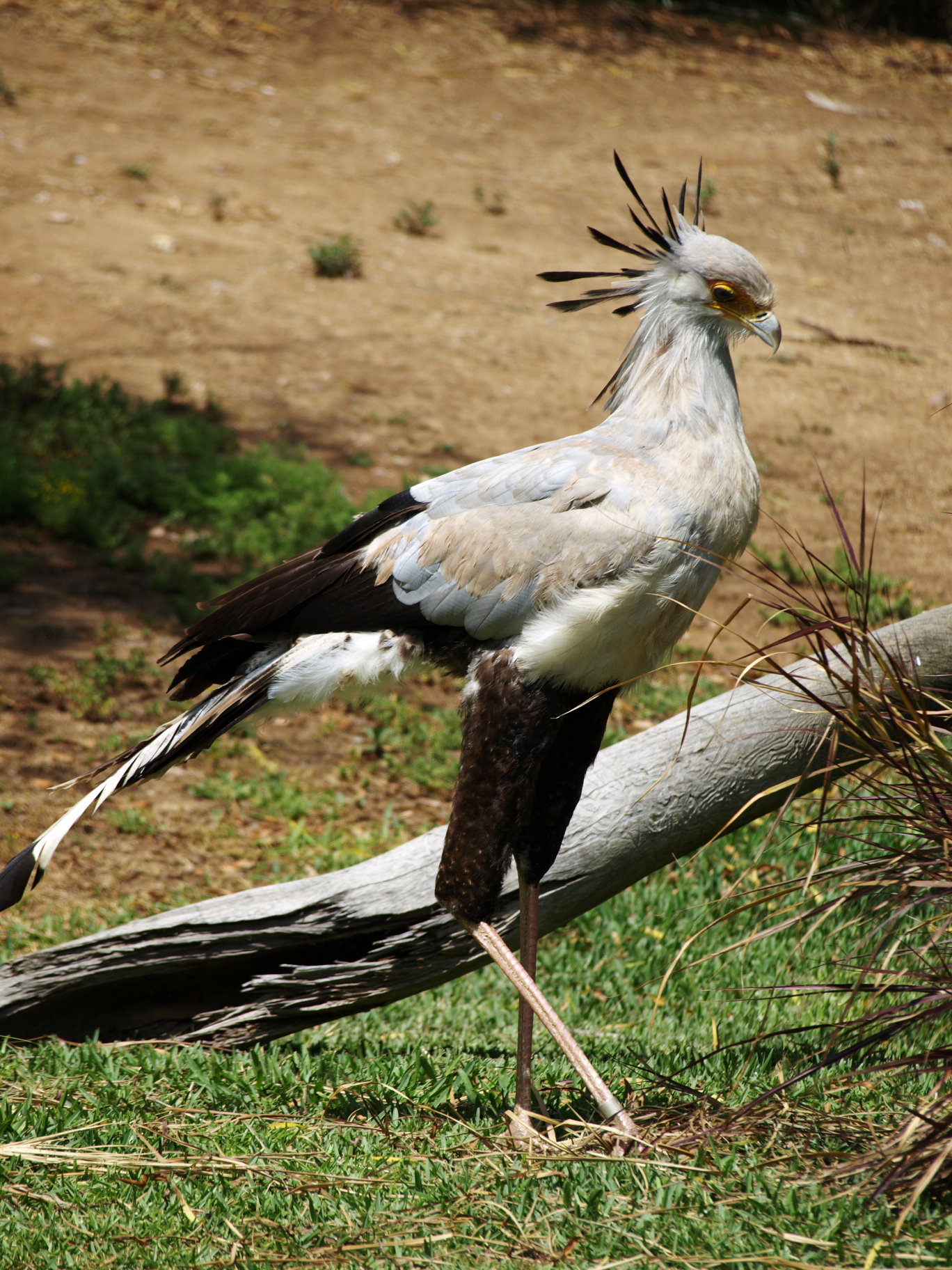
The secretarybird or secretary bird (Sagittarius serpentarius) is a large bird of prey that is endemic to Africa. It is mostly terrestrial, spending most of its time on the ground, and is usually found in the open grasslands and savanna of the sub-Saharan region. John Frederick Miller described the species in 1779. A member of the order Accipitriformes, which also includes many other diurnal birds of prey such as eagles, hawks, kites, vultures, and harriers, it is placed in its own family, the Sagittariidae. The secretarybird is instantly recognizable as a very large bird with an eagle-like body on crane-like legs that give the bird a height of as much as 1.3 m (4 ft 3 in). The sexes are similar in appearance. Adults have a featherless, red-orange face and predominantly grey plumage, with a flattened dark crest and black flight feathers and thighs. Breeding can take place at any time of year, but tends to be late in the dry season. The nest is built at the top of a thorny tree, and a clutch of one to three eggs is laid. In years with plentiful food, all three young can survive to fledging. The secretarybird hunts and catches prey on the ground, often stomping on victims to kill them. Insects and small vertebrates make up its diet. Although the secretarybird resides over a large range, the results of localized surveys suggest that the total population is experiencing a rapid decline, probably as a result of habitat destruction. The species is therefore classed as endangered by the International Union for Conservation of Nature. The secretarybird appears on the coats of arms of South Africa and Sudan.
Gallery
Ajouter des photos
Partagez vos photos de cette espèce (jusqu'à 20 à la fois) : elles sont vérifiées automatiquement, puis publiées.
Répartition
Occurrences observées (données GBIF). Les zones hors aire d'origine peuvent indiquer une présence introduite ou invasive.
Sources et crédits
Informations provenant de plusieurs sources vérifiées. Dernière mise à jour : .
Crédits photos (6)
- Photo : © Ben Lunsford · CC BY-SA 3.0
- Photo : Hendrik McCarthy (@hendrikmc) · CC BY-NC 4.0 · via iNaturalist
- Photo : @brutledge · CC BY-NC 4.0 · via iNaturalist
- Photo : Mahomed Desai (@m_d) · CC BY 4.0 · via iNaturalist
- Photo : Daniel France (@danielfrance) · CC BY-NC 4.0 · via iNaturalist
- Photo : Henry de Lange (@henrydelange) · CC BY 4.0 · via iNaturalist
Mentions de licence
Texte disponible sous licence CC BY-SA 4.0. Il adapte notamment Wikipedia (CC BY-SA) : Secretarybird (Wikipédia, auteurs dans l’historique de l’article).
- Taxonomie : GBIF Backbone Taxonomy (CC BY 4.0)
- Carte : occurrences GBIF, fond © contributeurs OpenStreetMap (ODbL)
Détail : Sources et licences.
Discussion (0)
Aucun message pour l’instant. Lancez la discussion sur cette fiche (sources, précisions, débats éditoriaux).
Connectez-vous pour participer à la discussion.