
Ring Ouzel
Turdus torquatus
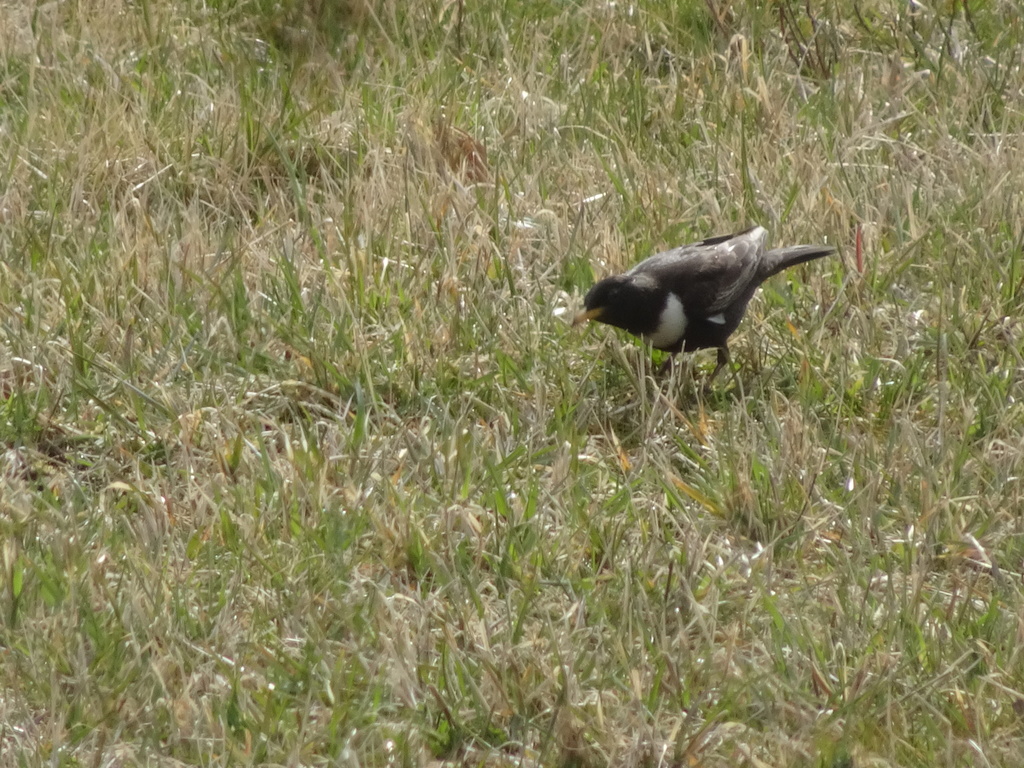
The ring ouzel (Turdus torquatus) is a mainly European member of the thrush family Turdidae.
- Kingdom
- Animalia
- Phylum
- Chordata
- Class
- Aves
- Order
- Passeriformes
- Family
- Turdidae
- Genus
- Turdus
- Species
- Turdus torquatus
Description
The ring ouzel (Turdus torquatus) is a mainly European member of the thrush family Turdidae. It is a medium-sized thrush, 23–24 centimetres (9.1–9.4 in) in length and weighing 90–138 grams (3.2–4.9 oz). The male is predominantly black with a conspicuous white crescent across its breast. Females are browner and duller than males, and young birds may lack the pale chest markings altogether. In all but the northernmost part of its range, this is a high-altitude species, with three subspecies breeding in mountains from Ireland east to Iran. It breeds in open mountain areas with some trees or shrubs, the latter often including juniper and other treeline conifers, rowan, bilberry, heather, and hairy alpenrose. It is a migratory bird, leaving the breeding areas to winter in southern Europe, North Africa and Turkey, typically in mountains with junipers. The typical clutch is 3–6 brown-flecked pale blue or greenish-blue eggs. They are incubated almost entirely by the female, with hatching normally occurring after 13 days. The altricial, downy chicks fledge in another 14 days and are dependent on their parents for about 12 days after fledging. The ring ouzel is omnivorous, eating invertebrates, particularly insects and earthworms, some small vertebrates, and a wide range of fruit. Most animal prey is caught on the ground. During spring migration and the breeding season, invertebrates dominate the adult's diet and are also fed to the chicks. Later in the year, fruit becomes more important, particularly the common juniper. With an extensive range and a large population, the ring ouzel is evaluated as least concern by the International Union for Conservation of Nature (IUCN). There are significant declines in several countries; suspected causes include climate change, human disturbance, hunting and outdoor leisure activities. Loss of junipers may also be a factor in some areas. Natural hazards include predation by mammalian carnivores and birds of prey, and locally there may also be competition from other large thrushes such as the common blackbird, mistle thrush and fieldfare.
Gallery
Ajouter des photos
Partagez vos photos de cette espèce (jusqu'à 20 à la fois) : elles sont vérifiées automatiquement, puis publiées.
Répartition
Occurrences observées (données GBIF). Les zones hors aire d'origine peuvent indiquer une présence introduite ou invasive.
Sources et crédits
Informations provenant de plusieurs sources vérifiées. Dernière mise à jour : .
Crédits photos (8)
- Photo : Mika Tomta (@mikat78) · CC BY-NC 4.0 · via iNaturalist
- Photo : Philipp Pavelka (@philpav) · CC BY 4.0 · via iNaturalist
- Photo : A Emmerson (@a_emmerson) · CC BY-NC 4.0 · via iNaturalist
- Photo : Алексей и Елизавета Романовы (Уральский птицезыр) (@romanovy-aleksey-i-elizaveta) · CC BY-NC 4.0 · via iNaturalist
- Photo : Enrico Cecconello (@ececc) · CC BY-NC 4.0 · via iNaturalist
- Photo : @syuttaya · CC BY-NC 4.0 · via iNaturalist
- Photo : Pavel Shukov (@shukov) · CC BY-NC 4.0 · via iNaturalist
- Photo : Calum McLennan (@calum_mclennan) · CC BY-NC 4.0 · via iNaturalist
Mentions de licence
Texte disponible sous licence CC BY-SA 4.0. Il adapte notamment Wikipedia (CC BY-SA) : Ring ouzel (Wikipédia, auteurs dans l’historique de l’article).
- Taxonomie : GBIF Backbone Taxonomy (CC BY 4.0)
- Carte : occurrences GBIF, fond © contributeurs OpenStreetMap (ODbL)
- Statut de conservation : Liste rouge de l'UICN, via Wikidata (CC0)
Détail : Sources et licences.
Discussion (0)
Aucun message pour l’instant. Lancez la discussion sur cette fiche (sources, précisions, débats éditoriaux).
Connectez-vous pour participer à la discussion.