
Red-winged Fairywren
Malurus elegans
The red-winged fairywren (Malurus elegans) is a species of passerine bird in the Australasian wren family, Maluridae.
- Kingdom
- Animalia
- Phylum
- Chordata
- Class
- Aves
- Order
- Passeriformes
- Family
- Maluridae
- Genus
- Malurus
- Species
- Malurus elegans
Description
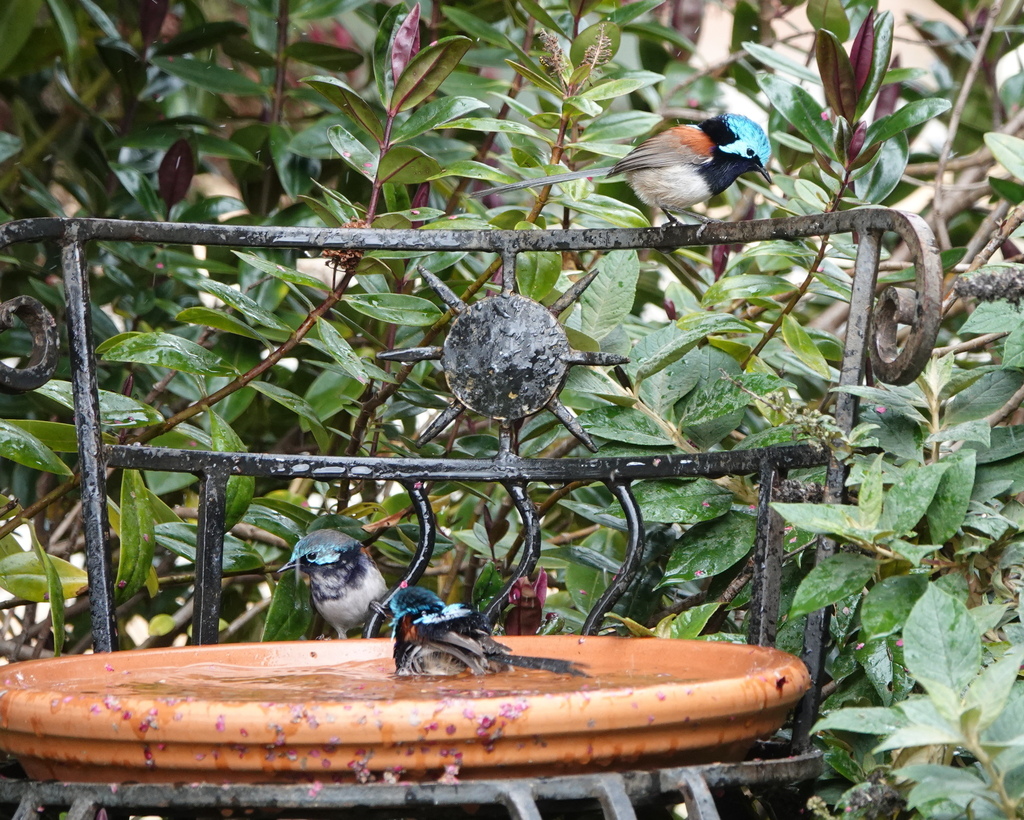
The red-winged fairywren (Malurus elegans) is a species of passerine bird in the Australasian wren family, Maluridae. It is non-migratory and endemic to the southwestern corner of Western Australia. Exhibiting a high degree of sexual dimorphism, the male adopts a brilliantly coloured breeding plumage, with an iridescent silvery-blue crown, ear coverts and upper back, red shoulders, contrasting with a black throat, grey-brown tail and wings and pale underparts. Non-breeding males, females and juveniles have predominantly grey-brown plumage, though males may bear isolated blue and black feathers. No separate subspecies are recognised. Similar in appearance and closely related to the variegated fairywren and the blue-breasted fairywren, it is regarded as a separate species as no intermediate forms have been recorded where their ranges overlap. Though the red-winged fairywren is locally common, there is evidence of a decline in numbers. Bearing a narrow pointed bill adapted for probing and catching insects, the red-winged fairywren is primarily insectivorous; it forages and lives in the shelter of scrubby vegetation in temperate wetter forests dominated by karri trees, remaining close to cover to avoid predators. Like other fairywrens, it is a cooperative breeding species, with small groups of birds maintaining and defending small territories year-round. Groups consist of a socially monogamous pair with several helper birds who assist in raising the young. There is a higher proportion of female helpers recorded for this species than for other species of fairywren. A variety of vocalisations and visual displays have been recorded for communication and courtship in this species. Singing is used to advertise territory, and birds can distinguish other individuals by song alone. Male wrens pluck yellow petals and display them to females as part of a courtship display.
Gallery
Ajouter des photos
Partagez vos photos de cette espèce (jusqu'à 20 à la fois) : elles sont vérifiées automatiquement, puis publiées.
Répartition
Occurrences observées (données GBIF). Les zones hors aire d'origine peuvent indiquer une présence introduite ou invasive.
Sources et crédits
Informations provenant de plusieurs sources vérifiées. Dernière mise à jour : .
Crédits photos (7)
- Photo : Kerry + Darren (@kezzza4) · CC BY-NC 4.0 · via iNaturalist
- Photo : @kdunnart · CC BY-NC 4.0 · via iNaturalist
- Photo : @dandm22 · CC BY-NC 4.0 · via iNaturalist
- Photo : Kerry + Darren (@kezzza4) · CC BY-NC 4.0 · via iNaturalist
- Photo : @kdunnart · CC BY-NC 4.0 · via iNaturalist
- Photo : soph (@cofernicus) · CC BY-NC 4.0 · via iNaturalist
- Photo : Ben Ward (@benw124) · CC BY-NC 4.0 · via iNaturalist
Mentions de licence
Texte disponible sous licence CC BY-SA 4.0. Il adapte notamment Wikipedia (CC BY-SA) : Red-winged fairywren (Wikipédia, auteurs dans l’historique de l’article).
- Taxonomie : GBIF Backbone Taxonomy (CC BY 4.0)
- Carte : occurrences GBIF, fond © contributeurs OpenStreetMap (ODbL)
- Statut de conservation : Liste rouge de l'UICN, via Wikidata (CC0)
Détail : Sources et licences.
Discussion (0)
Aucun message pour l’instant. Lancez la discussion sur cette fiche (sources, précisions, débats éditoriaux).
Connectez-vous pour participer à la discussion.