
Western Spinebill
Acanthorhynchus superciliosus
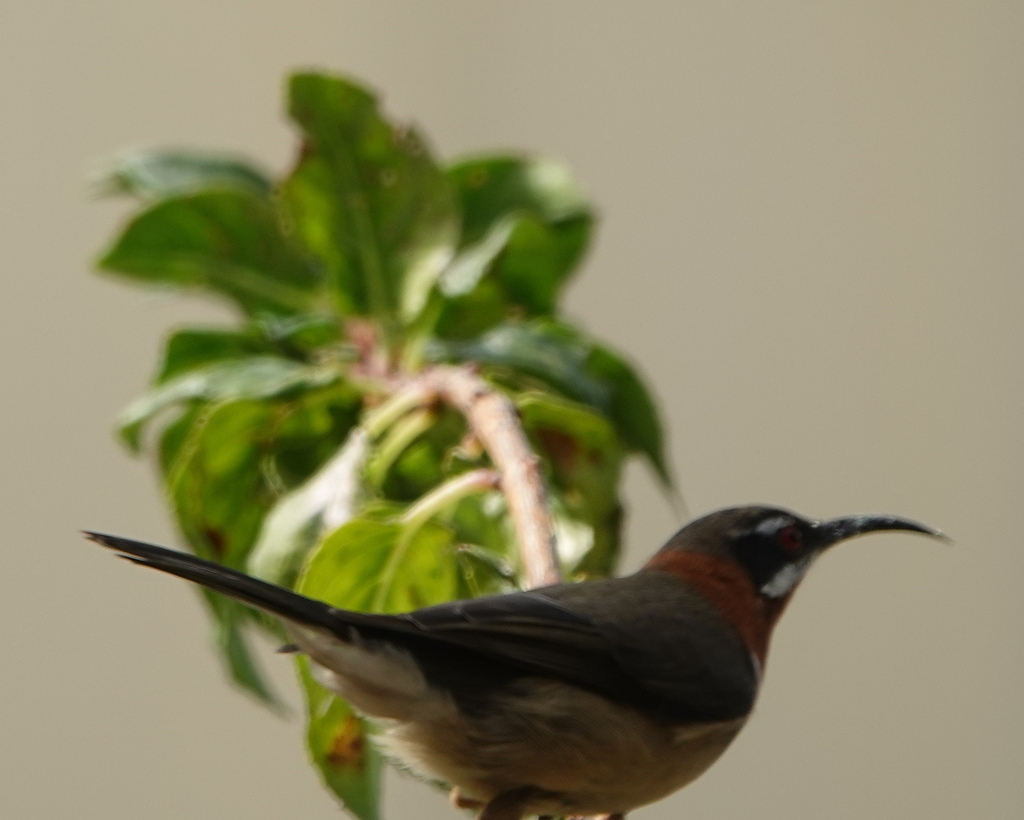
The western spinebill (Acanthorhynchus superciliosus) is a honeyeater found in the heath and woodland of south-western Australia.
- Kingdom
- Animalia
- Phylum
- Chordata
- Class
- Aves
- Order
- Passeriformes
- Family
- Meliphagidae
- Genus
- Acanthorhynchus
- Species
- Acanthorhynchus superciliosus
Description
The western spinebill (Acanthorhynchus superciliosus) is a honeyeater found in the heath and woodland of south-western Australia. Ranging between 12–16 centimetres (4.7–6.3 in) long, it weighs around 10 grams (0.35 oz). It has a black head, gray back and wings, with a red band behind its neck and from its throat to its breast. Its curved bill is long and slender. Like other honeyeaters, the western spinebill feeds on nectar. It tends to obtain its nectar from lower shrubs than most other honeyeaters, including Banksia, Dryandra, Grevillea, Adenanthos, and Verticordia. It also feeds from trees of Banksia and Eucalyptus, and from herbs such as Anigozanthos. In addition to nectar, it feeds on insects that it captures in the air or on plants. It is a frequent visitor to Adenanthos obovatus, and its territories are smaller when they contain more shrubs of this species. Male spinebills often contest their territory borders with other males, and allow females to live within them. These territories range from 0.2 to 0.5 hectares in size. With their long curved bills, western spinebills are the only honeyeaters able to gain nectar out of the tube-like flowers. It breeds from September to January, in a nest made from bark, plant stems, down and spider web. It lays 1–2 eggs, usually incubated by the female.
Gallery
Ajouter des photos
Partagez vos photos de cette espèce (jusqu'à 20 à la fois) : elles sont vérifiées automatiquement, puis publiées.
Répartition
Occurrences observées (données GBIF). Les zones hors aire d'origine peuvent indiquer une présence introduite ou invasive.
Sources et crédits
Informations provenant de plusieurs sources vérifiées. Dernière mise à jour : .
Crédits photos (8)
- Photo : Kerry + Darren (@kezzza4) · CC BY-NC 4.0 · via iNaturalist
- Photo : Haami Pukehika (@haamipukehika) · CC BY-NC 4.0 · via iNaturalist
- Photo : Wayne and Pam Osborn (@wayneosborn) · CC BY-NC 4.0 · via iNaturalist
- Photo : Kerry + Darren (@kezzza4) · CC BY-NC 4.0 · via iNaturalist
- Photo : Keith Morris (@boobook99) · CC BY-NC 4.0 · via iNaturalist
- Photo : @vbnt · CC BY-NC 4.0 · via iNaturalist
- Photo : Morgan Lythe (@slaadi) · CC BY-NC 4.0 · via iNaturalist
- Photo : Thomas Mesaglio (@thebeachcomber) · CC BY 4.0 · via iNaturalist
Mentions de licence
Texte disponible sous licence CC BY-SA 4.0. Il adapte notamment Wikipedia (CC BY-SA) : Western spinebill (Wikipédia, auteurs dans l’historique de l’article).
- Taxonomie : GBIF Backbone Taxonomy (CC BY 4.0)
- Carte : occurrences GBIF, fond © contributeurs OpenStreetMap (ODbL)
- Statut de conservation : Liste rouge de l'UICN, via Wikidata (CC0)
Détail : Sources et licences.
Discussion (0)
Aucun message pour l’instant. Lancez la discussion sur cette fiche (sources, précisions, débats éditoriaux).
Connectez-vous pour participer à la discussion.