
New Zealand Bellbird
Anthornis melanura
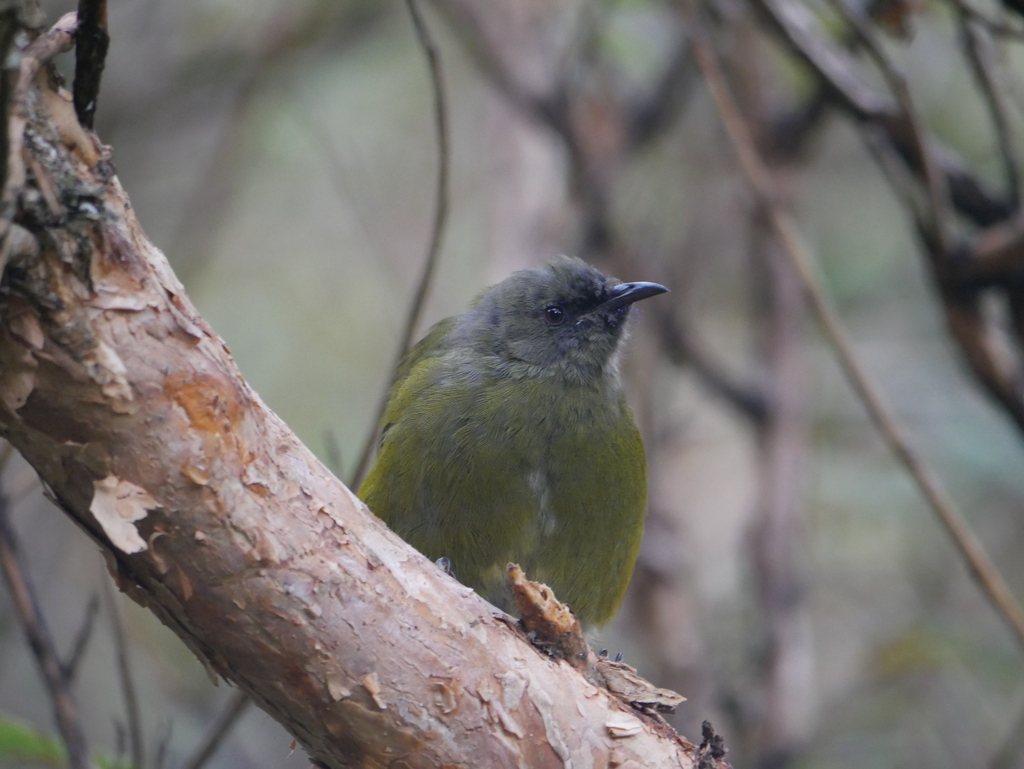
The New Zealand bellbird (Anthornis melanura), also known by its Māori language names korimako, makomako and kōmako, is a medium-sized species of honeyeater endemic to New Zealand.
- Kingdom
- Animalia
- Phylum
- Chordata
- Class
- Aves
- Order
- Passeriformes
- Family
- Meliphagidae
- Genus
- Anthornis
- Species
- Anthornis melanura
Description
The New Zealand bellbird (Anthornis melanura), also known by its Māori language names korimako, makomako and kōmako, is a medium-sized species of honeyeater endemic to New Zealand. It has been the only living member of the genus Anthornis since the Chatham Islands bellbird went extinct in the early 20th century. The bellbird's closest living relative is the only other New Zealand honeyeater, the tūī (Prosthemadera novaeseelandiae). The bellbird forms a significant component of the famed New Zealand dawn chorus of birdsong, which was much noted by early European settlers. Exceptional singing abilities were already observed by Captain James Cook, who described its song as "like small bells most exquisitely tuned". Bellbirds measure about 17–20 cm (6.7–7.9 in) in length, with females weighing approximately 25 g (0.88 oz) and males 33 g (1.2 oz). Males are mostly olive-green with paler underparts, and bluish-black wings and tail. Females are paler and browner. Like other honeyeaters, the bellbird has a brush-like tongue that enables effective feeding on nectar from deep flowers. The species is common across much of New Zealand, its offshore islands, and the Auckland Islands, but it is scarce north of Waikato and across the Canterbury Plains and Central Otago. Its habitat includes both native and exotic forests and scrublands, and it is commonly found in parks and gardens. Bellbirds feed on nectar, fruit, honeydew, and insects. During the breeding season, they become highly territorial and aggressively defend their territory against intruders. Bellbirds form monogamous pairs with long-lasting bonds that can span many years. Females typically lay around 3–4 eggs and incubate them for about 13–15 days. Fledging occurs approximately 19 days after hatching. Bellbirds have modified their ninth primary flight feathers, allowing them to produce specific whirring sounds in flight that they utilise during courtship and territorial defence. The bellbird is regarded as taonga (cultural or spiritual treasure) by the Māori, who traditionally valued it for both its meat and its melodious singing abilities.
Gallery
Ajouter des photos
Partagez vos photos de cette espèce (jusqu'à 20 à la fois) : elles sont vérifiées automatiquement, puis publiées.
Répartition
Occurrences observées (données GBIF). Les zones hors aire d'origine peuvent indiquer une présence introduite ou invasive.
Sources et crédits
Informations provenant de plusieurs sources vérifiées. Dernière mise à jour : .
Crédits photos (8)
- Photo : Mac Durning (@mac_durning) · CC BY-NC 4.0 · via iNaturalist
- Photo : Jon Sullivan (@jon_sullivan) · CC BY 4.0 · via iNaturalist
- Photo : Jon Sullivan (@jon_sullivan) · CC BY 4.0 · via iNaturalist
- Photo : Timothy E Myer (@tim2knowhim) · CC BY-NC 4.0 · via iNaturalist
- Photo : AK (@omen_ak) · CC BY-NC 4.0 · via iNaturalist
- Photo : Eric Cameron (@ericcameron) · CC BY-NC 4.0 · via iNaturalist
- Photo : @o2k · CC0 (domaine public) · via iNaturalist
- Photo : Amanda Bullington (@albullington) · CC BY-NC 4.0 · via iNaturalist
Mentions de licence
Texte disponible sous licence CC BY-SA 4.0. Il adapte notamment Wikipedia (CC BY-SA) : New Zealand bellbird (Wikipédia, auteurs dans l’historique de l’article).
- Taxonomie : GBIF Backbone Taxonomy (CC BY 4.0)
- Carte : occurrences GBIF, fond © contributeurs OpenStreetMap (ODbL)
- Statut de conservation : Liste rouge de l'UICN, via Wikidata (CC0)
Détail : Sources et licences.
Discussion (0)
Aucun message pour l’instant. Lancez la discussion sur cette fiche (sources, précisions, débats éditoriaux).
Connectez-vous pour participer à la discussion.