
Brown Honeyeater
Lichmera indistincta
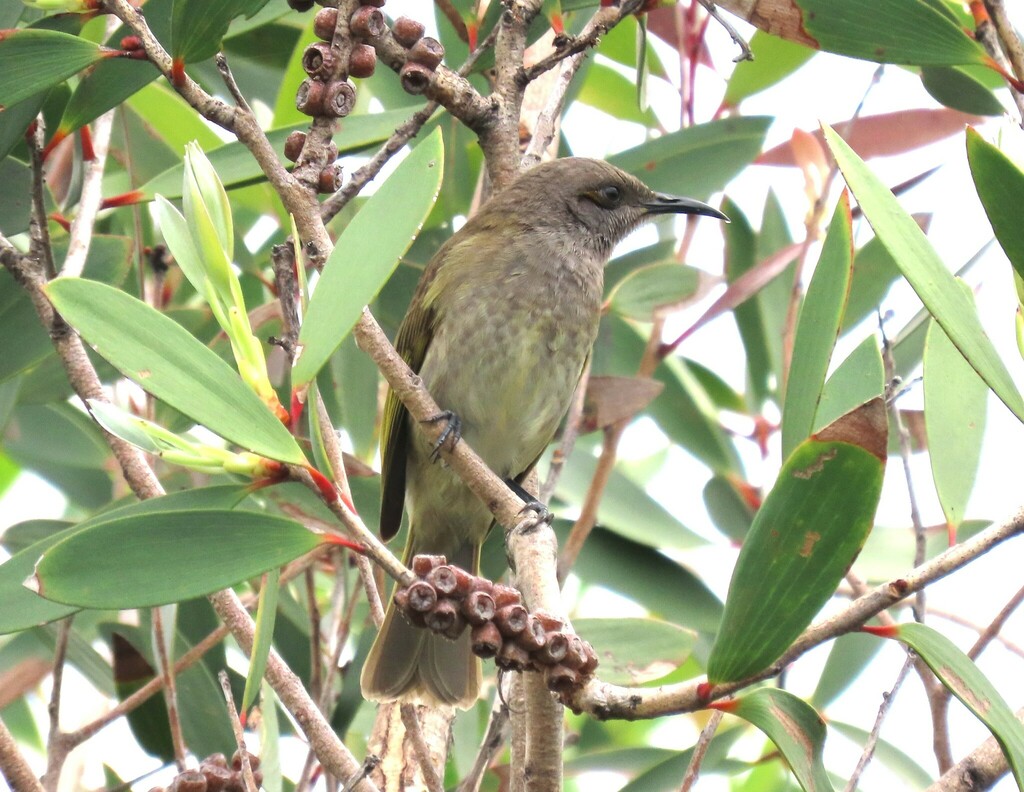
The brown honeyeater (Lichmera indistincta) is a species of bird in the family Meliphagidae.
- Kingdom
- Animalia
- Phylum
- Chordata
- Class
- Aves
- Order
- Passeriformes
- Family
- Meliphagidae
- Genus
- Lichmera
- Species
- Lichmera indistincta
Description
The brown honeyeater (Lichmera indistincta) is a species of bird in the family Meliphagidae. It belongs to the honeyeaters, a group of birds which have highly developed brush-tipped tongues adapted for nectar feeding. Honeyeaters are found mainly in Australia, New Guinea, and parts of Indonesia, but the brown honeyeater is unique in that it also occurs on the island of Bali, making it the only honeyeater to be found west of the Wallace Line, the biogeographical boundary between the Australian-Papuan and Oriental zoogeographical regions. It is a medium-small brownish bird, with yellow-olive panels in the tail and wing, and a yellow tuft behind the eye. It is widespread across western, northern and eastern Australia, New Guinea and surrounding islands, and the Lesser Sundas of Indonesia. Throughout this range, the brown honeyeater occupies a range of habitats from mangroves to eucalypt woodlands. It is seasonally nomadic within its local area, following flowering food plants. While it usually forages alone, it also feeds in small groups, or flocks of mixed honeyeater species. Nectar and insects form its diet. It occupies the same breeding territory each year, and lays two or three eggs in a cup-shaped nest woven from grass and soft bark. Both sexes contribute to nest building and feeding the young. It has a loud, clear, musical song, described as the best of all the honeyeaters. While the brown honeyeater is declining in some areas, such as the Wheatbelt region of Western Australia, overall its population levels and distribution are sufficient to have it described by the IUCN as being of least concern for conservation.
Gallery
Ajouter des photos
Partagez vos photos de cette espèce (jusqu'à 20 à la fois) : elles sont vérifiées automatiquement, puis publiées.
Répartition
Occurrences observées (données GBIF). Les zones hors aire d'origine peuvent indiquer une présence introduite ou invasive.
Sources et crédits
Informations provenant de plusieurs sources vérifiées. Dernière mise à jour : .
Crédits photos (8)
- Photo : @donnamareetomkinson · CC BY-NC 4.0 · via iNaturalist
- Photo : Stephen Fricker (@saltmarshsteve) · CC BY-NC 4.0 · via iNaturalist
- Photo : Sylvia Felicity Ann Haworth (@sylviafelicityannhaworth) · CC BY-NC 4.0 · via iNaturalist
- Photo : John D Reynolds (@johndreynolds) · CC BY-NC 4.0 · via iNaturalist
- Photo : Rebecca Stroud (@peregrine80) · CC BY-NC 4.0 · via iNaturalist
- Photo : Zaire Schutte (@the-reef-stalker) · CC BY-NC 4.0 · via iNaturalist
- Photo : Gayle Sp8 (@gayle0512) · CC BY-NC 4.0 · via iNaturalist
- Photo : @andrewpavlov · CC BY-NC 4.0 · via iNaturalist
Mentions de licence
Texte disponible sous licence CC BY-SA 4.0. Il adapte notamment Wikipedia (CC BY-SA) : Brown honeyeater (Wikipédia, auteurs dans l’historique de l’article).
- Taxonomie : GBIF Backbone Taxonomy (CC BY 4.0)
- Carte : occurrences GBIF, fond © contributeurs OpenStreetMap (ODbL)
- Statut de conservation : Liste rouge de l'UICN, via Wikidata (CC0)
Détail : Sources et licences.
Discussion (0)
Aucun message pour l’instant. Lancez la discussion sur cette fiche (sources, précisions, débats éditoriaux).
Connectez-vous pour participer à la discussion.