
Red Wattlebird
Anthochaera carunculata
The red wattlebird (Anthochaera carunculata) is a passerine bird native to southern Australia.
- Kingdom
- Animalia
- Phylum
- Chordata
- Class
- Aves
- Order
- Passeriformes
- Family
- Meliphagidae
- Genus
- Anthochaera
- Species
- Anthochaera carunculata
Description
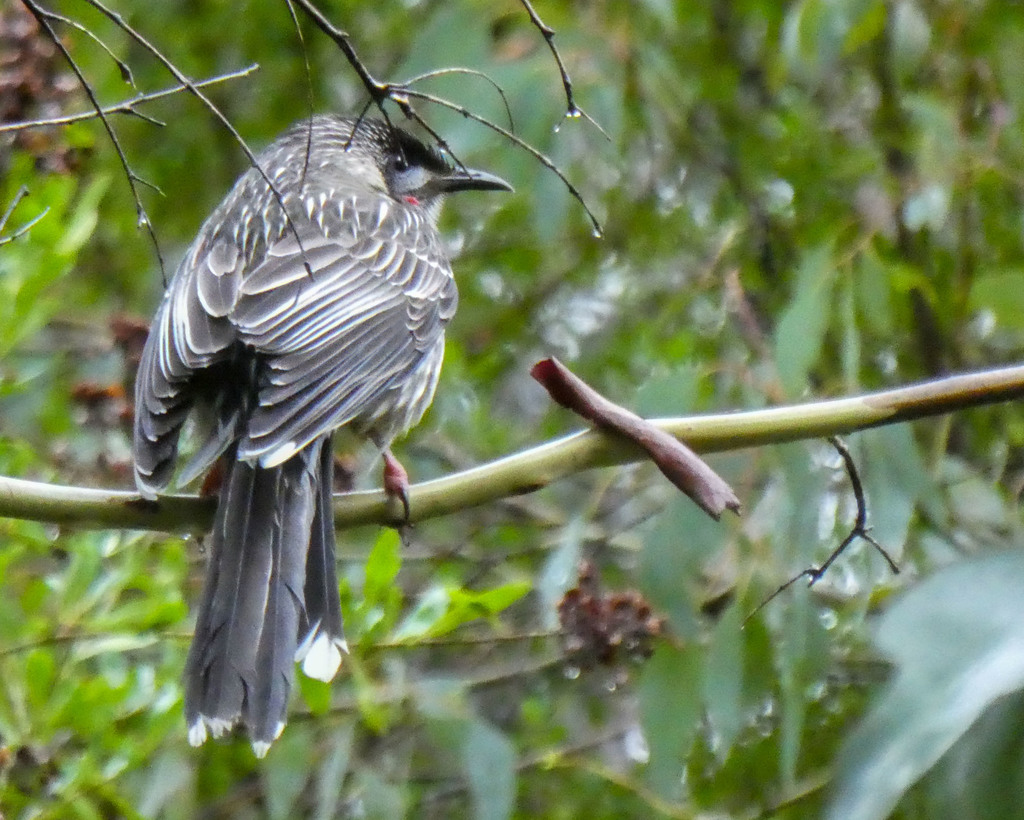
The red wattlebird (Anthochaera carunculata) is a passerine bird native to southern Australia. At 33–37 cm (13–14+1⁄2 in) in length, it is the second largest species of Australian honeyeater, after the yellow wattlebird. It has mainly grey-brown plumage, with red eyes, distinctive pinkish-red wattles on either side of the neck, white streaks on the chest and a large bright yellow patch on the lower belly. The sexes are similar in plumage. Juveniles have less prominent wattles and browner eyes. John White described the red wattlebird in 1790. Three subspecies are recognized. The species is found in southeast Queensland, New South Wales, Victoria, South Australia and southwest Western Australia in open forest and woodland, and is a common visitor to urban gardens and parks. Loud and conspicuous, the red wattlebird is generally found in trees, where it gets most of its food; occasionally it forages on the ground. It is one of the largest nectarivorous birds in the world, feeding from a wide variety of flowering plants. Insects also comprise part of its diet. It is territorial and at times aggressive towards birds of other species, often defending rich sources of nectar. Breeding throughout its range, the red wattlebird builds a cup-shaped nest in a tree and raises one or two broods a year. Although it has declined in places from land-clearing, it is classified as Least Concern on the IUCN Red List.
Gallery
Ajouter des photos
Partagez vos photos de cette espèce (jusqu'à 20 à la fois) : elles sont vérifiées automatiquement, puis publiées.
Répartition
Occurrences observées (données GBIF). Les zones hors aire d'origine peuvent indiquer une présence introduite ou invasive.
Sources et crédits
Informations provenant de plusieurs sources vérifiées. Dernière mise à jour : .
Crédits photos (8)
- Photo : Mononymous (@mononymous) · CC BY-NC 4.0 · via iNaturalist
- Photo : Elspeth Swan (@cygnet) · CC BY 4.0 · via iNaturalist
- Photo : Mononymous (@mononymous) · CC BY-NC 4.0 · via iNaturalist
- Photo : Anna Lanigan (@annalanigan) · CC BY-NC 4.0 · via iNaturalist
- Photo : Matt (@manderson80) · CC BY-NC 4.0 · via iNaturalist
- Photo : @patrix1 · CC BY-NC 4.0 · via iNaturalist
- Photo : Heidi Clark (@heidicee) · CC BY-NC 4.0 · via iNaturalist
- Photo : Susan Kruss (@skruss) · CC BY-NC 4.0 · via iNaturalist
Mentions de licence
Texte disponible sous licence CC BY-SA 4.0. Il adapte notamment Wikipedia (CC BY-SA) : Red wattlebird (Wikipédia, auteurs dans l’historique de l’article).
- Taxonomie : GBIF Backbone Taxonomy (CC BY 4.0)
- Carte : occurrences GBIF, fond © contributeurs OpenStreetMap (ODbL)
- Statut de conservation : Liste rouge de l'UICN, via Wikidata (CC0)
Détail : Sources et licences.
Discussion (0)
Aucun message pour l’instant. Lancez la discussion sur cette fiche (sources, précisions, débats éditoriaux).
Connectez-vous pour participer à la discussion.