
Blue-faced Honeyeater
Entomyzon cyanotis
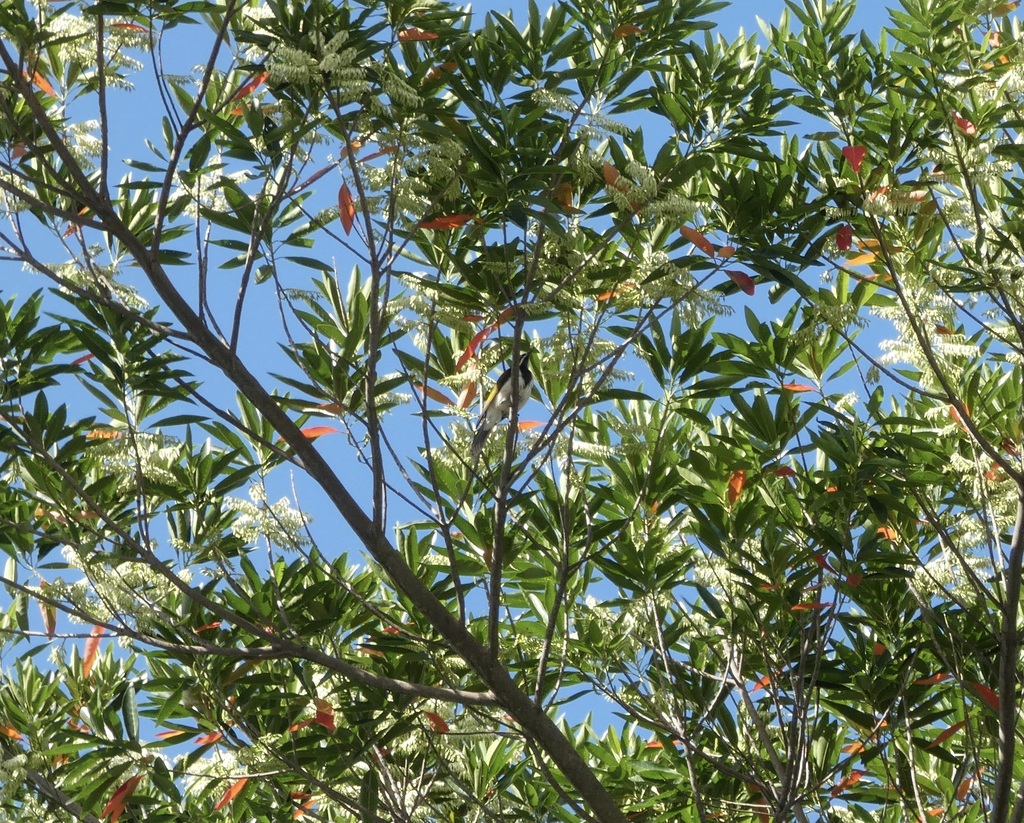
The blue-faced honeyeater (Entomyzon cyanotis), also colloquially known as the bananabird, is a passerine bird of the honeyeater family, Meliphagidae.
- Kingdom
- Animalia
- Phylum
- Chordata
- Class
- Aves
- Order
- Passeriformes
- Family
- Meliphagidae
- Genus
- Entomyzon
- Species
- Entomyzon cyanotis
Description
The blue-faced honeyeater (Entomyzon cyanotis), also colloquially known as the bananabird, is a passerine bird of the honeyeater family, Meliphagidae. It is the only member of its genus, and it is most closely related to honeyeaters of the genus Melithreptus. Three subspecies are recognised. At around 29.5 cm (11.6 in) in length, the blue-faced species is large for a honeyeater. Its plumage is distinctive, with olive upperparts, white underparts, and a black head and throat with white nape and cheeks. Males and females are similar in external appearance. Adults have a blue area of bare skin on each side of the face readily distinguishing them from juveniles, which have yellow or green patches of bare skin. Found in open woodland, parks and gardens, the blue-faced honeyeater is common in northern and eastern Australia, and southern New Guinea. It appears to be sedentary in parts of its range, and locally nomadic in other parts; however, the species has been little studied. Its diet is mostly composed of invertebrates, supplemented with nectar and fruit. They often take over and renovate old babbler nests, in which the female lays and incubates two or rarely three eggs.
Gallery
Ajouter des photos
Partagez vos photos de cette espèce (jusqu'à 20 à la fois) : elles sont vérifiées automatiquement, puis publiées.
Répartition
Occurrences observées (données GBIF). Les zones hors aire d'origine peuvent indiquer une présence introduite ou invasive.
Sources et crédits
Informations provenant de plusieurs sources vérifiées. Dernière mise à jour : .
Crédits photos (8)
- Photo : Sylvia Felicity Ann Haworth (@sylviafelicityannhaworth) · CC BY-NC 4.0 · via iNaturalist
- Photo : @datadan · CC BY 4.0 · via iNaturalist
- Photo : Sylvia Felicity Ann Haworth (@sylviafelicityannhaworth) · CC BY-NC 4.0 · via iNaturalist
- Photo : Nathan Ruser (@nrg800) · CC BY 4.0 · via iNaturalist
- Photo : Dan Blamey (@headsoup) · CC BY-NC 4.0 · via iNaturalist
- Photo : @donnamareetomkinson · CC BY-NC 4.0 · via iNaturalist
- Photo : @bizzeelizzie · CC BY-NC 4.0 · via iNaturalist
- Photo : ISTARI (@istari) · CC BY-NC 4.0 · via iNaturalist
Mentions de licence
Texte disponible sous licence CC BY-SA 4.0. Il adapte notamment Wikipedia (CC BY-SA) : Blue-faced honeyeater (Wikipédia, auteurs dans l’historique de l’article).
- Taxonomie : GBIF Backbone Taxonomy (CC BY 4.0)
- Carte : occurrences GBIF, fond © contributeurs OpenStreetMap (ODbL)
- Statut de conservation : Liste rouge de l'UICN, via Wikidata (CC0)
Détail : Sources et licences.
Discussion (0)
Aucun message pour l’instant. Lancez la discussion sur cette fiche (sources, précisions, débats éditoriaux).
Connectez-vous pour participer à la discussion.