
Blyth's Kingfisher
Alcedo hercules
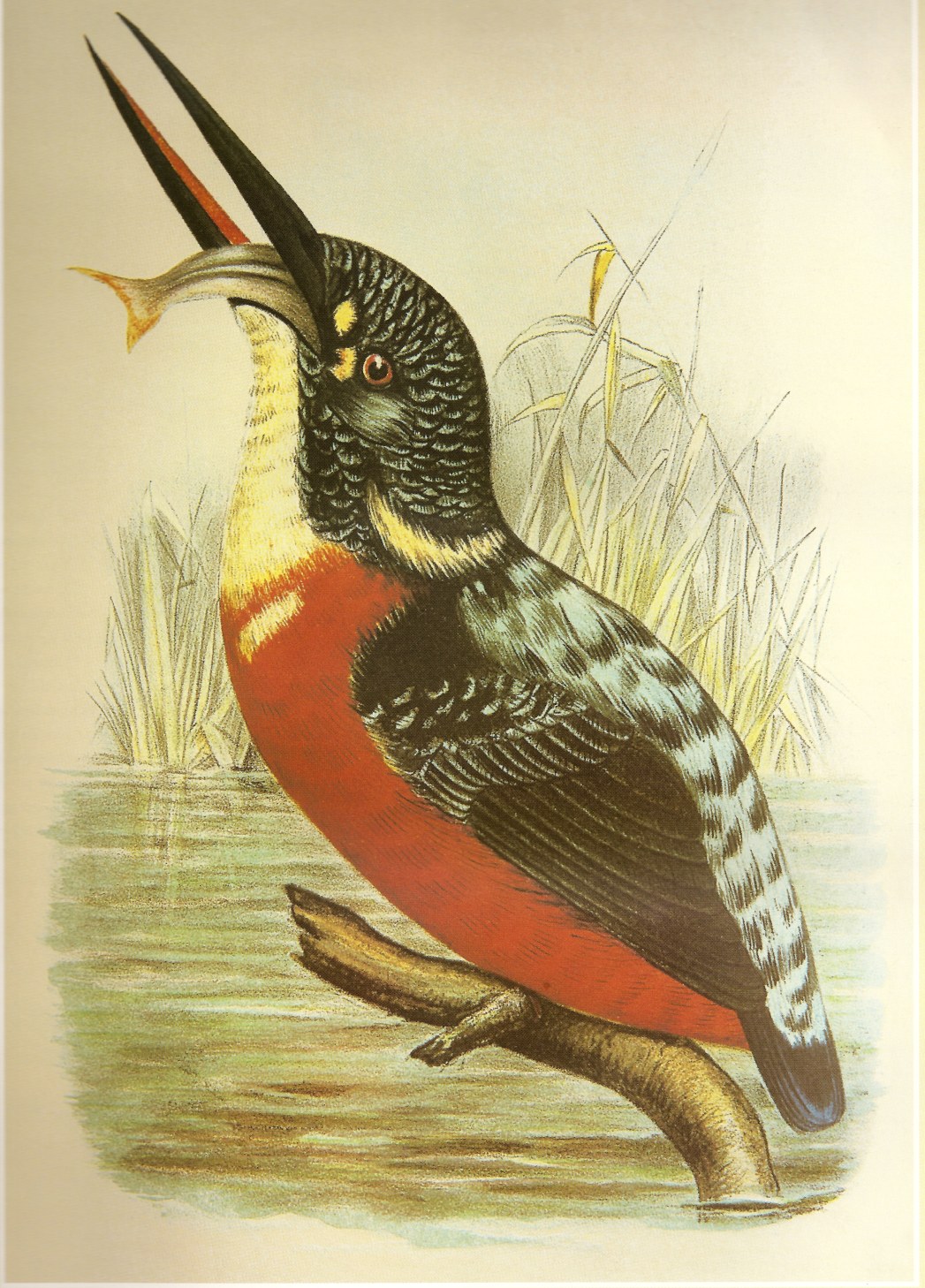
Blyth's kingfisher (Alcedo hercules) is the largest kingfisher in the genus Alcedo.
- Kingdom
- Animalia
- Phylum
- Chordata
- Class
- Aves
- Order
- Coraciiformes
- Family
- Alcedinidae
- Genus
- Alcedo
- Species
- Alcedo hercules
Description
Blyth's kingfisher (Alcedo hercules) is the largest kingfisher in the genus Alcedo. Named for Edward Blyth, the species has also been known as Alcedo grandis and as the great blue kingfisher. Between 22 and 23 cm (8+5⁄8 and 9 in) long, the kingfisher has deep rufous underparts with a blackish blue breast patch, and brilliant cobalt blue or azure upperparts, tinged with purple. The wings are a dark blackish green, with blue speckles and tips to some of the feathers. The bill of the male is entirely black, while the female has a dark red lower mandible. The species is distinguished from the similar blue-eared kingfisher (Alcedo meninting) and common kingfisher (Alcedo atthis) by its greater size, heavy black bill, and dark lores. The species breeds between the months of March and June. It builds nests at the end of tunnels dug in the banks of streams or ravines. Four to six eggs are laid, with both sexes incubating. A shy bird, it frequents small waterways, feeding on fish and insects caught by diving from a shrub close to the water. It is found along streams in evergreen forest and adjacent open country between 200 and 1,200 m (660 and 3,900 ft), mainly between 400 and 1,000 m (1,300 and 3,300 ft). The species ranges from Nepal through India, Bangladesh, Bhutan, China, Myanmar, Thailand, Laos, and Vietnam. Even within its preferred habitat the density of the species is low, and the population, though not thoroughly surveyed, is believed to be small, and declining further. The International Union for Conservation of Nature classifies it as "near threatened".
Gallery
Ajouter des photos
Partagez vos photos de cette espèce (jusqu'à 20 à la fois) : elles sont vérifiées automatiquement, puis publiées.
Répartition
Occurrences observées (données GBIF). Les zones hors aire d'origine peuvent indiquer une présence introduite ou invasive.
Sources et crédits
Informations provenant de plusieurs sources vérifiées. Dernière mise à jour : .
Crédits photos (6)
- Photo : E C Stuart Baker · Domaine public
- Photo : Manuel Ruedi (@manuel_ruedi) · CC BY-NC 4.0 · via iNaturalist
- Photo : @rohanmenzies · CC BY 4.0 · via iNaturalist
- Photo : @p_concolor · CC BY-NC 4.0 · via iNaturalist
- Photo : Rofikul Islam (@birdinghimalayas) · CC BY-NC 4.0 · via iNaturalist
- Photo : @shivaprakash · CC BY-NC 4.0 · via iNaturalist
Mentions de licence
Texte disponible sous licence CC BY-SA 4.0. Il adapte notamment Wikipedia (CC BY-SA) : Blyth's kingfisher (Wikipédia, auteurs dans l’historique de l’article).
- Taxonomie : GBIF Backbone Taxonomy (CC BY 4.0)
- Carte : occurrences GBIF, fond © contributeurs OpenStreetMap (ODbL)
- Statut de conservation : Liste rouge de l'UICN, via Wikidata (CC0)
Détail : Sources et licences.
Discussion (0)
Aucun message pour l’instant. Lancez la discussion sur cette fiche (sources, précisions, débats éditoriaux).
Connectez-vous pour participer à la discussion.