
Emperor Penguin
Aptenodytes forsteri
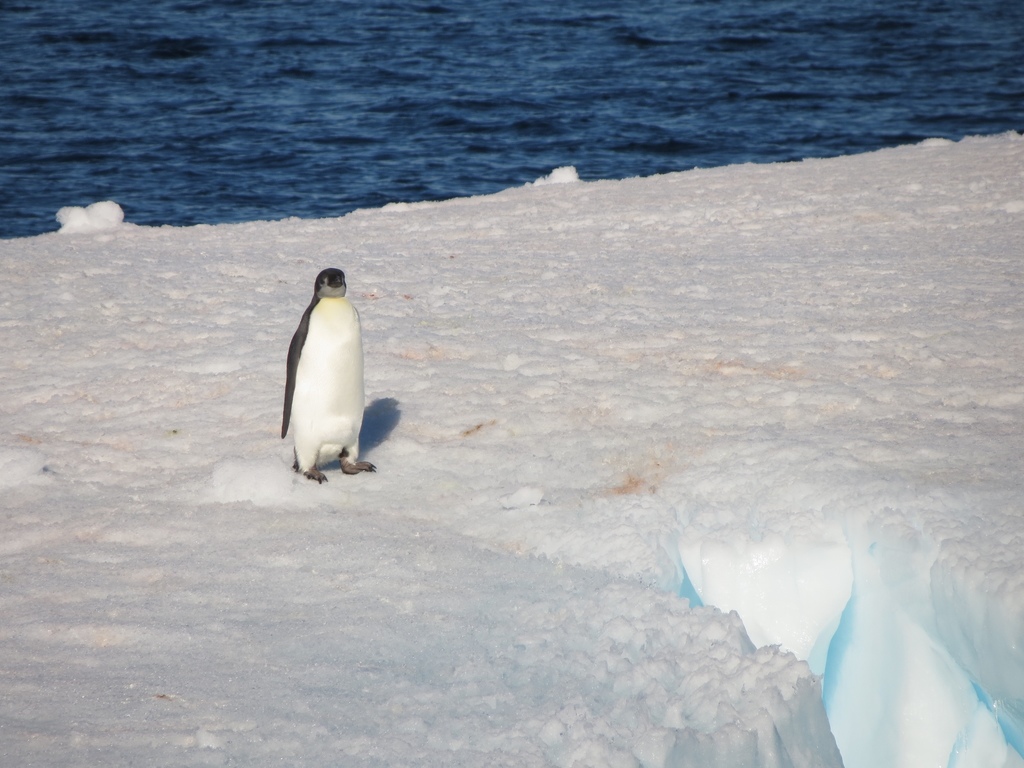
The emperor penguin (Aptenodytes forsteri) is the tallest and heaviest of all living penguin species and lives exclusively in Antarctica.
- Kingdom
- Animalia
- Phylum
- Chordata
- Class
- Aves
- Order
- Sphenisciformes
- Family
- Spheniscidae
- Genus
- Aptenodytes
- Species
- Aptenodytes forsteri
Description
The emperor penguin (Aptenodytes forsteri) is the tallest and heaviest of all living penguin species and lives exclusively in Antarctica. The male and female are similar in plumage and size, reaching 100 cm (39 in) in length and weighing from 22 to 45 kg (49 to 99 lb). Feathers of the head and back are black and sharply delineated from the white belly, pale-yellow breast and bright-yellow ear patches. Like all species of penguin, the emperor is flightless, with a streamlined body, and wings stiffened and flattened into flippers for a marine habitat. Its diet consists primarily of fish, but also includes crustaceans, such as krill, and cephalopods, such as squid. While hunting, the species can remain submerged around 20 minutes, diving to a depth of 535 m (1,755 ft). It has several adaptations to facilitate this, including an unusually structured haemoglobin to allow it to function at low oxygen levels, solid bones that reduce barotrauma, and the ability to reduce its metabolism and shut down non-essential organ functions. The only penguin species that breeds during the Antarctic winter, emperor penguins trek 50–120 km (31–75 mi) over the ice to breeding colonies which can contain up to several thousand individuals. The female lays a single egg, which is incubated for just over two months by the male while the female returns to the sea to feed; parents subsequently take turns foraging at sea and caring for their chick in the colony. The lifespan of an emperor penguin is typically 20 years in the wild, although observations suggest that some individuals may live as long as 50 years.
Gallery
Ajouter des photos
Partagez vos photos de cette espèce (jusqu'à 20 à la fois) : elles sont vérifiées automatiquement, puis publiées.
Répartition
Occurrences observées (données GBIF). Les zones hors aire d'origine peuvent indiquer une présence introduite ou invasive.
Sources et crédits
Informations provenant de plusieurs sources vérifiées. Dernière mise à jour : .
Crédits photos (5)
- Photo : @petrahallbauer · CC BY-NC 4.0 · via iNaturalist
- Photo : Peter Shanks (@botheredbybees) · CC0 (domaine public) · via iNaturalist
- Photo : Seig (@seigmond) · CC BY 4.0 · via iNaturalist
- Photo : Nigel Forshaw (@nigelforshaw) · CC BY-NC 4.0 · via iNaturalist
- Photo : Christopher Stephens (@christopherstephens) · CC BY 4.0 · via iNaturalist
Mentions de licence
Texte disponible sous licence CC BY-SA 4.0. Il adapte notamment Wikipedia (CC BY-SA) : Emperor penguin (Wikipédia, auteurs dans l’historique de l’article).
- Taxonomie : GBIF Backbone Taxonomy (CC BY 4.0)
- Carte : occurrences GBIF, fond © contributeurs OpenStreetMap (ODbL)
- Statut de conservation : Liste rouge de l'UICN, via Wikidata (CC0)
Détail : Sources et licences.
Discussion (0)
Aucun message pour l’instant. Lancez la discussion sur cette fiche (sources, précisions, débats éditoriaux).
Connectez-vous pour participer à la discussion.