
Pin-tailed Manakin
Ilicura militaris
The pin-tailed manakin (Ilicura militaris) is a suboscine species of bird within the manakin family, Pipridae.
- Kingdom
- Animalia
- Phylum
- Chordata
- Class
- Aves
- Order
- Passeriformes
- Family
- Pipridae
- Genus
- Ilicura
- Species
- Ilicura militaris
Description
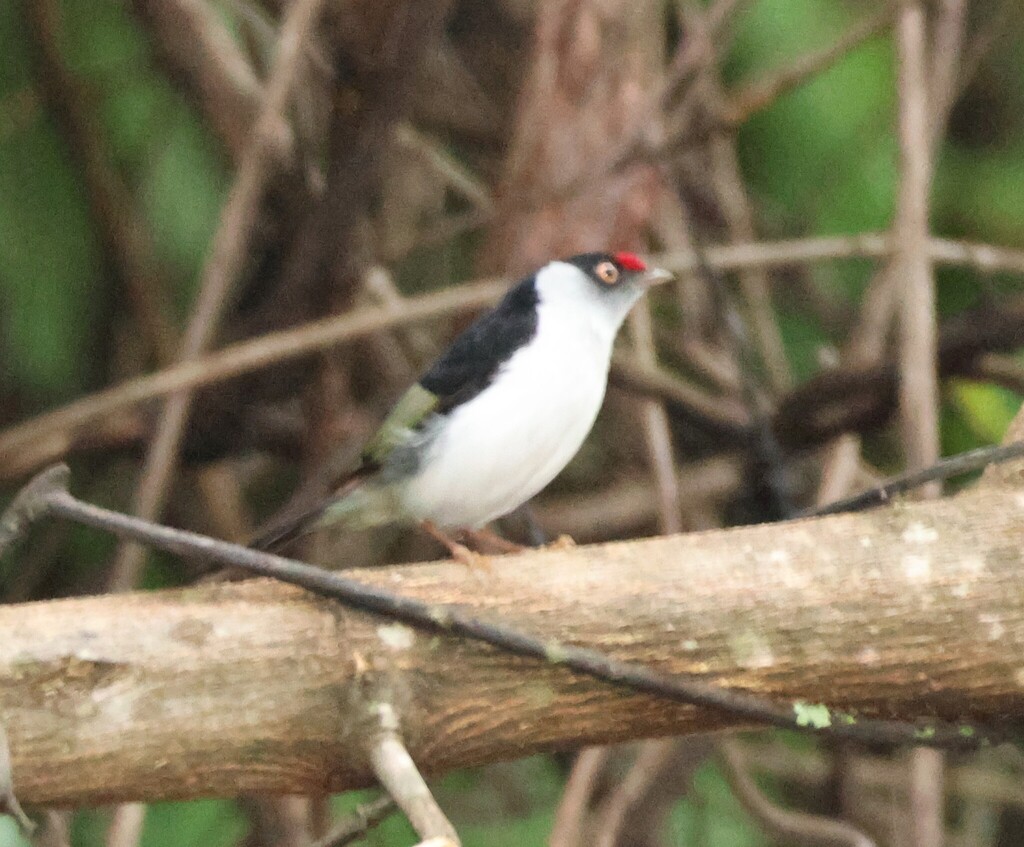
The pin-tailed manakin (Ilicura militaris) is a suboscine species of bird within the manakin family, Pipridae. This species is endemic to the Eastern coast of Brazil within the humid Atlantic Forest, and its range extends from the State of Bahia to the State of Rio Grande Do Sul. The pin-tailed manakin is monotypic within the genus Ilicura, and has no known subspecies. It is a relatively small species that has pronounced sexual dimorphism. Male birds of this species have a bright white neck, chest, auriculars, and flanks. They have black and dark-green wings, with a signature pin shape tail that has a small fork near the tip, helping to give it its common name in English. The males are most easily identified by their characteristically vibrant red fore-crown and rump. The females of this species are a muted green, except for their neck and auriculars-which are light grey, and their cream-colored chest. Both male and female birds of this species share a slightly elongated head shape that gives them a distinguished raised forehead. The pin-tailed manakin's vocalizations are quiet, but resemble a high-pitched "see-see-see" in descending tones. There has been very little research conducted on this species of manakin, and it especially lacks information on its ecology and breeding habits. The pin-tailed manakin is a primary frugivore, but it has been recorded consuming small amounts of insects on occasion. The diet is relatively unknown, but is hypothesized to be able to transform the keto-carotenoids found within its diet into rhodoxanthin, a rare pigment in animals, that gives this bird its signature red color. The pin-tailed manakin has an elaborate courtship ritual called lekking, and is suspected to breed sometime between November and February. This bird is non-migratory, and its conservation status is currently least concern, but its population numbers are hypothesized to be in decline.
Gallery
Ajouter des photos
Partagez vos photos de cette espèce (jusqu'à 20 à la fois) : elles sont vérifiées automatiquement, puis publiées.
Répartition
Occurrences observées (données GBIF). Les zones hors aire d'origine peuvent indiquer une présence introduite ou invasive.
Sources et crédits
Informations provenant de plusieurs sources vérifiées. Dernière mise à jour : .
Crédits photos (8)
- Photo : Paulo Gonçalves Carvalho (@paulogcarvalho) · CC BY-NC 4.0 · via iNaturalist
- Photo : Matheus M. Santos (@matheusmsantos) · CC BY-NC 4.0 · via iNaturalist
- Photo : Nil Rodrigues (@nilrodrigues) · CC BY-NC 4.0 · via iNaturalist
- Photo : @agujaceratops · CC BY 4.0 · via iNaturalist
- Photo : Laura Gaudette (@gaudettelaura) · CC BY 4.0 · via iNaturalist
- Photo : @rshewack · CC BY-NC 4.0 · via iNaturalist
- Photo : Leonardo Breder Passalacqua (@leobreder) · CC BY-NC 4.0 · via iNaturalist
- Photo : Monitores PEC (@monitorespec) · CC BY-NC 4.0 · via iNaturalist
Mentions de licence
Texte disponible sous licence CC BY-SA 4.0. Il adapte notamment Wikipedia (CC BY-SA) : Pin-tailed manakin (Wikipédia, auteurs dans l’historique de l’article).
- Taxonomie : GBIF Backbone Taxonomy (CC BY 4.0)
- Carte : occurrences GBIF, fond © contributeurs OpenStreetMap (ODbL)
- Statut de conservation : Liste rouge de l'UICN, via Wikidata (CC0)
Détail : Sources et licences.
Discussion (0)
Aucun message pour l’instant. Lancez la discussion sur cette fiche (sources, précisions, débats éditoriaux).
Connectez-vous pour participer à la discussion.