
Bohemian Waxwing
Bombycilla garrulus
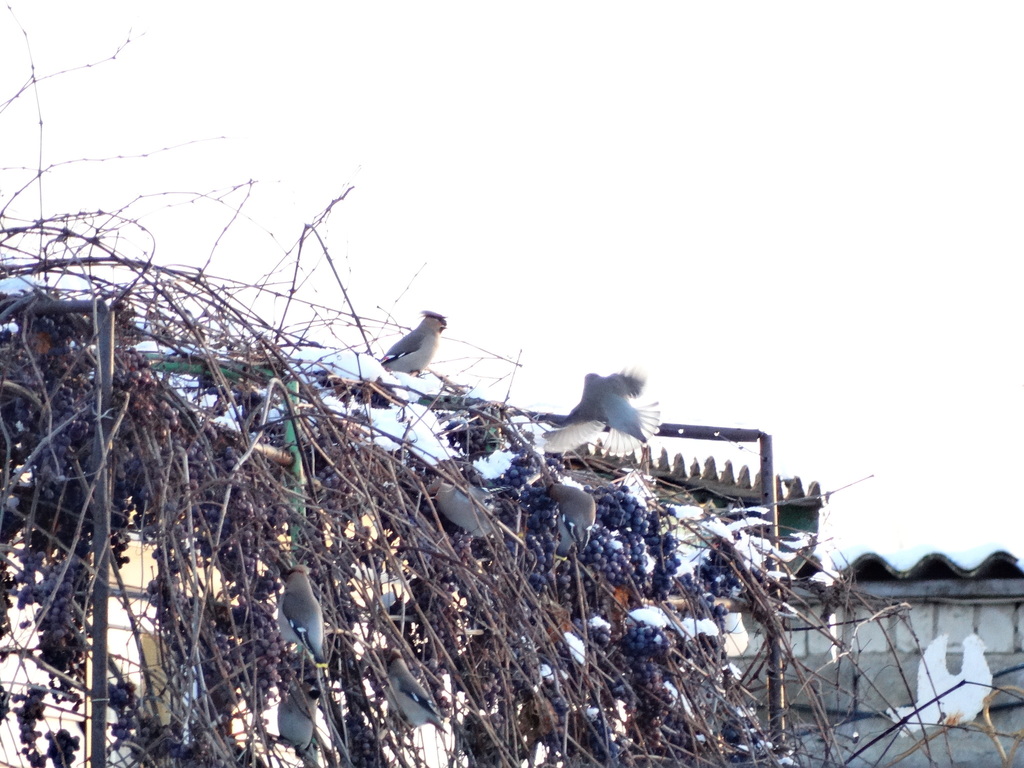
The Bohemian waxwing (Bombycilla garrulus) is a starling-sized passerine bird that breeds in the northern forests of the Palearctic and North America.
- Kingdom
- Animalia
- Phylum
- Chordata
- Class
- Aves
- Order
- Passeriformes
- Family
- Bombycillidae
- Genus
- Bombycilla
- Species
- Bombycilla garrulus
Description
The Bohemian waxwing (Bombycilla garrulus) is a starling-sized passerine bird that breeds in the northern forests of the Palearctic and North America. It has mainly buff-grey plumage, black face markings and a pointed crest. Its wings are patterned with white and bright yellow, and some of the wing feathers have red tips, the resemblance of which to sealing wax gives these birds their common name. The two or three subspecies show only minor differences in appearance. Females are similar to males, although young birds are less well-marked and have few or no waxy wingtips. Although the Bohemian waxwing's range overlaps those of the cedar and Japanese waxwings, it is easily distinguished from them by size and plumage differences. The breeding habitat is coniferous forests, usually near water. The pair build a lined cup-shaped nest in a tree or bush, often close to the trunk. The clutch of 3–7 eggs is incubated by the female alone for 13–14 days to hatching. The chicks are altricial and naked, and are fed by both parents, initially mostly with insects, but thereafter mainly fruit. They fledge about 14–16 days after leaving the egg. Many birds desert their nesting range in winter and migrate farther south. In some years, large numbers of Bohemian waxwings irrupt well beyond their normal winter range in search of the fruit that makes up most of their diet. Waxwings can be very tame in winter, entering towns and gardens in search of food, rowan berries being a particular favourite. They can metabolise alcohol produced in fermenting fruit, but can still become intoxicated, sometimes fatally. Other hazards include predation by birds of prey, infestation by parasites, and collisions with cars or windows. The large numbers and very large breeding area mean that it is classified as being of least concern by the International Union for Conservation of Nature.
Gallery
Ajouter des photos
Partagez vos photos de cette espèce (jusqu'à 20 à la fois) : elles sont vérifiées automatiquement, puis publiées.
Répartition
Occurrences observées (données GBIF). Les zones hors aire d'origine peuvent indiquer une présence introduite ou invasive.
Sources et crédits
Informations provenant de plusieurs sources vérifiées. Dernière mise à jour : .
Crédits photos (8)
- Photo : @ekaterinamakrenkova · CC BY-NC 4.0 · via iNaturalist
- Photo : Александр Химин (@aleks-khimin) · CC BY-NC 4.0 · via iNaturalist
- Photo : Алина Боксорн (@alinaboksorn) · CC BY-NC 4.0 · via iNaturalist
- Photo : Serych (@serycherny) · CC BY-NC 4.0 · via iNaturalist
- Photo : Наталия Зуева (@nat_zouieva) · CC BY-NC 4.0 · via iNaturalist
- Photo : Елена (@elacrimarum) · CC BY-NC 4.0 · via iNaturalist
- Photo : @village_meatball · CC BY-NC 4.0 · via iNaturalist
- Photo : Ксения Волянская (@ksanavolya) · CC BY 4.0 · via iNaturalist
Mentions de licence
Texte disponible sous licence CC BY-SA 4.0. Il adapte notamment Wikipedia (CC BY-SA) : Bohemian waxwing (Wikipédia, auteurs dans l’historique de l’article).
- Taxonomie : GBIF Backbone Taxonomy (CC BY 4.0)
- Carte : occurrences GBIF, fond © contributeurs OpenStreetMap (ODbL)
- Statut de conservation : Liste rouge de l'UICN, via Wikidata (CC0)
Détail : Sources et licences.
Discussion (0)
Aucun message pour l’instant. Lancez la discussion sur cette fiche (sources, précisions, débats éditoriaux).
Connectez-vous pour participer à la discussion.