
Southern Bald Ibis
Geronticus calvus
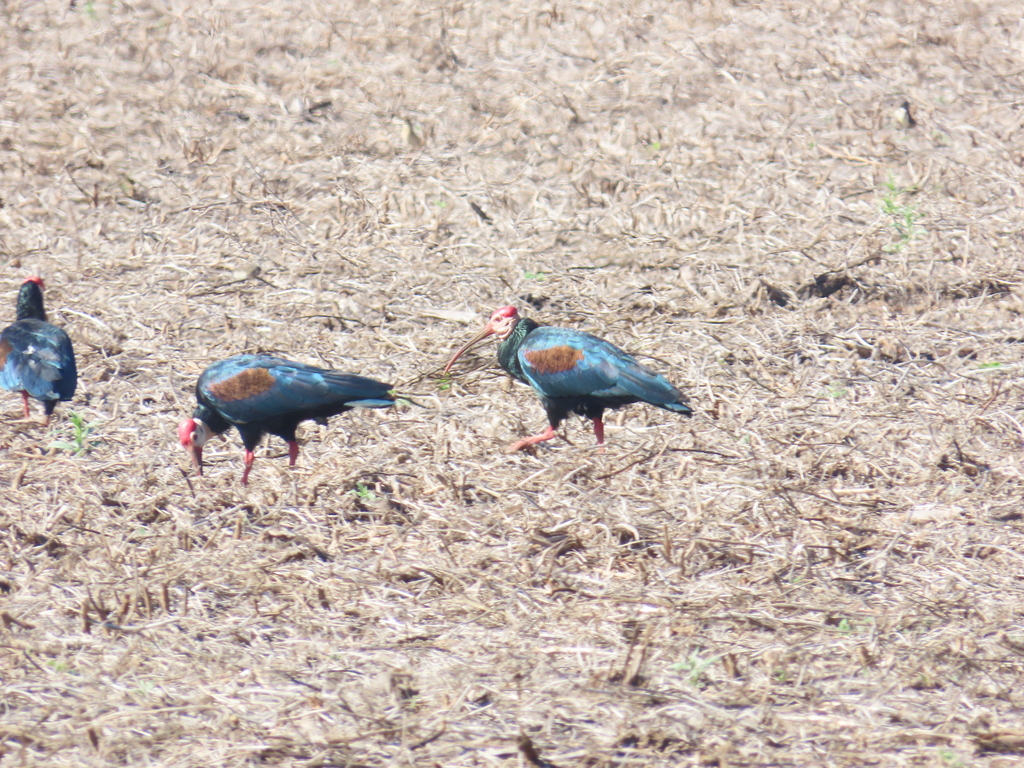
The southern bald ibis (Geronticus calvus) is a large bird found in open grassland or semi-desert in the mountains of southern Africa.
- Kingdom
- Animalia
- Phylum
- Chordata
- Class
- Aves
- Order
- Pelecaniformes
- Family
- Threskiornithidae
- Genus
- Geronticus
- Species
- Geronticus calvus
Description
The southern bald ibis (Geronticus calvus) is a large bird found in open grassland or semi-desert in the mountains of southern Africa. Taxonomically, it is most closely related to its counterpart in the northern regions of Africa, the waldrapp (Geronticus eremita). As a species, it has a very restricted homerange, limited to the southern tips of South Africa in highland and mountainous regions. This large, glossy, blue-black ibis has an unfeathered red face and head, and a long, decurved red bill. It breeds colonially on and amongst rocks and on cliffs, laying two or three eggs which are incubated for 21 days before hatching. It is a large bird that feeds and roosts in substantial groups. It feeds on insects, small reptiles, rodents and small birds. They do little vocalizing other than occasional gobbling sounds. The ibises are gregarious long-legged wading birds with long down-curved bills; they form one subfamily of the Threskiornithidae, the other subfamily being the spoonbills. The two Geronticus species differ from other ibises in that they have unfeathered faces and heads, breed on cliffs rather than in trees, and prefer arid habitats to the wetlands used by their relatives. The species is currently listed as near threatened on the IUCN Red List, however, it is in no immediate danger of extinction.
Gallery
Ajouter des photos
Partagez vos photos de cette espèce (jusqu'à 20 à la fois) : elles sont vérifiées automatiquement, puis publiées.
Répartition
Occurrences observées (données GBIF). Les zones hors aire d'origine peuvent indiquer une présence introduite ou invasive.
Sources et crédits
Informations provenant de plusieurs sources vérifiées. Dernière mise à jour : .
Crédits photos (8)
- Photo : @jderasmus · CC BY-NC 4.0 · via iNaturalist
- Photo : Phillip Nieuwoudt (@ecowild) · CC BY-NC 4.0 · via iNaturalist
- Photo : Sarah Taylor (@taylorse) · CC BY-NC 4.0 · via iNaturalist
- Photo : Richard Johnstone (@richard_johnstone) · CC BY-NC 4.0 · via iNaturalist
- Photo : @dominiquev · CC BY-NC 4.0 · via iNaturalist
- Photo : Dan Jones (@antshrike1) · CC BY-NC 4.0 · via iNaturalist
- Photo : Jay Pruett (@greenjay6) · CC BY 4.0 · via iNaturalist
- Photo : Dewald du Plessis (@dewald2) · CC BY-NC 4.0 · via iNaturalist
Mentions de licence
Texte disponible sous licence CC BY-SA 4.0. Il adapte notamment Wikipedia (CC BY-SA) : Southern bald ibis (Wikipédia, auteurs dans l’historique de l’article).
- Taxonomie : GBIF Backbone Taxonomy (CC BY 4.0)
- Carte : occurrences GBIF, fond © contributeurs OpenStreetMap (ODbL)
- Statut de conservation : Liste rouge de l'UICN, via Wikidata (CC0)
Détail : Sources et licences.
Discussion (0)
Aucun message pour l’instant. Lancez la discussion sur cette fiche (sources, précisions, débats éditoriaux).
Connectez-vous pour participer à la discussion.