
American White Ibis
Eudocimus albus
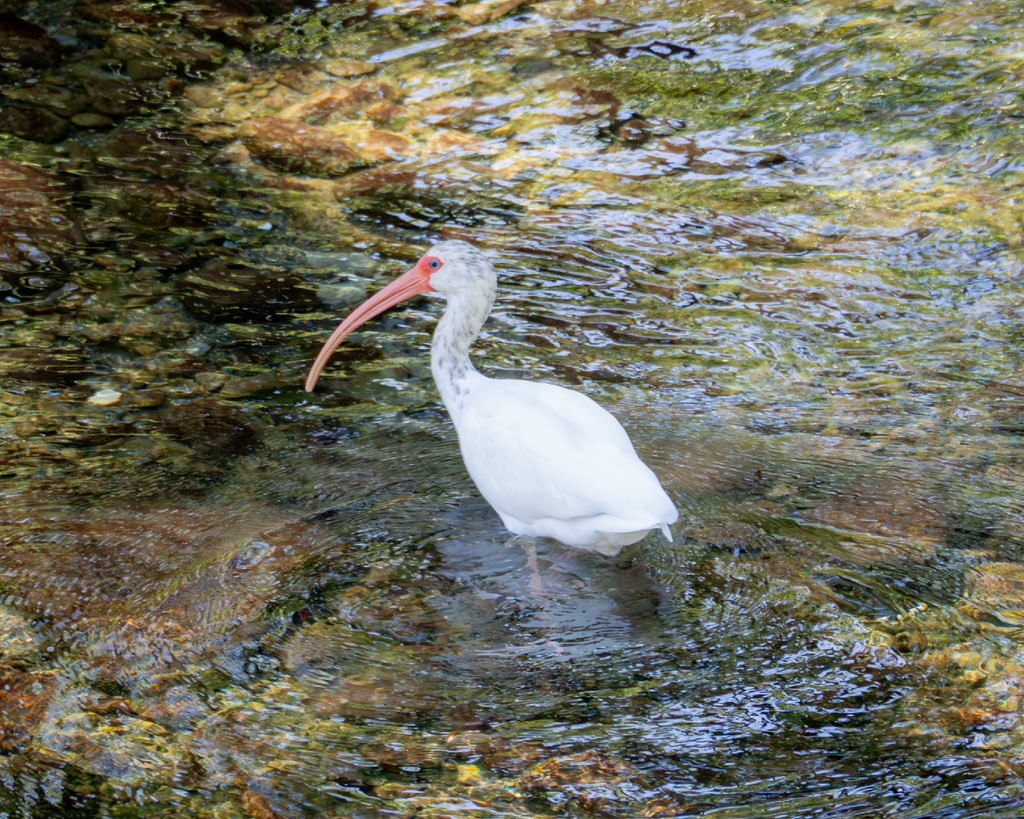
The American white ibis (Eudocimus albus) is a species of bird in the ibis family, Threskiornithidae.
- Kingdom
- Animalia
- Phylum
- Chordata
- Class
- Aves
- Order
- Pelecaniformes
- Family
- Threskiornithidae
- Genus
- Eudocimus
- Species
- Eudocimus albus
Description
The American white ibis (Eudocimus albus) is a species of bird in the ibis family, Threskiornithidae. It is found from the southern half of the US East Coast (from southern New Jersey to Georgia), along the Gulf Coast states (Florida, Alabama, Mississippi, Louisiana and Texas) and south through most of the Caribbean coastal regions of Central America. This particular ibis species is a medium-sized wading bird, possessing an overall white plumage with black wing-tips (usually only visible in flight), and having the typical downward-curving bill of the ibises, though of a bright red-orange color, the same hue as its long legs. Males are larger and have longer bills than females. The breeding range runs along the Gulf and Atlantic Coast, and the coasts of Mexico and Central America. Outside the breeding period, the range extends further inland in North America and also includes the Caribbean. It is also found along the northwestern South American coastline in Colombia and Venezuela. Populations in central Venezuela overlap and interbreed with the scarlet ibis. The two have been classified by some authorities as a single species. Their diet consists primarily of small aquatic prey, such as insects and small fishes. Crayfish are its preferred food in most regions, but it can adjust its diet according to the habitat and prey abundance. Its main foraging behavior is probing with its beak at the bottom of shallow water to feel for and capture its prey. It does not see the prey. During the breeding season, the American white ibis gathers in huge colonies near water. Pairs are predominantly monogamous and both parents care for the young, although males tend to engage in extra-pair copulation with other females to increase their reproductive success. Males have also been found to pirate food from unmated females and juveniles during the breeding season. Human pollution has affected the behavior of the American white ibis via an increase in the concentrations of methylmercury, which is released into the environment from untreated waste. Exposure to methylmercury alters the hormone levels of American white ibis, affecting their mating and nesting behavior and leading to lower reproduction rates.
Gallery
Ajouter des photos
Partagez vos photos de cette espèce (jusqu'à 20 à la fois) : elles sont vérifiées automatiquement, puis publiées.
Répartition
Occurrences observées (données GBIF). Les zones hors aire d'origine peuvent indiquer une présence introduite ou invasive.
Sources et crédits
Informations provenant de plusieurs sources vérifiées. Dernière mise à jour : .
Crédits photos (8)
- Photo : Diego Pino (@diegopino94) · CC BY-NC 4.0 · via iNaturalist
- Photo : Ermilo López-Cobá (@milohongo76) · CC BY-NC 4.0 · via iNaturalist
- Photo : Russell James (@russell16055) · CC BY-NC 4.0 · via iNaturalist
- Photo : @nachovallarta · CC BY-NC 4.0 · via iNaturalist
- Photo : @charley · CC BY-NC 4.0 · via iNaturalist
- Photo : JeffreyGammon (@kingmush) · CC BY-NC 4.0 · via iNaturalist
- Photo : @sschiereck · CC BY-NC 4.0 · via iNaturalist
- Photo : Rich Kostecke (@rkostecke) · CC BY-NC 4.0 · via iNaturalist
Mentions de licence
Texte disponible sous licence CC BY-SA 4.0. Il adapte notamment Wikipedia (CC BY-SA) : American white ibis (Wikipédia, auteurs dans l’historique de l’article).
- Taxonomie : GBIF Backbone Taxonomy (CC BY 4.0)
- Carte : occurrences GBIF, fond © contributeurs OpenStreetMap (ODbL)
- Statut de conservation : Liste rouge de l'UICN, via Wikidata (CC0)
Détail : Sources et licences.
Discussion (0)
Aucun message pour l’instant. Lancez la discussion sur cette fiche (sources, précisions, débats éditoriaux).
Connectez-vous pour participer à la discussion.