
Australian White Ibis
Threskiornis molucca
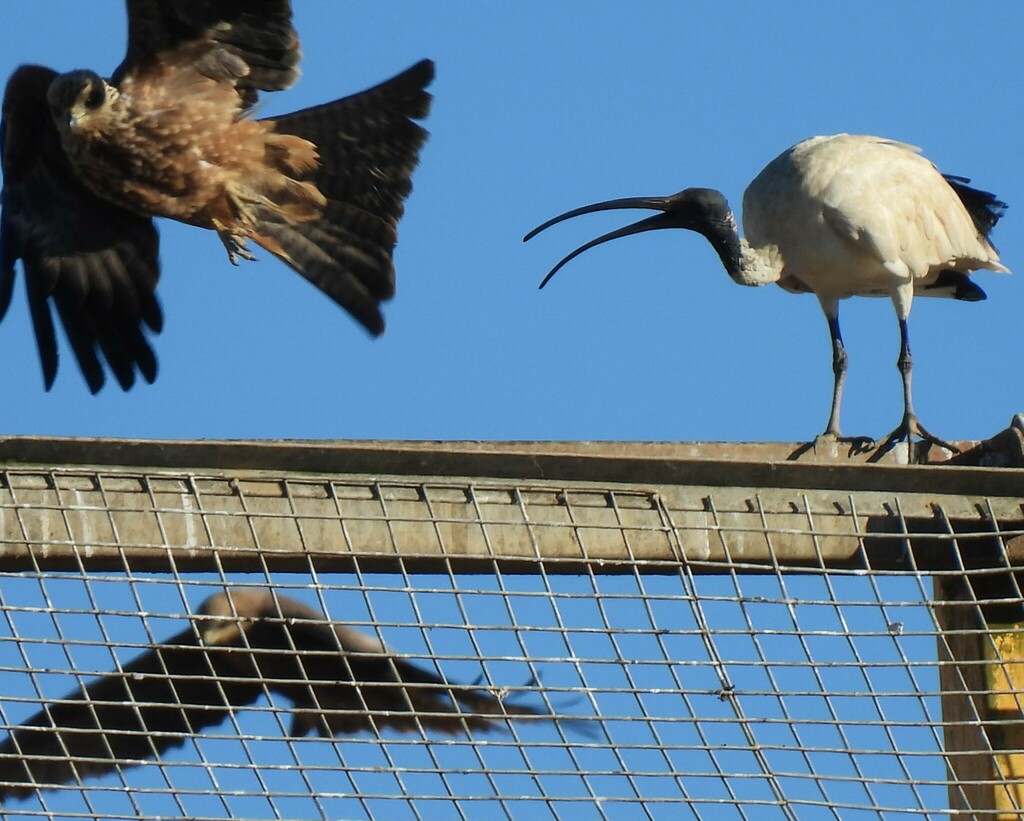
The Australian white ibis (Threskiornis molucca) , commonly known as the bin chicken, is a wading bird of the family Threskiornithidae.
- Kingdom
- Animalia
- Phylum
- Chordata
- Class
- Aves
- Order
- Pelecaniformes
- Family
- Threskiornithidae
- Genus
- Threskiornis
- Species
- Threskiornis molucca
Description
The Australian white ibis (Threskiornis molucca) , commonly known as the bin chicken, is a wading bird of the family Threskiornithidae. It is widespread across much of Australia. It has a predominantly white plumage with a bare, black head, long downcurved bill, and black legs. While it is closely related to the African sacred ibis, the Australian white ibis is a native Australian bird. Contrary to urban myth, it is not a feral species introduced to Australia by people, and it does not come from Egypt. Historically rare in urban areas, the Australian white ibis has established in urban areas of the east coast in increasing numbers since the late 1970s; it is now commonly seen in Wollongong, Sydney, Melbourne, Adelaide, Darwin, the Gold Coast, Brisbane and Townsville. In recent years, the bird has also become increasingly common in Perth, Western Australia, and surrounding towns in south-western Australia. Populations have disappeared from natural breeding areas such as the Macquarie Marshes in northern New South Wales. Management plans have been introduced to control problematic urban populations in Sydney. Due to their commonality in urban areas, and their habit of rummaging in outside garbage, the species has acquired a variety of names, including "tip turkey" and "bin chicken".
Gallery
Ajouter des photos
Partagez vos photos de cette espèce (jusqu'à 20 à la fois) : elles sont vérifiées automatiquement, puis publiées.
Répartition
Occurrences observées (données GBIF). Les zones hors aire d'origine peuvent indiquer une présence introduite ou invasive.
Sources et crédits
Informations provenant de plusieurs sources vérifiées. Dernière mise à jour : .
Crédits photos (8)
- Photo : Jeff Giddins (@jeff1159) · CC BY-NC 4.0 · via iNaturalist
- Photo : Always Amity (@beautiful_gudrun) · CC BY-NC 4.0 · via iNaturalist
- Photo : Mononymous (@mononymous) · CC BY-NC 4.0 · via iNaturalist
- Photo : @neilhenry · CC BY-NC 4.0 · via iNaturalist
- Photo : Paul Tavares (@paultavares) · CC BY-NC 4.0 · via iNaturalist
- Photo : Belinda Forbes (@gemfyre713) · CC BY 4.0 · via iNaturalist
- Photo : Sharon Dodd (@sharondodd) · CC BY-NC 4.0 · via iNaturalist
- Photo : @tonyslater · CC BY-NC 4.0 · via iNaturalist
Mentions de licence
Texte disponible sous licence CC BY-SA 4.0. Il adapte notamment Wikipedia (CC BY-SA) : Australian white ibis (Wikipédia, auteurs dans l’historique de l’article).
- Taxonomie : GBIF Backbone Taxonomy (CC BY 4.0)
- Carte : occurrences GBIF, fond © contributeurs OpenStreetMap (ODbL)
- Statut de conservation : Liste rouge de l'UICN, via Wikidata (CC0)
Détail : Sources et licences.
Discussion (0)
Aucun message pour l’instant. Lancez la discussion sur cette fiche (sources, précisions, débats éditoriaux).
Connectez-vous pour participer à la discussion.