
Huia
Heteralocha acutirostris
The huia ( HOO-yə, -ee-ə; Māori: [ˈhʉia]; Heteralocha acutirostris) is an extinct species of New Zealand wattlebird, endemic to the North Island of New Zealand.
- Kingdom
- Animalia
- Phylum
- Chordata
- Class
- Aves
- Order
- Passeriformes
- Family
- Callaeatidae
- Genus
- Heteralocha
- Species
- Heteralocha acutirostris
Description
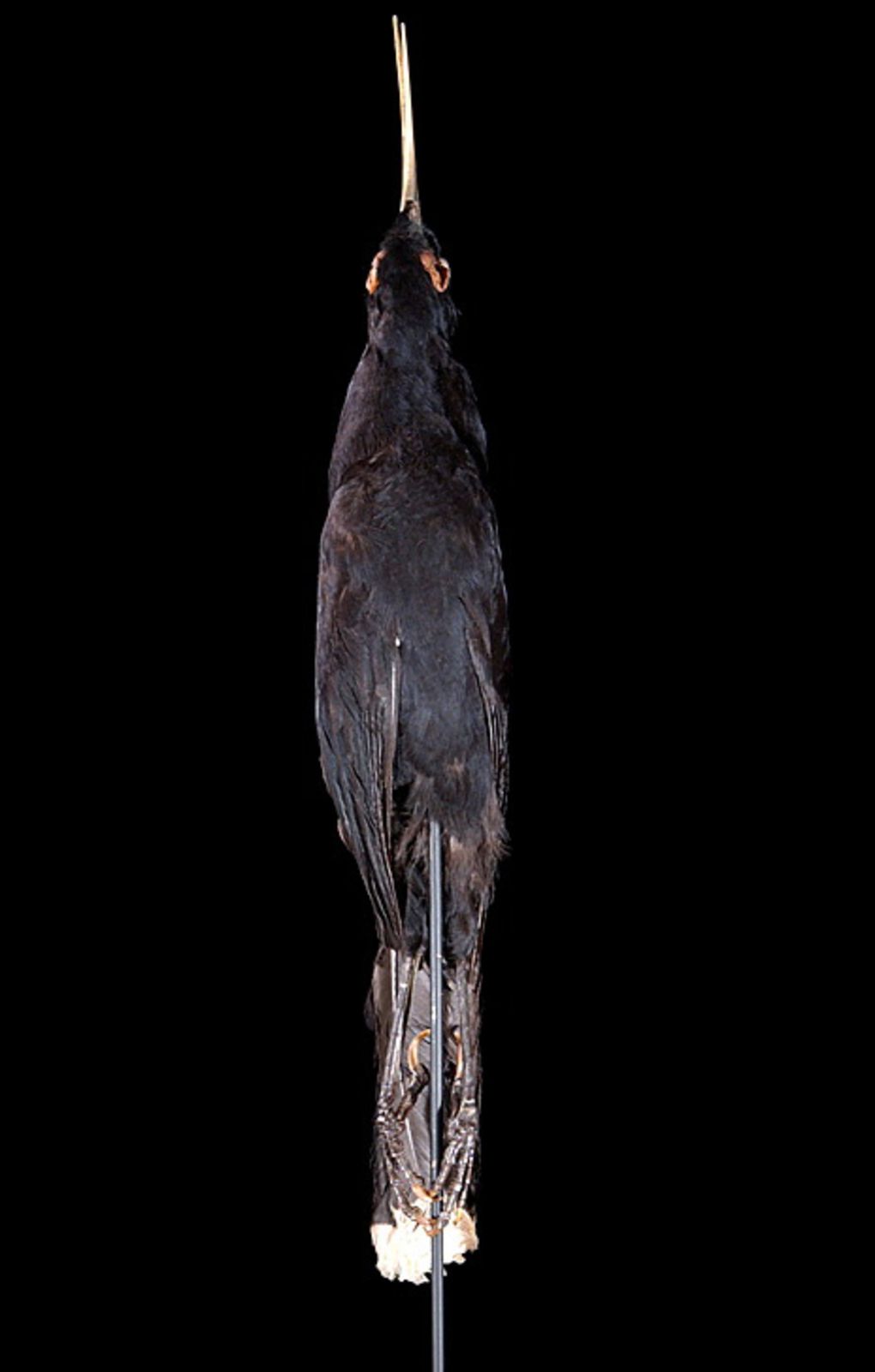
The huia ( HOO-yə, -ee-ə; Māori: [ˈhʉia]; Heteralocha acutirostris) is an extinct species of New Zealand wattlebird, endemic to the North Island of New Zealand. The last confirmed sighting of a huia was in 1907, although there was another credible sighting in 1924. It was already a rare bird before the arrival of Europeans, confined to the Ruahine, Tararua, Rimutaka and Kaimanawa mountain ranges in the south-east of the North Island. It was remarkable for its pronounced sexual dimorphism in bill shape; the female's beak was long, thin and arched downward, while the male's was short and stout, like that of a crow. Males were 45 cm (18 in) long, while females were larger at 48 cm (19 in). The sexes were otherwise similar, with orange wattles and deep metallic, bluish-black plumage with a greenish iridescence on the upper surface, especially about the head. The tail feathers were unique among New Zealand birds in having a broad white band across the tips. The birds lived in forests at both montane and lowland elevations – they are thought to have moved seasonally, living at higher elevations in summer and descending to lower elevations in winter. Huia were omnivorous and ate adult insects, grubs and spiders, as well as the fruits of a small number of native plants. Males and females used their beaks to feed in different ways: the male used his bill to chisel away at rotting wood, while the female's longer, more flexible bill was able to probe deeper areas. Even though the huia is frequently mentioned in biology and ornithology textbooks because of this striking dimorphism, not much is known about its biology; it was little studied before going extinct. The huia is one of New Zealand's best-known extinct birds because of its bill shape and beauty, as well as its special place in Māori culture and oral tradition. The bird was regarded by Māori as tapu (sacred), and the wearing of its skin or feathers was reserved for people of high status.
Gallery
Ajouter des photos
Partagez vos photos de cette espèce (jusqu'à 20 à la fois) : elles sont vérifiées automatiquement, puis publiées.
Répartition
Occurrences observées (données GBIF). Les zones hors aire d'origine peuvent indiquer une présence introduite ou invasive.
Sources et crédits
Informations provenant de plusieurs sources vérifiées. Dernière mise à jour : .
Crédits photos (10)
- Photo : Naturalis Biodiversity Center · CC0 (domaine public) · via GBIF
- Photo : Naturalis Biodiversity Center · CC0 (domaine public) · via GBIF
- Photo : Division of Birds · CC0 (domaine public) · via GBIF
- Photo : Mr Jacobs · CC BY 4.0 · via GBIF
- Photo : Mr Jacobs · CC BY 4.0 · via GBIF
- Photo : Lars Erik Johannessen, NHM Oslo · CC BY 4.0 · via GBIF
- Photo : NHM · CC BY 4.0 · via GBIF
- Photo : Lars Erik Johannessen, NHM Oslo · CC BY 4.0 · via GBIF
- Photo : Lars Erik Johannessen, NHM Oslo · CC BY 4.0 · via GBIF
- Photo : Anonyme · CC BY 4.0 · via GBIF
Mentions de licence
Texte disponible sous licence CC BY-SA 4.0. Il adapte notamment Wikipedia (CC BY-SA) : Huia (Wikipédia, auteurs dans l’historique de l’article).
- Taxonomie : GBIF Backbone Taxonomy (CC BY 4.0)
- Carte : occurrences GBIF, fond © contributeurs OpenStreetMap (ODbL)
- Statut de conservation : Liste rouge de l'UICN, via Wikidata (CC0)
Détail : Sources et licences.
Discussion (0)
Aucun message pour l’instant. Lancez la discussion sur cette fiche (sources, précisions, débats éditoriaux).
Connectez-vous pour participer à la discussion.