
Golden Swallow
Tachycineta euchrysea
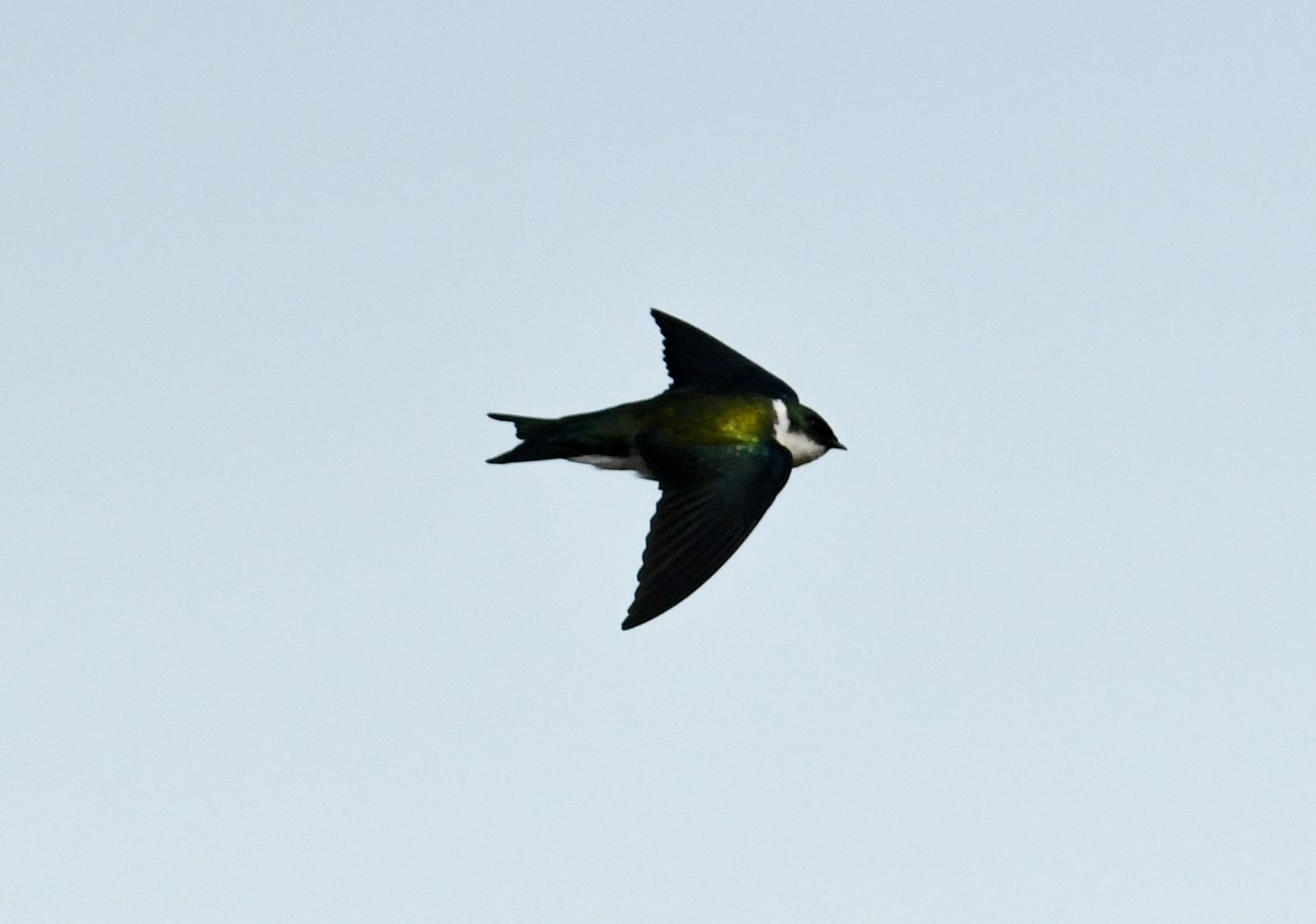
The golden swallow (Tachycineta euchrysea) is a swallow endemic to the Caribbean island of Hispaniola (split between the Dominican Republic and Haiti) and was once native to Jamaica, but is now extirpated there.
- Kingdom
- Animalia
- Phylum
- Chordata
- Class
- Aves
- Order
- Passeriformes
- Family
- Hirundinidae
- Genus
- Tachycineta
- Species
- Tachycineta euchrysea
Description
The golden swallow (Tachycineta euchrysea) is a swallow endemic to the Caribbean island of Hispaniola (split between the Dominican Republic and Haiti) and was once native to Jamaica, but is now extirpated there. It is restricted to isolated montane forests that primarily consist of the Hispaniolan pine (Pinus occidentalis). This species is considered to be a vulnerable species by the International Union for Conservation of Nature (IUCN). The exact cause of its extirpation from Jamaica is unknown, but likely factors include predation by introduced mammals and habitat loss, although the habitat loss theory is not supported by much evidence. The last sighting of the nominate subspecies was in Hardwar Gap (located on the boundary between Saint Andrew and Portland parishes), with three birds being seen on 8 June 1989. A relatively small swallow, the Jamaican subspecies had bronze upperparts and bronze sides of the head. The ears and lores were duller and the forehead area was more green than bronze. The shoulders, back, rump, and uppertail-coverts were, on the other hand, a coppery-bronze colour. The lesser and median coverts were more coppery, with the greater and primary-wing-coverts more of a dusky green. The primaries, secondaries, and tail were a dusky bronze-green. The underparts were mostly white. The legs, feet, and irides were dark brown, and the bill was black. The female was similar, but with its breast, and occasionally throat and undertail-coverts, mottled grey-brown. The juvenile was also mottled-grey brown, and duller overall. The Hispaniolan subspecies, T. e. sclateri, is primarily differentiated by its more deeply forked tail, blue-green forehead and uppertail-coverts, and blue-black wings and tail. In Hispaniola, this swallow breeds from April to July, where it lays a clutch consisting of two to four white eggs. It formerly bred from June to July in Jamaica. The eggs are laid in a cup nest that is mainly found in Hispaniolan pine. It also nests in caves, under the eaves of houses, in burned stands, and in nest boxes. This swallow is an aerial insectivore, foraging for insects at heights that are usually under 20 m (66 ft), and very rarely at heights over 30 m (98 ft). When foraging, it is known to explore most habitats except forests.
Gallery
Ajouter des photos
Partagez vos photos de cette espèce (jusqu'à 20 à la fois) : elles sont vérifiées automatiquement, puis publiées.
Répartition
Occurrences observées (données GBIF). Les zones hors aire d'origine peuvent indiquer une présence introduite ou invasive.
Sources et crédits
Informations provenant de plusieurs sources vérifiées. Dernière mise à jour : .
Crédits photos (10)
- Photo : David Chernack · CC BY-NC 4.0 · via GBIF
- Photo : David Chernack · CC BY-NC 4.0 · via GBIF
- Photo : Pedro Genaro Rodriguez · CC BY-NC 4.0 · via GBIF
- Photo : Juan Sangiovanni · CC BY-NC 4.0 · via GBIF
- Photo : Pedro Genaro Rodriguez · CC BY-NC 4.0 · via GBIF
- Photo : avocat · CC BY 4.0 · via GBIF
- Photo : abcdefgewing · CC BY-NC 4.0 · via GBIF
- Photo : Pedro Genaro Rodriguez · CC BY-NC 4.0 · via GBIF
- Photo : Margo Mora · CC BY-NC 4.0 · via GBIF
- Photo : alcedo77 · CC BY-NC 4.0 · via GBIF
Mentions de licence
Texte disponible sous licence CC BY-SA 4.0. Il adapte notamment Wikipedia (CC BY-SA) : Golden swallow (Wikipédia, auteurs dans l’historique de l’article).
- Taxonomie : GBIF Backbone Taxonomy (CC BY 4.0)
- Carte : occurrences GBIF, fond © contributeurs OpenStreetMap (ODbL)
- Statut de conservation : Liste rouge de l'UICN, via Wikidata (CC0)
Détail : Sources et licences.
Discussion (0)
Aucun message pour l’instant. Lancez la discussion sur cette fiche (sources, précisions, débats éditoriaux).
Connectez-vous pour participer à la discussion.