
Mascarene Martin
Phedina borbonica
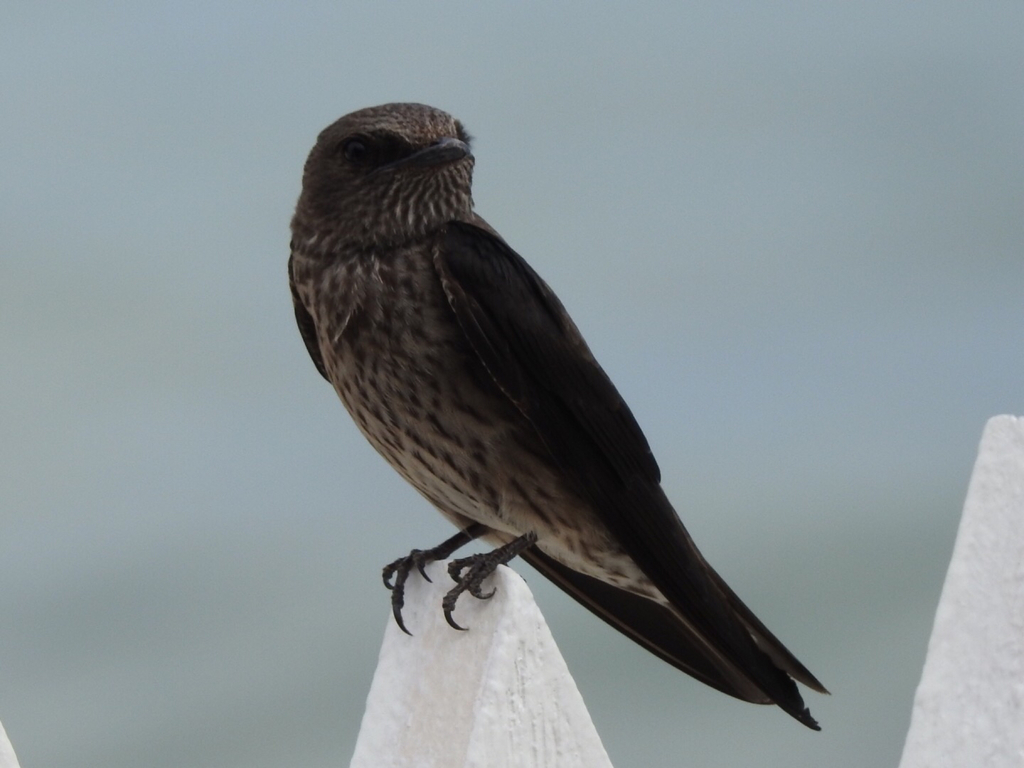
The Mascarene martin or Mascarene swallow (Phedina borbonica) is a passerine bird in the swallow family that breeds in Madagascar and in the Mascarene Islands.
- Kingdom
- Animalia
- Phylum
- Chordata
- Class
- Aves
- Order
- Passeriformes
- Family
- Hirundinidae
- Genus
- Phedina
- Species
- Phedina borbonica
Description
The Mascarene martin or Mascarene swallow (Phedina borbonica) is a passerine bird in the swallow family that breeds in Madagascar and in the Mascarene Islands. The nominate subspecies occurs on Mauritius and Réunion and has never been found away from the Mascarene Islands, but the smaller Madagascan subspecies, P. b. madagascariensis, is migratory and has been recorded wintering in East Africa or wandering to other Indian Ocean islands. The Mascarene martin is a small swallow that has grey-brown underparts becoming white on the throat and lower abdomen, dark grey-brown upperparts and a slightly forked tail. The underparts are heavily streaked with black. It nests in small colonies anywhere with suitably sheltered sites for constructing a nest, such as ledges, buildings, tunnels, caves or amongst rocks. The nest is a shallow cup of twigs and other plant material, and the normal clutch is two or three brown-spotted white eggs. The incubation and fledging times are unknown. The Mascarene martin has a heavy flight with slow wingbeats interspersed with glides, and frequently perches on wires. It feeds on insects in flight, often hunting low over the ground or vegetation. In eastern Africa, open habitats such as deforested areas are frequently used for hunting. A number of internal and external parasites have been detected in this species. Tropical cyclones can adversely affect populations on the smaller islands, but the Mascarene martin is a locally common bird with an apparently stable population and is classed as a species of Least Concern by the International Union for Conservation of Nature (IUCN). Its legal protection ranges from none on the French overseas department of Réunion to a status on Mauritius as a "species of wildlife in respect of which more severe penalties are provided".
Gallery
Ajouter des photos
Partagez vos photos de cette espèce (jusqu'à 20 à la fois) : elles sont vérifiées automatiquement, puis publiées.
Répartition
Occurrences observées (données GBIF). Les zones hors aire d'origine peuvent indiquer une présence introduite ou invasive.
Sources et crédits
Informations provenant de plusieurs sources vérifiées. Dernière mise à jour : .
Crédits photos (8)
- Photo : Richard Carlson (@rccarl) · CC BY-NC 4.0 · via iNaturalist
- Photo : Pieter Huybrechts (@pieterhuy) · CC0 (domaine public) · via iNaturalist
- Photo : Natalia Zakhartseva (@natali22206) · CC BY-NC 4.0 · via iNaturalist
- Photo : Pierre-Louis Stenger (@pl_stenger) · CC BY-NC 4.0 · via iNaturalist
- Photo : François Sandrin (@francois_sandrin) · CC BY-NC 4.0 · via iNaturalist
- Photo : Yash Bhagwanji (@ybhagwan) · CC BY-NC 4.0 · via iNaturalist
- Photo : Jacob Zinn (@cinco02000) · CC BY-NC 4.0 · via iNaturalist
- Photo : Decklan (@decklan) · CC BY-NC 4.0 · via iNaturalist
Mentions de licence
Texte disponible sous licence CC BY-SA 4.0. Il adapte notamment Wikipedia (CC BY-SA) : Mascarene martin (Wikipédia, auteurs dans l’historique de l’article).
- Taxonomie : GBIF Backbone Taxonomy (CC BY 4.0)
- Carte : occurrences GBIF, fond © contributeurs OpenStreetMap (ODbL)
- Statut de conservation : Liste rouge de l'UICN, via Wikidata (CC0)
Détail : Sources et licences.
Discussion (0)
Aucun message pour l’instant. Lancez la discussion sur cette fiche (sources, précisions, débats éditoriaux).
Connectez-vous pour participer à la discussion.