
Mangrove Swallow
Tachycineta albilinea
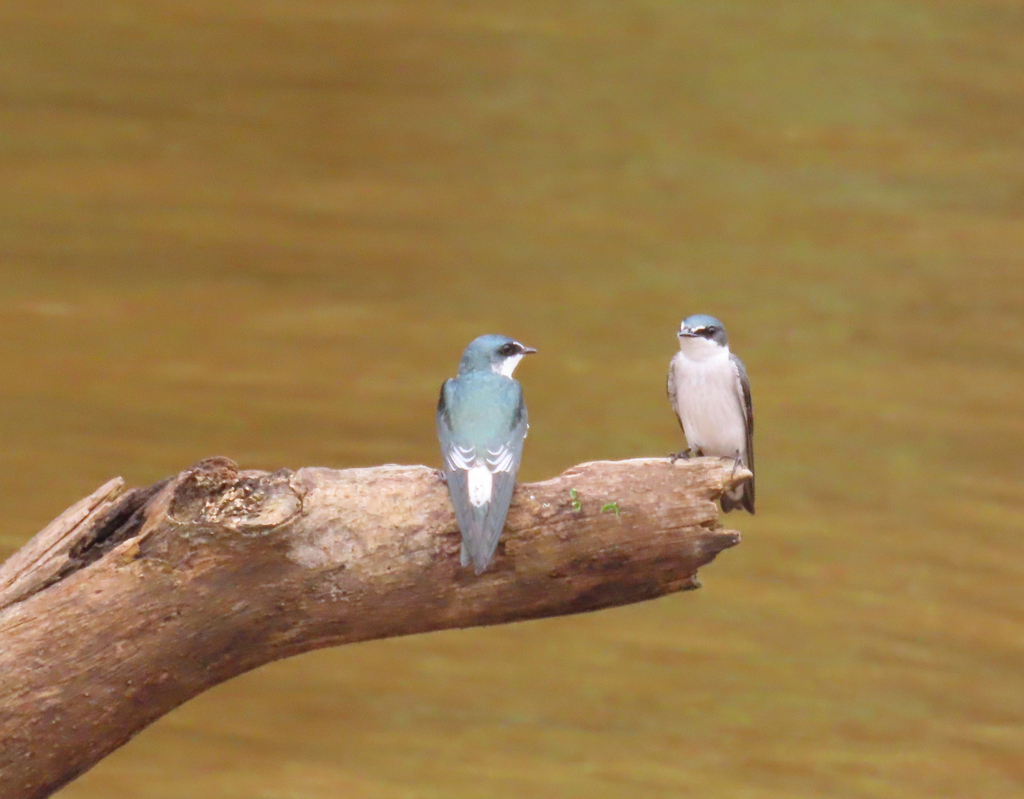
The mangrove swallow (Tachycineta albilinea) is a passerine bird in the swallow family that breeds in coastal regions from Mexico through Central America to Panama.
- Kingdom
- Animalia
- Phylum
- Chordata
- Class
- Aves
- Order
- Passeriformes
- Family
- Hirundinidae
- Genus
- Tachycineta
- Species
- Tachycineta albilinea
Description
The mangrove swallow (Tachycineta albilinea) is a passerine bird in the swallow family that breeds in coastal regions from Mexico through Central America to Panama. It has blue-green upperparts, blackish flight feathers, a white rump, a black tail, and white underparts. It can be identified by the supraloral white streak, the white line near its eye, which only occurs in two other species of Tachycineta: the violet-green swallow and the white-rumped swallow. The sexes, although similar in plumage, differ slightly in size. The juveniles have grey-brown upperparts and white-washed underparts. This swallow's song is generally described as a soft trilling, with a rolled jeerrt call, and a sharp alarm note. The mangrove swallow is very territorial when breeding, much like the related tree swallow. Its nest is normally built in a hole or crevice near water and less than 2 metres (7 ft) above the ground. This species usually feeds alone when breeding, but will feed in groups when not. It normally forages closer to the nest when hunting for its chicks, but will go much further when foraging for itself. In between foraging attempts, it is frequently seen perching near water. It is an aerial insectivore and eats unusually large prey for its size. With an estimated population of at least 500,000 individuals, the mangrove swallow is classified as a species of least concern by the International Union for Conservation of Nature (IUCN). Its numbers are decreasing, although not fast enough for it to be classified as vulnerable. Little is known about the predation of this species, although it is a host of Sternostoma hirundinis, a type of nasal mite. It has also been known to lose nests both to termites and black flies.
Gallery
Ajouter des photos
Partagez vos photos de cette espèce (jusqu'à 20 à la fois) : elles sont vérifiées automatiquement, puis publiées.
Répartition
Occurrences observées (données GBIF). Les zones hors aire d'origine peuvent indiquer une présence introduite ou invasive.
Sources et crédits
Informations provenant de plusieurs sources vérifiées. Dernière mise à jour : .
Crédits photos (8)
- Photo : @twobeavers · CC BY-NC 4.0 · via iNaturalist
- Photo : Jenny (@jyoung68) · CC BY-NC 4.0 · via iNaturalist
- Photo : @eliphaleth · CC BY-NC 4.0 · via iNaturalist
- Photo : @sergiovillegas · CC BY-NC 4.0 · via iNaturalist
- Photo : Marckott Vinkus (@marckott) · CC BY-NC 4.0 · via iNaturalist
- Photo : Luis Mora (@krotalo25) · CC BY 4.0 · via iNaturalist
- Photo : Maria Elena Martinez-Tapia (@maelmata) · CC BY-NC 4.0 · via iNaturalist
- Photo : Siyaj Chan SC de RL de CV (@siyaj-chan) · CC BY-NC 4.0 · via iNaturalist
Mentions de licence
Texte disponible sous licence CC BY-SA 4.0. Il adapte notamment Wikipedia (CC BY-SA) : Mangrove swallow (Wikipédia, auteurs dans l’historique de l’article).
- Taxonomie : GBIF Backbone Taxonomy (CC BY 4.0)
- Carte : occurrences GBIF, fond © contributeurs OpenStreetMap (ODbL)
- Statut de conservation : Liste rouge de l'UICN, via Wikidata (CC0)
Détail : Sources et licences.
Discussion (0)
Aucun message pour l’instant. Lancez la discussion sur cette fiche (sources, précisions, débats éditoriaux).
Connectez-vous pour participer à la discussion.