
Common House Martin
Delichon urbicum
The western house martin (Delichon urbicum), sometimes called the common house martin, northern house martin or, particularly in Europe, just house martin, is a migratory passerine bird of the swallow family which breeds in Europe,…
- Kingdom
- Animalia
- Phylum
- Chordata
- Class
- Aves
- Order
- Passeriformes
- Family
- Hirundinidae
- Genus
- Delichon
- Species
- Delichon urbicum
Description
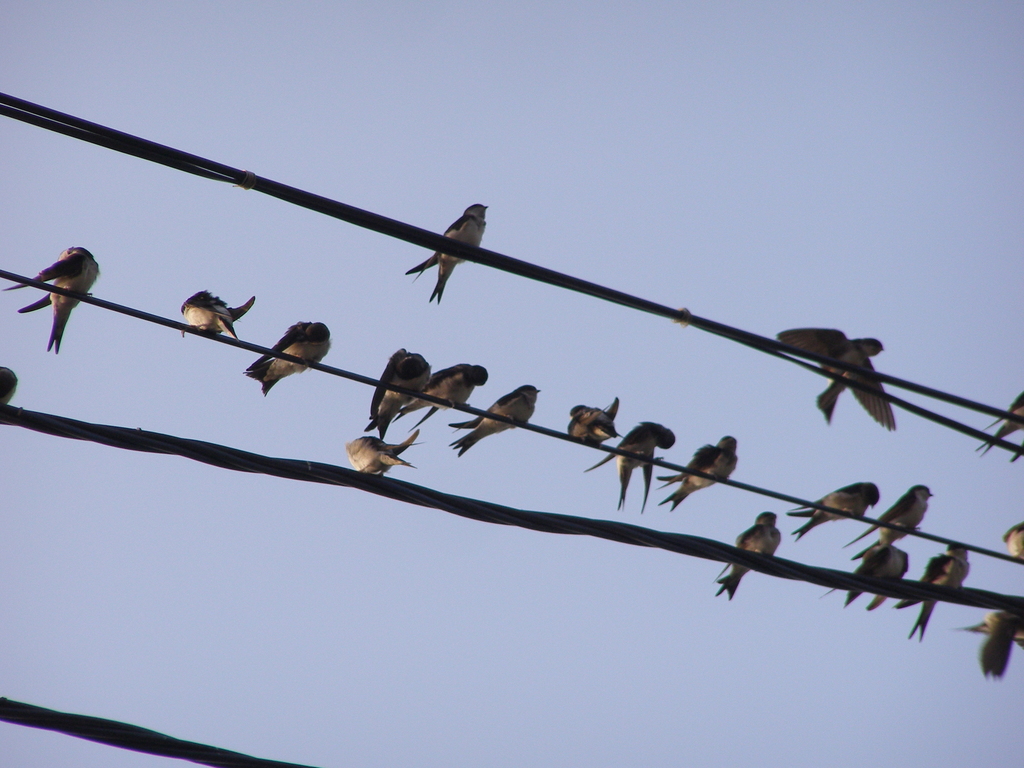
The western house martin (Delichon urbicum), sometimes called the common house martin, northern house martin or, particularly in Europe, just house martin, is a migratory passerine bird of the swallow family which breeds in Europe, north Africa and west-central Asia; and winters in sub-Saharan Africa and southwestern Asia. It feeds on insects which are caught in flight, and it migrates to climates where flying insects are plentiful. It has a blue head and upperparts, white rump and pure white underparts, and is found in both open country and near human habitation. It is similar in appearance to the two other martin species of the genus Delichon, which are both endemic to eastern and southern Asia. It has two accepted subspecies. Both the scientific and colloquial name of the bird are related to its use of human-made structures. It builds a closed cup nest from mud pellets under eaves or similar locations on buildings usually in colonies. It is hunted by the Eurasian hobby (Falco subbuteo), and like other birds is affected by internal parasites and external fleas and mites. Its large range and population mean that it is not threatened globally.
Gallery
Ajouter des photos
Partagez vos photos de cette espèce (jusqu'à 20 à la fois) : elles sont vérifiées automatiquement, puis publiées.
Répartition
Occurrences observées (données GBIF). Les zones hors aire d'origine peuvent indiquer une présence introduite ou invasive.
Sources et crédits
Informations provenant de plusieurs sources vérifiées. Dernière mise à jour : .
Crédits photos (5)
- Photo : Богданович Светлана (@svetlana-bogdanovich) · CC BY-NC 4.0 · via iNaturalist
- Photo : @pulmat · CC BY-NC 4.0 · via iNaturalist
- Photo : Мария Пахлеванова (@pamari) · CC BY-NC 4.0 · via iNaturalist
- Photo : Татьяна Данилина (@tatyana-seaangel) · CC BY-NC 4.0 · via iNaturalist
- Photo : Charles Davis (@davisc1) · CC BY-NC 4.0 · via iNaturalist
Mentions de licence
Texte disponible sous licence CC BY-SA 4.0. Il adapte notamment Wikipedia (CC BY-SA) : Western house martin (Wikipédia, auteurs dans l’historique de l’article).
- Taxonomie : GBIF Backbone Taxonomy (CC BY 4.0)
- Carte : occurrences GBIF, fond © contributeurs OpenStreetMap (ODbL)
- Statut de conservation : Liste rouge de l'UICN, via Wikidata (CC0)
Détail : Sources et licences.
Discussion (0)
Aucun message pour l’instant. Lancez la discussion sur cette fiche (sources, précisions, débats éditoriaux).
Connectez-vous pour participer à la discussion.