
Tree Swallow
Tachycineta bicolor
The tree swallow (Tachycineta bicolor) is a migratory bird of the family Hirundinidae.
- Kingdom
- Animalia
- Phylum
- Chordata
- Class
- Aves
- Order
- Passeriformes
- Family
- Hirundinidae
- Genus
- Tachycineta
- Species
- Tachycineta bicolor
Description
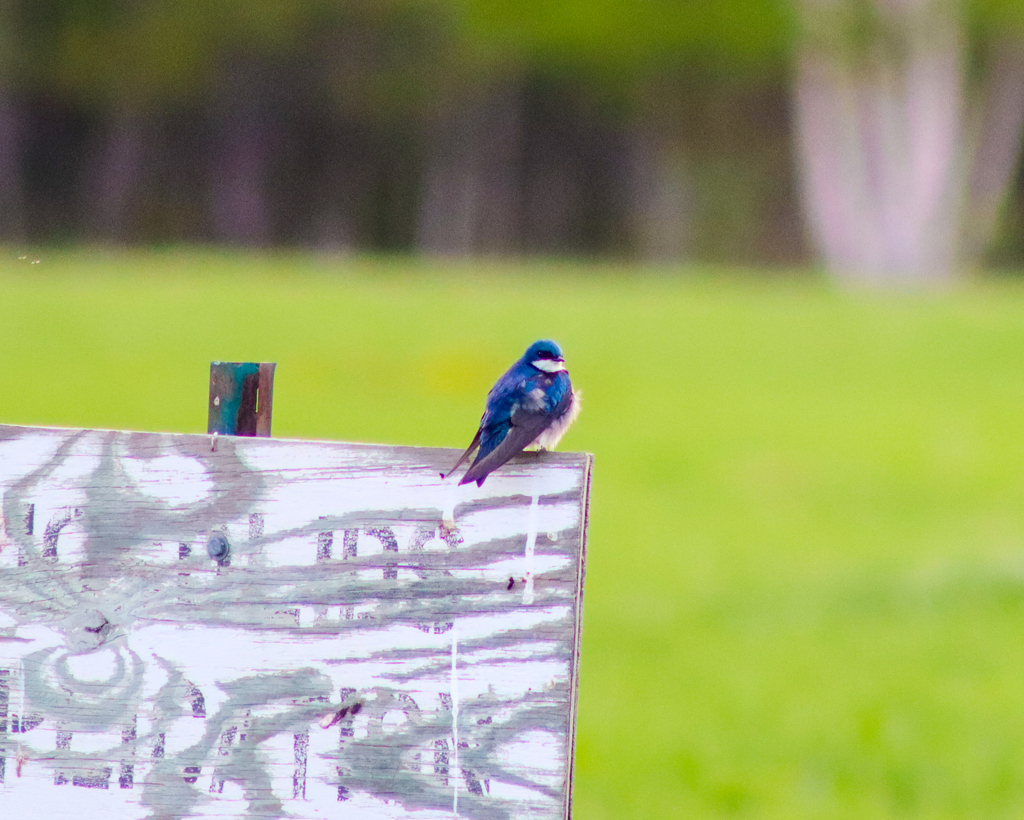
The tree swallow (Tachycineta bicolor) is a migratory bird of the family Hirundinidae. Found in the Americas, the tree swallow was first described in 1807 by French ornithologist Louis Vieillot as Hirundo bicolor. It has since been moved to its current genus, Tachycineta, within which its phylogenetic placement is debated. The tree swallow has glossy blue-green upperparts, with the exception of the blackish wings and tail, and white underparts. The bill is black, the eyes dark brown, and the legs and feet pale brown. The female is generally duller than the male, and the first-year female has mostly brown upperparts, with some blue feathers. Juveniles have brown upperparts, and gray-brown-washed breasts. The tree swallow breeds in the US and Canada. It winters along southern US coasts south, along the Gulf Coast, to Panama and the northwestern coast of South America, and in the West Indies. The tree swallow nests either in isolated pairs or loose groups, in both natural and artificial cavities. Breeding can start as soon as early May, although this date is occurring earlier because of climate change, and it can end as late as July. This bird is generally socially monogamous (although about 8% of males are polygynous), with high levels of extra-pair paternity. This can benefit the male, but since the female controls copulation, the lack of resolution on how this behavior benefits females makes the high level of extra-pair paternity puzzling. The female incubates the clutch of two to eight (but usually four to seven) pure white eggs for around 14 to 15 days. The chicks hatch slightly asynchronously, allowing the female to prioritize which chicks to feed in times of food shortage. They generally fledge about 18 to 22 days after hatching. The tree swallow is sometimes considered a model organism, due to the large amount of research done on it. An aerial insectivore, the tree swallow forages both alone and in groups, eating mostly insects, in addition to mollusks, spiders, and fruit. The nestlings, like the adult, primarily eat insects, fed to it by both sexes. This swallow is vulnerable to parasites, but, when on nestlings, these do little damage. The effect of disease can become stronger as a tree swallow gets older, as some parts of the immune system decline with age. Acquired T cell-mediated immunity, for example, decreases with age, whereas both innate and acquired humoral immunity do not. Because of its large range and stable population, the tree swallow is considered to be least concern by the International Union for Conservation of Nature. In the US, it is protected by the Migratory Bird Treaty Act of 1918, and in Canada by the Migratory Birds Convention Act. This swallow is negatively affected by human activities, such as the clearing of forests; acidified lakes can force a breeding tree swallow to go long distances to find calcium-rich food items to feed to its chicks.
Gallery
Ajouter des photos
Partagez vos photos de cette espèce (jusqu'à 20 à la fois) : elles sont vérifiées automatiquement, puis publiées.
Répartition
Occurrences observées (données GBIF). Les zones hors aire d'origine peuvent indiquer une présence introduite ou invasive.
Sources et crédits
Informations provenant de plusieurs sources vérifiées. Dernière mise à jour : .
Crédits photos (8)
- Photo : Josephine Thomson (@josephine_thomson) · CC BY-NC 4.0 · via iNaturalist
- Photo : Kent Ross (@kentross) · CC BY-NC 4.0 · via iNaturalist
- Photo : Reuven Martin (@reuvenm) · CC0 (domaine public) · via iNaturalist
- Photo : A. Moore (@bdale1334) · CC BY-NC 4.0 · via iNaturalist
- Photo : Millie Basden (@milliebasden) · CC BY 4.0 · via iNaturalist
- Photo : @inat_ash · CC BY-NC 4.0 · via iNaturalist
- Photo : Abby Hyde (@abbyhyde) · CC BY-NC 4.0 · via iNaturalist
- Photo : Dexter Chiclo (@unraisedshelf) · CC BY-NC 4.0 · via iNaturalist
Mentions de licence
Texte disponible sous licence CC BY-SA 4.0. Il adapte notamment Wikipedia (CC BY-SA) : Tree swallow (Wikipédia, auteurs dans l’historique de l’article).
- Taxonomie : GBIF Backbone Taxonomy (CC BY 4.0)
- Carte : occurrences GBIF, fond © contributeurs OpenStreetMap (ODbL)
- Statut de conservation : Liste rouge de l'UICN, via Wikidata (CC0)
Détail : Sources et licences.
Discussion (0)
Aucun message pour l’instant. Lancez la discussion sur cette fiche (sources, précisions, débats éditoriaux).
Connectez-vous pour participer à la discussion.