
White-rumped swallow
Tachycineta leucorrhoa
The white-rumped swallow (Tachycineta leucorrhoa) is a species of bird in the family Hirundinidae.
- Kingdom
- Animalia
- Phylum
- Chordata
- Class
- Aves
- Order
- Passeriformes
- Family
- Hirundinidae
- Genus
- Tachycineta
- Species
- Tachycineta leucorrhoa
Description
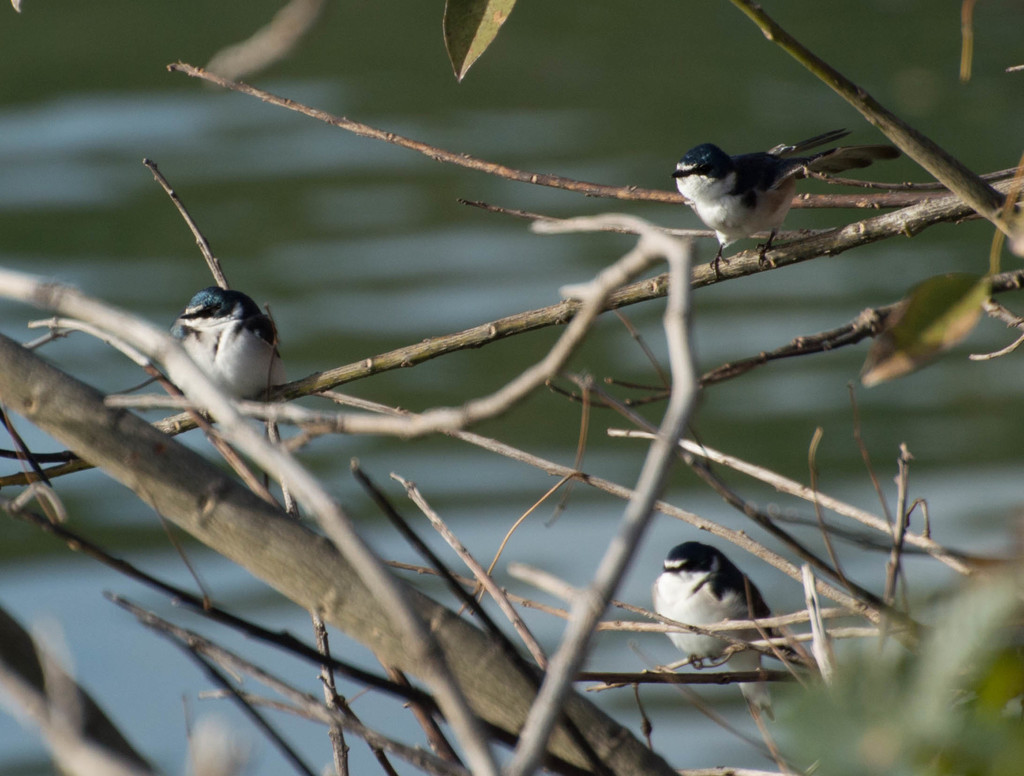
The white-rumped swallow (Tachycineta leucorrhoa) is a species of bird in the family Hirundinidae. First described and given its binomial name by French ornithologist Louis Pierre Vieillot in 1817, it was for many years considered a subspecies of the Chilean swallow. The species is monotypic with no known population variations. It has a white supraloral streak, or streak above its lores (the region between a bird's eye and nostrils), which can be used to differentiate it from the Chilean swallow. The lores, ear coverts, tail, and wings are black, with white tips on the inner secondaries, tertials, and greater coverts of the wings. The rest of the upperparts are a glossy blue. Its underparts and underwing-coverts are white, in addition to the rump, as the name suggests. The sexes are similar, and the juvenile is duller and browner with a dusky breast. This species usually builds its nest in holes in trees or dead snags or under or in artificial structures like fence posts and the eaves of buildings. The white-rumped swallow is solitary and nests in distributed pairs during the breeding season. The breeding season is from October to December in Brazil and from October to February in neighboring Argentina. Usually, only one brood with four to seven eggs is laid, although a second one will occasionally be laid. The female incubates the eggs over a period usually between 15 and 16 days, with the fledging usually occurring between 21 and 25 days after hatching. This swallow is found in Argentina, Bolivia, Brazil, Paraguay, Peru, and Uruguay. Its natural habitats are: dry savanna, pastureland, the edge of forests, subtropical or tropical seasonally wet or flooded lowland grassland. It is classified as a least-concern species by the International Union for Conservation of Nature (IUCN). Its population is increasing and it may benefit from the increase in availability of artificial nest sites. The shiny cowbird is an occasional brood parasite of the white-rumped swallow.
Gallery
Ajouter des photos
Partagez vos photos de cette espèce (jusqu'à 20 à la fois) : elles sont vérifiées automatiquement, puis publiées.
Répartition
Occurrences observées (données GBIF). Les zones hors aire d'origine peuvent indiquer une présence introduite ou invasive.
Sources et crédits
Informations provenant de plusieurs sources vérifiées. Dernière mise à jour : .
Crédits photos (8)
- Photo : Facundo Chieffo (@fchieffo) · CC BY 4.0 · via iNaturalist
- Photo : Dana Piedrabuena (@danapiedrabuena) · CC BY-NC 4.0 · via iNaturalist
- Photo : Patricio Cowper Coles (@patriciocowpercoles) · CC BY 4.0 · via iNaturalist
- Photo : Silvia Mallet (@silvia_mallet) · CC BY-NC 4.0 · via iNaturalist
- Photo : Néri Andrades (@apenas_ner) · CC BY-NC 4.0 · via iNaturalist
- Photo : Franco Palandri (@francopalandri) · CC BY-NC 4.0 · via iNaturalist
- Photo : RAMOS, M. A. (@miscbr) · CC BY-NC 4.0 · via iNaturalist
- Photo : Juan M. Atencio (@juanmanuelatencio) · CC BY-NC 4.0 · via iNaturalist
Mentions de licence
Texte disponible sous licence CC BY-SA 4.0. Il adapte notamment Wikipedia (CC BY-SA) : White-rumped swallow (Wikipédia, auteurs dans l’historique de l’article).
- Taxonomie : GBIF Backbone Taxonomy (CC BY 4.0)
- Carte : occurrences GBIF, fond © contributeurs OpenStreetMap (ODbL)
- Statut de conservation : Liste rouge de l'UICN, via Wikidata (CC0)
Détail : Sources et licences.
Discussion (0)
Aucun message pour l’instant. Lancez la discussion sur cette fiche (sources, précisions, débats éditoriaux).
Connectez-vous pour participer à la discussion.