
Common Murre
Uria aalge
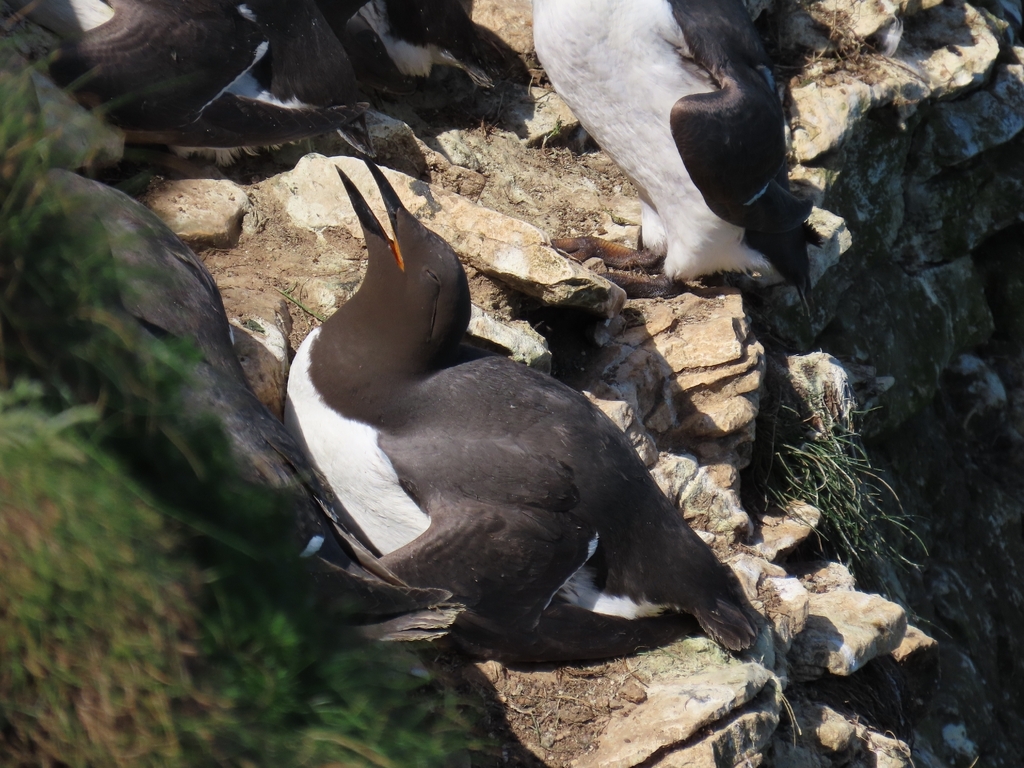
The common murre or common guillemot (Uria aalge) is a large auk, one of several species called murre or guillemot.
- Kingdom
- Animalia
- Phylum
- Chordata
- Class
- Aves
- Order
- Charadriiformes
- Family
- Alcidae
- Genus
- Uria
- Species
- Uria aalge
Description
The common murre or common guillemot (Uria aalge) is a large auk, one of several species called murre or guillemot. It has a circumpolar distribution, occurring in low-Arctic and boreal waters in the North Atlantic and North Pacific. It spends most of its time at sea, only coming to land to breed on rocky cliff shores or islands. Common murres are fast in direct flight but are not very agile. They are highly mobile underwater using their wings to 'fly' through the water column, where they typically dive to depths of 30–60 m (100–195 ft). Depths of up to 180 m (590 ft) have been recorded. Common murres breed in colonies at high densities. Nesting pairs may be in bodily contact with their neighbours. They make no nest; their single egg is incubated between the adult's feet on a bare rock ledge on a cliff face. Eggs hatch after ~30 days' incubation. The chick is born downy and can regulate its body temperature after 10 days. Some 20 days after hatching, the chick leaves its nesting ledge and heads for the sea, unable to fly, but gliding for some distance with fluttering wings, accompanied by its male parent. Male guillemots spend more time diving, and dive more deeply than females during this time. Chicks are capable of diving as soon as they hit the water. The female stays at the nest site for some 14 days after the chick has left. Both male and female common murres moult after breeding and become flightless for 1–2 months. Some populations have short migration distances, instead remaining close to the breeding site year-round. Such populations return to the nest site from autumn onwards. Adult birds balance their energetic budgets during the winter by reducing the time that they spend flying and are able to forage nocturnally.
Gallery
Ajouter des photos
Partagez vos photos de cette espèce (jusqu'à 20 à la fois) : elles sont vérifiées automatiquement, puis publiées.
Répartition
Occurrences observées (données GBIF). Les zones hors aire d'origine peuvent indiquer une présence introduite ou invasive.
Sources et crédits
Informations provenant de plusieurs sources vérifiées. Dernière mise à jour : .
Crédits photos (8)
- Photo : Africa Gomez (@hootinghoopoe) · CC BY-NC 4.0 · via iNaturalist
- Photo : James Maughn (@jmaughn) · CC BY-NC 4.0 · via iNaturalist
- Photo : @elipos · CC BY-NC 4.0 · via iNaturalist
- Photo : Pep Cantó (@pepcanto) · CC BY-NC 4.0 · via iNaturalist
- Photo : @francoisducarme · CC BY-NC 4.0 · via iNaturalist
- Photo : Nico (@oecophylla) · CC0 (domaine public) · via iNaturalist
- Photo : Pavel Shukov (@shukov) · CC BY-NC 4.0 · via iNaturalist
- Photo : Huey (@hueyl) · CC BY 4.0 · via iNaturalist
Mentions de licence
Texte disponible sous licence CC BY-SA 4.0. Il adapte notamment Wikipedia (CC BY-SA) : Common murre (Wikipédia, auteurs dans l’historique de l’article).
- Taxonomie : GBIF Backbone Taxonomy (CC BY 4.0)
- Carte : occurrences GBIF, fond © contributeurs OpenStreetMap (ODbL)
- Statut de conservation : Liste rouge de l'UICN, via Wikidata (CC0)
Détail : Sources et licences.
Discussion (0)
Aucun message pour l’instant. Lancez la discussion sur cette fiche (sources, précisions, débats éditoriaux).
Connectez-vous pour participer à la discussion.