
Brolga
Grus rubicunda
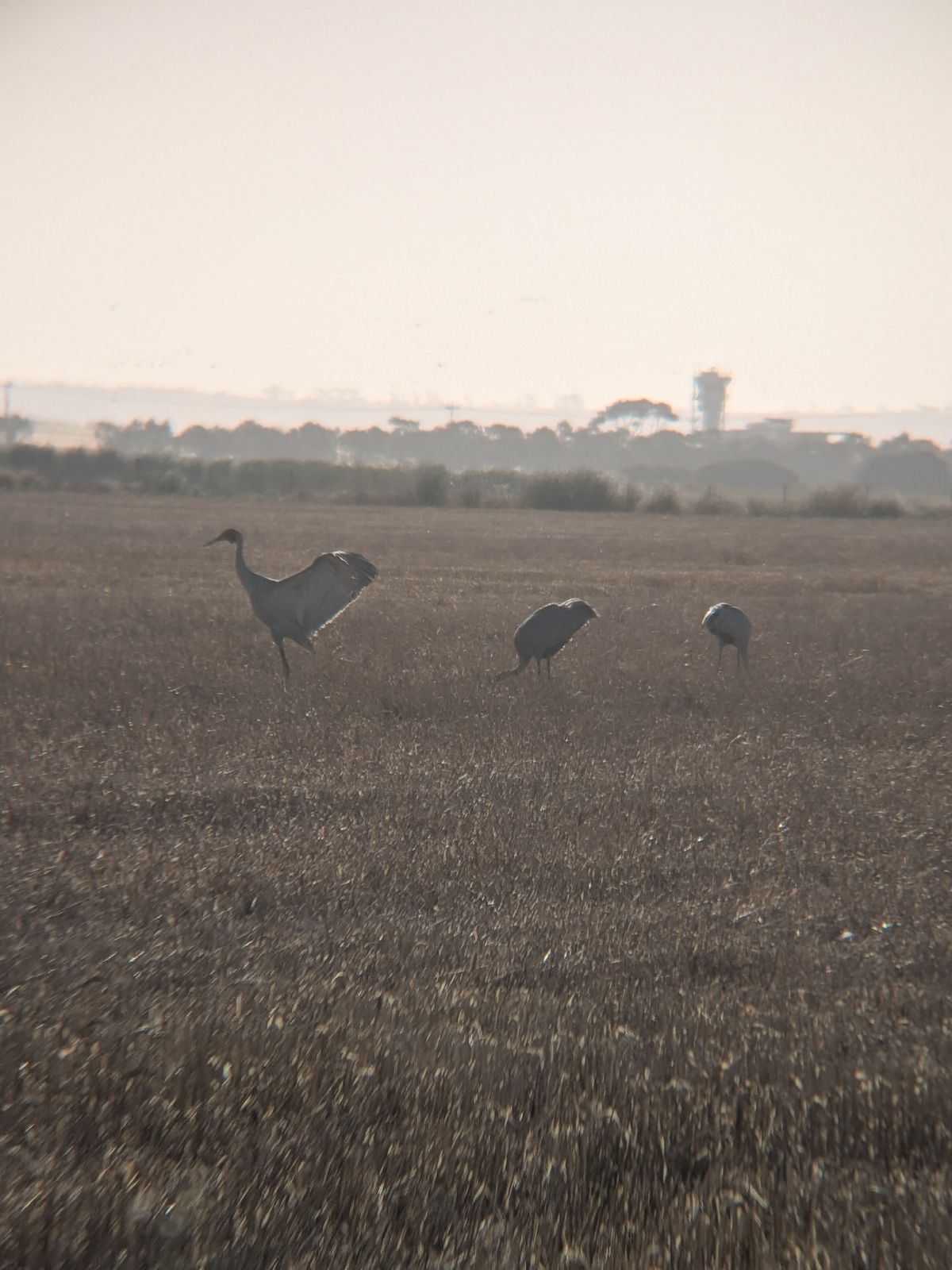
The brolga (Antigone rubicunda), formerly known as the native companion, is a bird in the crane family.
- Kingdom
- Animalia
- Phylum
- Chordata
- Class
- Aves
- Order
- Gruiformes
- Family
- Gruidae
- Genus
- Grus
- Species
- Grus rubicunda
Description
The brolga (Antigone rubicunda), formerly known as the native companion, is a bird in the crane family. It has also been given the name Australian crane, a term coined in 1865 by well-known ornithologist John Gould in his Birds of Australia. The brolga is a common, gregarious wetland bird species of tropical and south-eastern Australia and New Guinea. It is a tall, upright bird with a small head, long beak, slender neck, and long legs. Its plumage is mainly grey, with black wing tips, and it has an orange-red band on its head. The brolga's courting dance is similar to that of other cranes. The nest is built of wetland vegetation, either on an elevated piece of land or floating on shallow water in marshland, and usually two eggs are laid. Incubation takes 32 days, and the newly hatched young are precocial. The adult diet is omnivorous and includes plant matter, invertebrates, and small vertebrates. Although the bird is not considered endangered over the majority of its range, populations are showing some decline, especially in southern Australia, and local action plans are being undertaken in some areas. It has featured on the Queensland coat of arms since 1977 and was formally declared as the bird emblem of the state in 1986.
Gallery
Ajouter des photos
Partagez vos photos de cette espèce (jusqu'à 20 à la fois) : elles sont vérifiées automatiquement, puis publiées.
Répartition
Occurrences observées (données GBIF). Les zones hors aire d'origine peuvent indiquer une présence introduite ou invasive.
Sources et crédits
Informations provenant de plusieurs sources vérifiées. Dernière mise à jour : .
Crédits photos (10)
- Photo : Caitlyn McDonnell · CC BY-NC 4.0 · via GBIF
- Photo : reneelw · CC BY-NC 4.0 · via GBIF
- Photo : noahfrog · CC BY-NC 4.0 · via GBIF
- Photo : Stephen Cox · CC BY-NC 4.0 · via GBIF
- Photo : coanne · CC BY-NC 4.0 · via GBIF
- Photo : antitower · CC BY-NC 4.0 · via GBIF
- Photo : pdubbin · CC BY-NC 4.0 · via GBIF
- Photo : Jeff Giddins · CC BY-NC 4.0 · via GBIF
- Photo : Stephen Fricker · CC BY-NC 4.0 · via GBIF
- Photo : Matt Campbell · CC BY-NC 4.0 · via GBIF
Mentions de licence
Texte disponible sous licence CC BY-SA 4.0. Il adapte notamment Wikipedia (CC BY-SA) : Brolga (Wikipédia, auteurs dans l’historique de l’article).
- Taxonomie : GBIF Backbone Taxonomy (CC BY 4.0)
- Carte : occurrences GBIF, fond © contributeurs OpenStreetMap (ODbL)
- Statut de conservation : Liste rouge de l'UICN, via Wikidata (CC0)
Détail : Sources et licences.
Discussion (0)
Aucun message pour l’instant. Lancez la discussion sur cette fiche (sources, précisions, débats éditoriaux).
Connectez-vous pour participer à la discussion.