
Hawfinch
Coccothraustes coccothraustes
The hawfinch (Coccothraustes coccothraustes) is a passerine bird in the finch family Fringillidae.
- Kingdom
- Animalia
- Phylum
- Chordata
- Class
- Aves
- Order
- Passeriformes
- Family
- Fringillidae
- Genus
- Coccothraustes
- Species
- Coccothraustes coccothraustes
Description
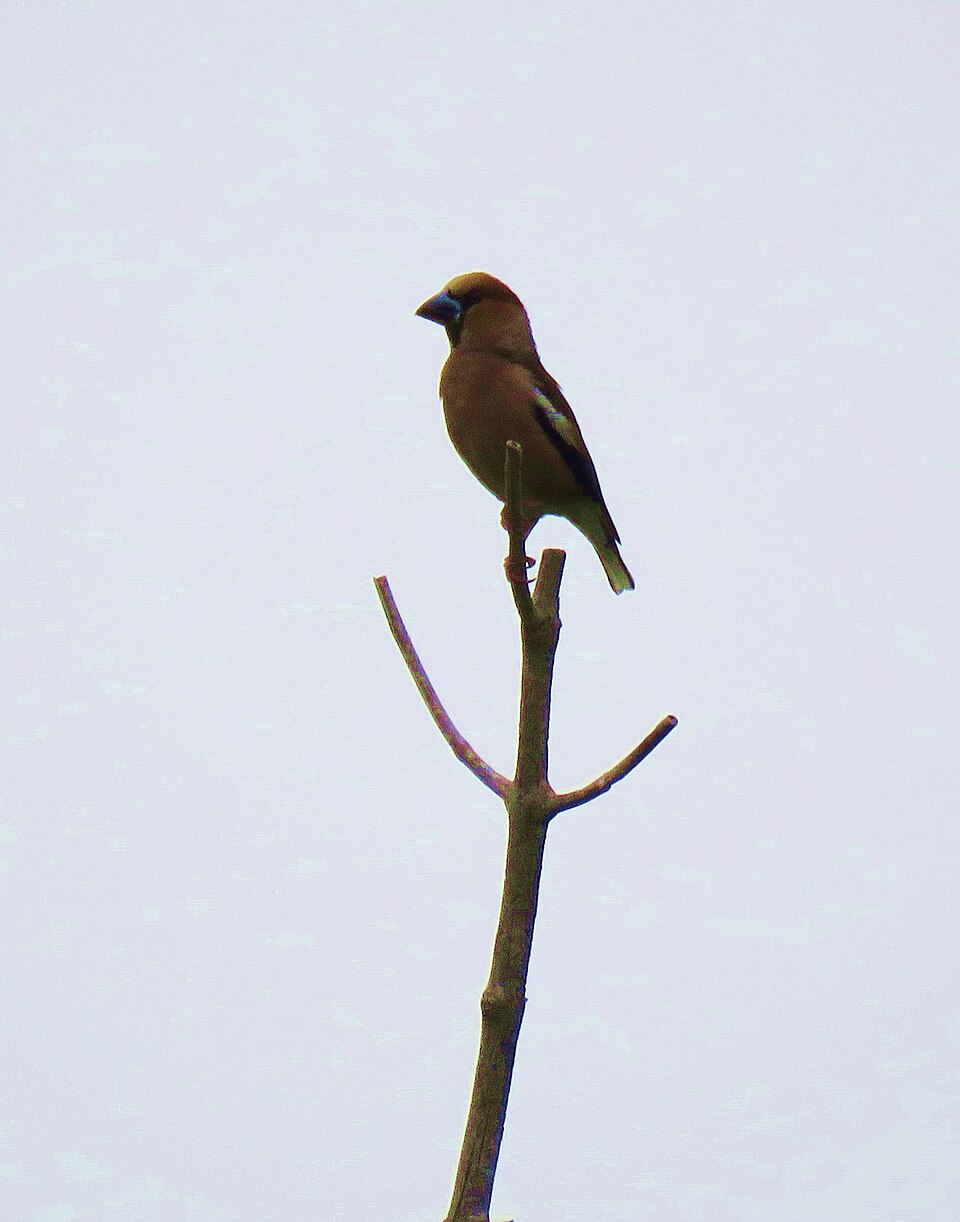
The hawfinch (Coccothraustes coccothraustes) is a passerine bird in the finch family Fringillidae. It is the only extant species placed in the genus Coccothraustes. Its closest living relatives are the genus Eophona of East Asia, and Hesperiphona of Central and North America. This bird breeds across Europe and temperate Asia (Palearctic). It is mainly resident in Europe, but many Asian birds migrate further south in the winter. It is a rare vagrant to the western islands of Alaska. Deciduous or mixed woodland, including parkland, with large trees – especially hornbeam – is favoured for breeding. The hawfinch builds its nest in a bush or tree, and lays 2–7 eggs. The food is mainly seeds and fruit kernels, especially those of cherries, which it cracks with its powerful bill. This large finch species is usually seen in a pair or small group. The 16.5–18 cm long hawfinch is a bulky bull-headed bird, which appears very short-tailed in flight. Its head is orange-brown with a black eyestripe and bib, and a massive bill, which is black in summer but paler in winter. The upper parts are dark brown and the underparts orange. The white wing bars and tail tip are striking in flight. The sexes are similar. The call is a hard chick. The song of this unobtrusive bird is quiet and mumbled.
Gallery
Ajouter des photos
Partagez vos photos de cette espèce (jusqu'à 20 à la fois) : elles sont vérifiées automatiquement, puis publiées.
Répartition
Occurrences observées (données GBIF). Les zones hors aire d'origine peuvent indiquer une présence introduite ou invasive.
Sources et crédits
Informations provenant de plusieurs sources vérifiées. Dernière mise à jour : .
Crédits photos (7)
- Photo : Zerocool.marko · CC BY-SA 4.0
- Photo : Cindy kuiphuis · CC BY-SA 4.0
- Photo : Jürgen Spindler (@spjch) · CC BY-NC 4.0 · via iNaturalist
- Photo : Mika Tomta (@mikat78) · CC BY-NC 4.0 · via iNaturalist
- Photo : Татьяна Месюсина (@mesusina) · CC BY-NC 4.0 · via iNaturalist
- Photo : Albert Krasniqi (@albert52) · CC BY-NC 4.0 · via iNaturalist
- Photo : @juniorre · CC BY-NC 4.0 · via iNaturalist
Mentions de licence
Texte disponible sous licence CC BY-SA 4.0. Il adapte notamment Wikipedia (CC BY-SA) : Hawfinch (Wikipédia, auteurs dans l’historique de l’article).
- Taxonomie : GBIF Backbone Taxonomy (CC BY 4.0)
- Carte : occurrences GBIF, fond © contributeurs OpenStreetMap (ODbL)
- Statut de conservation : Liste rouge de l'UICN, via Wikidata (CC0)
Détail : Sources et licences.
Discussion (0)
Aucun message pour l’instant. Lancez la discussion sur cette fiche (sources, précisions, débats éditoriaux).
Connectez-vous pour participer à la discussion.