
Mistle Thrush
Turdus viscivorus
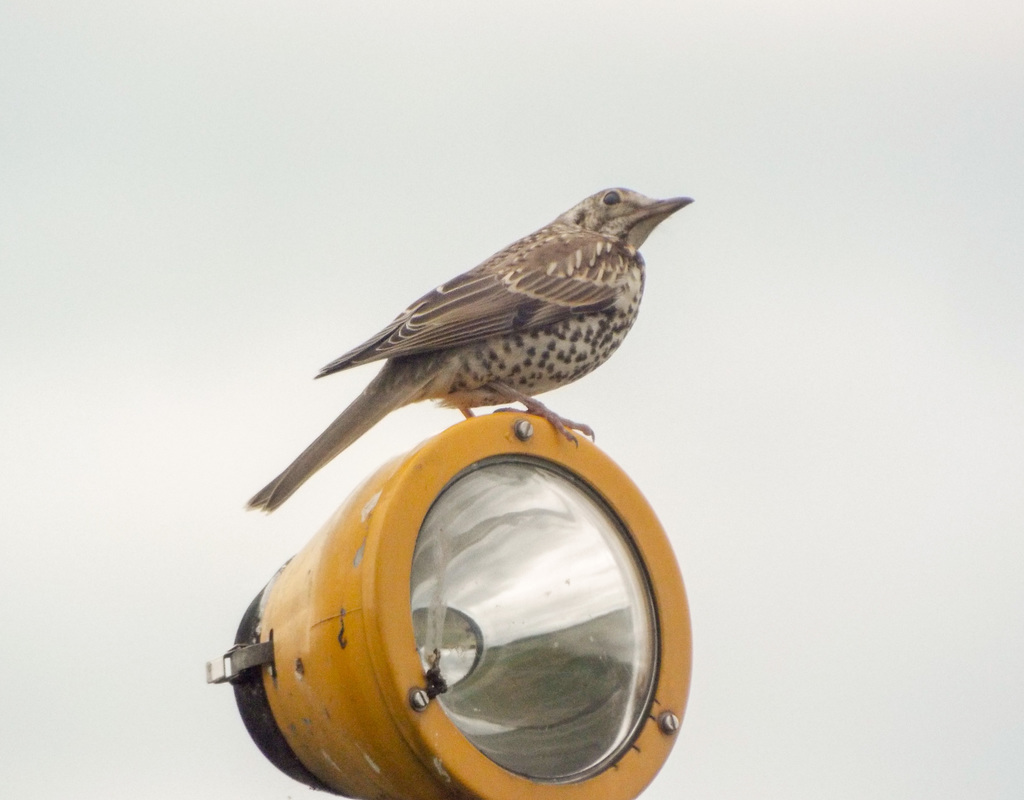
The mistle thrush (Turdus viscivorus) is a bird common to much of Europe, temperate Asia and North Africa.
- Kingdom
- Animalia
- Phylum
- Chordata
- Class
- Aves
- Order
- Passeriformes
- Family
- Turdidae
- Genus
- Turdus
- Species
- Turdus viscivorus
Description
The mistle thrush (Turdus viscivorus) is a bird common to much of Europe, temperate Asia and North Africa. It is a year-round resident in a large part of its range, but northern and eastern populations migrate south for the winter, often in small flocks. It is a large thrush with pale grey-brown upper parts, a greyish-white chin and throat, and black spots on its pale yellow and off-white under parts. The sexes are similar in plumage, and its three subspecies show only minimal differences. The male has a loud, far-carrying song which is delivered even in wet and windy weather, earning the bird the old name of stormcock. Historically, the name was also sometimes spelled "missel thrush". Found in open woods, parks, hedges and cultivated land, the mistle thrush feeds on a wide variety of invertebrates, seeds and berries. Its preferred fruit include those of mistletoe, holly, rowan, and yew. Mistletoe is favoured where it is available, and this is reflected in the thrush's English and scientific names; the plant, a parasitic species, benefits from its seeds being excreted by the thrush onto branches where they can germinate. In winter, a mistle thrush will vigorously defend mistletoe clumps or other fruit-bearing trees as a food reserve for when times are hard, chasing off other thrushes and other fruit-eating birds like waxwings. The open cup nest is built against a trunk or in a forked branch, and is fearlessly defended against potential predators, sometimes including humans or cats. The clutch, typically of three to five eggs, is incubated for 12–15 days, mainly by the female. The chicks fledge about 14–16 days after hatching. There are normally two broods. There was a range expansion in the 18th and early 19th centuries, and a small decline in recent decades, perhaps due to changes in agricultural practices. Given its numbers and large range, this thrush is classified by the International Union for Conservation of Nature as being of least concern.
Gallery
Ajouter des photos
Partagez vos photos de cette espèce (jusqu'à 20 à la fois) : elles sont vérifiées automatiquement, puis publiées.
Répartition
Occurrences observées (données GBIF). Les zones hors aire d'origine peuvent indiquer une présence introduite ou invasive.
Sources et crédits
Informations provenant de plusieurs sources vérifiées. Dernière mise à jour : .
Crédits photos (8)
- Photo : Cowcornerman (@cowcornerman) · CC BY-NC 4.0 · via iNaturalist
- Photo : Mourad Harzallah (@mourad-harzallah) · CC BY 4.0 · via iNaturalist
- Photo : @erdonmezon · CC BY-NC 4.0 · via iNaturalist
- Photo : Оля (@olya_ily) · CC BY-NC 4.0 · via iNaturalist
- Photo : Angel (@amhernando-anapri) · CC BY-NC 4.0 · via iNaturalist
- Photo : Daniel Eskildsen (@dpeskildsen) · CC BY-NC 4.0 · via iNaturalist
- Photo : Alexey Katz (@alexey_katz) · CC BY-NC 4.0 · via iNaturalist
- Photo : Ирина Рогова (@irilily) · CC BY-NC 4.0 · via iNaturalist
Mentions de licence
Texte disponible sous licence CC BY-SA 4.0. Il adapte notamment Wikipedia (CC BY-SA) : Mistle thrush (Wikipédia, auteurs dans l’historique de l’article).
- Taxonomie : GBIF Backbone Taxonomy (CC BY 4.0)
- Carte : occurrences GBIF, fond © contributeurs OpenStreetMap (ODbL)
- Statut de conservation : Liste rouge de l'UICN, via Wikidata (CC0)
Détail : Sources et licences.
Discussion (0)
Aucun message pour l’instant. Lancez la discussion sur cette fiche (sources, précisions, débats éditoriaux).
Connectez-vous pour participer à la discussion.