
Chestnut-capped Thrush
Geokichla interpres
The chestnut-capped thrush (Geokichla interpres) lives in forests and woodlands of Southeast Asia.
- Kingdom
- Animalia
- Phylum
- Chordata
- Class
- Aves
- Order
- Passeriformes
- Family
- Turdidae
- Genus
- Geokichla
- Species
- Geokichla interpres
Description
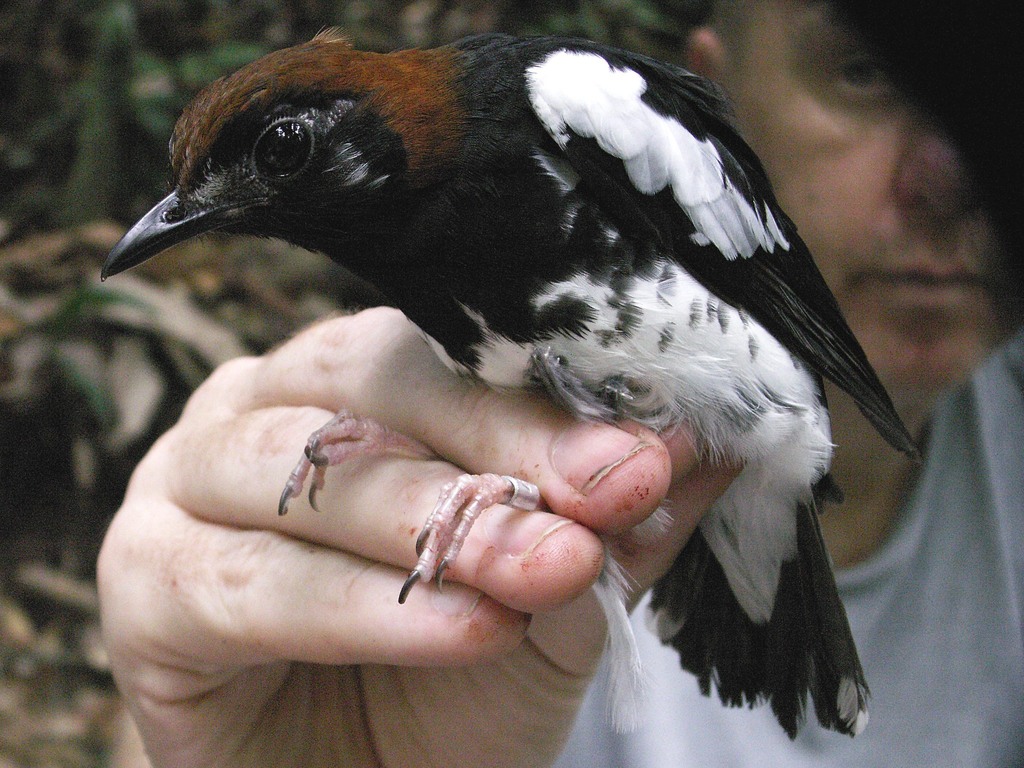
The chestnut-capped thrush (Geokichla interpres) lives in forests and woodlands of Southeast Asia. It is a songbird species in the family Turdidae. Traditionally, it has included the Enggano thrush as a subspecies, but a recent review recommended treating them as separate. Consequently, the chestnut-capped thrush is monotypic. The chestnut-capped thrush has a black back and a white belly with black spots. As its common name suggests, it has a chestnut cap. Its face is black with a white mark on the cheeks and another on the lores. The superficially similar chestnut-backed thrush is substantially larger when seen alongside one another, and has a black crown and rufous back, whereas the Enggano thrush has an olive-ochre back and little or no white on the lores and auriculars. The chestnut-capped thrush is very rare in zoos. According to ISIS, Chester Zoo had the only female outside of Asia, until she died in 2007. However, small numbers have been held in private European aviaries since the mid-1990s and very small numbers remain as of late 2009. It was formerly classified as a species of Least Concern by the IUCN. New research has shown it to be rarer than previously believed. Consequently, it was uplisted to Near Threatened status in 2008 and once again to Endangered in 2020.
Gallery
Ajouter des photos
Partagez vos photos de cette espèce (jusqu'à 20 à la fois) : elles sont vérifiées automatiquement, puis publiées.
Répartition
Occurrences observées (données GBIF). Les zones hors aire d'origine peuvent indiquer une présence introduite ou invasive.
Sources et crédits
Informations provenant de plusieurs sources vérifiées. Dernière mise à jour : .
Crédits photos (8)
- Photo : Julien Bottinelli (@bottin) · CC BY-NC 4.0 · via iNaturalist
- Photo : Ben Ward (@benw124) · CC BY-NC 4.0 · via iNaturalist
- Photo : owling (@morethanowls) · CC BY-NC 4.0 · via iNaturalist
- Photo : Ingkayut Sa-ar (@ingkayut) · CC BY-NC 4.0 · via iNaturalist
- Photo : Premala Arulampalam (@malafish) · CC BY-NC 4.0 · via iNaturalist
- Photo : Niall Perrins (@niallp) · CC BY-NC 4.0 · via iNaturalist
- Photo : Marc Thibault (@marcthibault) · CC BY-NC 4.0 · via iNaturalist
- Photo : Yingyod Lapwong (@charliev) · CC BY-NC 4.0 · via iNaturalist
Mentions de licence
Texte disponible sous licence CC BY-SA 4.0. Il adapte notamment Wikipedia (CC BY-SA) : Chestnut-capped thrush, Grive de Kuhl (Wikipédia, auteurs dans l’historique de l’article).
- Taxonomie : GBIF Backbone Taxonomy (CC BY 4.0)
- Carte : occurrences GBIF, fond © contributeurs OpenStreetMap (ODbL)
Détail : Sources et licences.
Discussion (0)
Aucun message pour l’instant. Lancez la discussion sur cette fiche (sources, précisions, débats éditoriaux).
Connectez-vous pour participer à la discussion.