
Short-toed treecreeper
Certhia brachydactyla
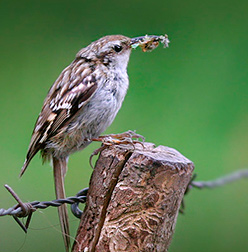
The short-toed treecreeper (Certhia brachydactyla) is a small passerine bird found in woodlands through much of the warmer regions of Europe and into north Africa.
- Kingdom
- Animalia
- Phylum
- Chordata
- Class
- Aves
- Order
- Passeriformes
- Family
- Certhiidae
- Genus
- Certhia
- Species
- Certhia brachydactyla
Description
The short-toed treecreeper (Certhia brachydactyla) is a small passerine bird found in woodlands through much of the warmer regions of Europe and into north Africa. It has a generally more southerly distribution than the other European treecreeper species, the common treecreeper, with which it is easily confused where they both occur. The short-toed treecreeper tends to prefer deciduous trees and lower altitudes than its relative in these overlap areas. Although mainly sedentary, vagrants have occurred outside the breeding range. The short-toed treecreeper is one of a group of four very similar Holarctic treecreepers, including the closely related North American brown creepers, and has five subspecies differing in appearance and song. Like other treecreepers, the short-toed is inconspicuously plumaged brown above and whitish below, and has a curved bill and stiff tail feathers. It is a resident in woodlands throughout its range, and nests in tree crevices or behind bark flakes, laying about six eggs. This common, unwary, but inconspicuous species feeds mainly on insects which are picked from the tree trunk as the treecreeper ascends with short hops.
Gallery
Ajouter des photos
Partagez vos photos de cette espèce (jusqu'à 20 à la fois) : elles sont vérifiées automatiquement, puis publiées.
Répartition
Occurrences observées (données GBIF). Les zones hors aire d'origine peuvent indiquer une présence introduite ou invasive.
Sources et crédits
Informations provenant de plusieurs sources vérifiées. Dernière mise à jour : .
Crédits photos (8)
- Photo : Monique Bogaerts on nl.wikipedia · CC BY-SA 3.0 · via Wikimedia Commons
- Photo : Zwiegel · CC BY-SA 3.0
- Photo : Zwiegel · CC BY-SA 3.0
- Photo : Roberto Ghiglia (@roberto421) · CC BY-NC 4.0 · via iNaturalist
- Photo : Ivan Paz-Vinas (@ivanpazvinas) · CC BY-NC 4.0 · via iNaturalist
- Photo : Dominique (@dominiquebayne) · CC BY-NC 4.0 · via iNaturalist
- Photo : Gabriele Vaudano (@gabrivauda) · CC BY 4.0 · via iNaturalist
- Photo : @ahls · CC BY-NC 4.0 · via iNaturalist
Mentions de licence
Texte disponible sous licence CC BY-SA 4.0. Il adapte notamment Wikipedia (CC BY-SA) : Short-toed treecreeper (Wikipédia, auteurs dans l’historique de l’article).
- Taxonomie : GBIF Backbone Taxonomy (CC BY 4.0)
- Carte : occurrences GBIF, fond © contributeurs OpenStreetMap (ODbL)
- Statut de conservation : Liste rouge de l'UICN, via Wikidata (CC0)
Détail : Sources et licences.
Discussion (0)
Aucun message pour l’instant. Lancez la discussion sur cette fiche (sources, précisions, débats éditoriaux).
Connectez-vous pour participer à la discussion.